Housing and Urban Development Principal Secretary (PS), Charles Hinga Mwaura has hailed the Kenya Urban Support Program (KUSP) and its role in transforming our urban areas through planning and development of urban infrastructure.
He observed this was happening at a time when the urban areas in the country were growing rapidly and added that there is need to maintain this momentum to ensure that our urban areas which are major revenue generators are both well planned and developed.
The World Bank through the second phase of the Kenya Urban Support Program (KUSP II), which commenced in March 2024 will contribute a total of Sh42 Billion (US$350million) to the Government of Kenya to strengthen the capacities of 79 cities and municipalities in the country
The PS said this is aimed at improving delivery and development of resilience urban infrastructure and services, enhance private sector engagement in urban planning and support the transition of refugee camps into integrated host communities and settlements. The program which runs for fours will end in June 2028.
Hinga at the same time announced that through Annual Performance Assessments (APAs), the second phase of KUSP II) has disbursed Sh58million as Urban Institutional Grants (UIG) to Kisumu County Government which is being used to support in management, administrative activities and establishment of urban areas in the county.
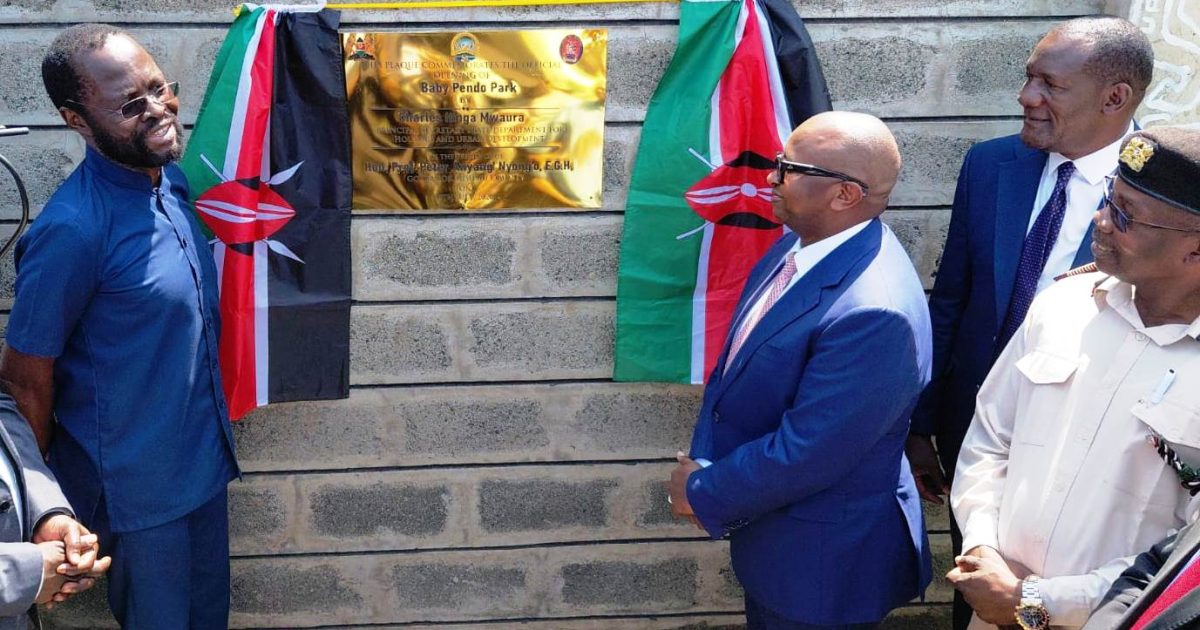
The PS was speaking in Kisumu during the official opening of Baby Pendo Botanical Garden and the ground breaking ceremony for the Non-Motorized Transport Phase 3A (NMT Phase IIIA).
NMT Phase IIIA is a Sh306 million urban infrastructure project in Kisumu, designed to construct continuous pedestrian walkways, dedicated pedal cycle lanes, and landscaped green spaces.
“Kisumu City has identified and will use part of the Urban Development Grant to construct Non-Motorised Transport facilities within the city for use by pedestrians and cyclists in order to reduce risks on the roads,” he said.
Hinga noted that the second phase of KUSP has also disbursed nearly Sh390Million to Kisumu city and about Sh22Million to Ahero municipality as the first Urban Development Grants (UDGs) for development of Kisumu City and Ahero Municipality Infrastructure Investments.
The Kenya Urban Support Program is a World Bank funded initiative aimed at strengthening urban institutions, improving infrastructure service delivery, and supporting climate resilience in Kenyan counties. The program; now in its second phase (KUSP II) helps municipal governance, private sector engagement, and the transition of refugee camps into integrated host communities
The World Bank through the first phase of the Kenya Urban Support Program (KUSP I), which commenced in January, 2018 and ended in December 2023 disbursed a total of Sh36 billion (US$300 Million) to the Kenya Government to implement the Urban Areas and Cities Act (No. 13 of 2011) (UACA).
This regulation provides the legal and policy framework for the classification, governance, and management of urban areas across the country. Through it, a total of 59 urban areas (cities/municipalities) were established and participated in the first phase of KUSP.
Hinga further revealed that through Annual Performance Assessments (APAs), the first phase of KUSP disbursed in total Sh50million as Urban Institutional Grants (UIG) to Kisumu County Government which was used to support the county in formation of Kisumu City and administrative structure (Board and Manager etc.).
In addition, the first phase of KUSP also disbursed in total Sh1.8 billion as Urban Development Grants (UDGs) for development of various Kisumu City Infrastructure Investments.
Among the projects funded include; Construction of NMT Project Phase 1 at a cost of nest of nearly Sh300 million, Construction of the Fire Station Phase 1 Project at nearly Sh260 million384 and Construction of Nyamasaria Bus Park within City of Kisumu – ta a cost of nearly Sh100 million, among other projects
The Non-Motorised Transport (NMT) Project Phase 3A project will cost Sh306million and will comprise construction of 4.8kms of block paved walkways, asphalt concrete cycle tracks and green spaces. This project is anticipated to be completed in seven months’ period, by February, 2027.
This project is a continuation of the provision of NMT facilities within Kisumu City to reduce the conflict of cyclists and pedestrians with motorized transport and ensure their safety. The facilities will also provide conducive and safe spaces for exercises and recreation.
Kisumu governor Prof. Peter Anyang’ Nyong’o on his part took the audience down the memory lane to the violence that erupted just after the announcement of the 2017 General Elections results where chaos erupted in the country after the announcement of the results that pitted Retired President Uhuru Kenyatta the late former Prime Minister Raila Odinga.
He said the park was named after the Baby Pendo to remind Kenyans that what happened then should then happen again.
The place where the Sh30million recreational park now stands was a dumpsite and the governor said the decision to rehabilitate it and name after Baby Pendo was meant to spur memories of our history as we move into the future.
“Baby Pendo Botanical Park is therefore more than a park. It is evidence that decline need not be permanent. A society must remember its past if it wishes to move forward honestly,” Nyong`o said.
“Every child who plays here, every student who learns here, every family that finds rest here will know that something beautiful was deliberately created where something tragic once occurred,” he said.
Kisumu was the hotbed of these chaos whereupon Baby Pendo, at only six months, while in her mother`s arms was hit on the head by a security officer after a team of security personnel invaded their home in Nyalenda, while trying to quell riots. The baby unfortunately died in hospital, raising hue and cry in the country.
It was an emotional moment at the event as Pendo`s parents, Mr. and Mrs. Joseph Abanja were invited to greet the gathering.
The mother, Lencer Abanja dancing to a Luo gospel son; Otiyo to aling`a aling`a by Milka Omondi meaning, “God is working while am quiet (behind the scenes), said they were elated to the honour her baby had been given and added that no mother should ever again lose her child in that manner.
Before opening the park, the governor and the PS did a groundbreaking for works under Phase Three of our Non-Motorised Transport Program.
Prof. Nyong`o reiterated that the majority of our urban residents walk; they cycle and even trade along our streets. To this end, he said walkways are important in order to reduce risks on our roads.
“Development must therefore reflect the lives people actually live. That is what this project seeks to do,” he said.
The governor noted that they were acting on the statistically proven forewarning, that more than 50 per cent of Africa’s population, will by 2050, be living in urban setups.
“Rather than wait to deal with informality in settlements then, we have chosen to act now for the sake of our generations coming. That is why we continue investing in parks, trees and public spaces when there are many competing demands.”
On the aforementioned new Mowlem–Nyamasaria Bus Stage which the PS also visited, Prof Nyong`o clarified that the bus stage is not intended to replace the terminus along Jomo Kenyatta Highway, but it is a subsidiary facility designed to complement the existing terminus, improve traffic management and accommodate the growth of our city.
“Modern cities operate through integrated transport systems, not isolated facilities,” he said.
Kisumu County Commissioner Mohammed Mwabudzo on his part said security personnel in the area were on high alert to deal with criminal gangs or goons bend on terrorizing residents in the area.