The Judiciary and the Independent Electoral and Boundaries Commission (IEBC) have reaffirmed their joint commitment to securing democratic legitimacy, warning that flawed political processes, rather than mere voting numbers, compromise the sovereign will of the people.
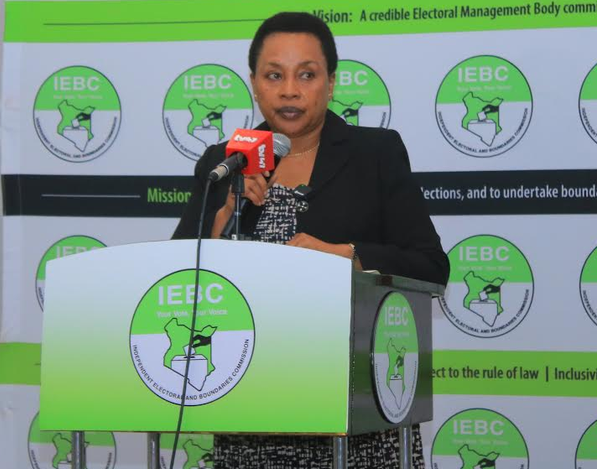
Speaking during the official launch of the 2022 Pre-Election Dispute Resolution Committee (DRC) Report and Case Digest in Nairobi, Deputy Chief Justice (DCJ) Philomena Mwilu stated that democratic resilience hinges on robust institutional checks before polling day.
“Democracy is not sustained by simply casting ballots,” Justice Mwilu observed. “It is sustained by the confidence of citizens that every stage of the electoral process is governed by law, administered fairly, and subject to impartial review where disputes arise.”
Recalling the landmark findings from the 2017 presidential election petition, the DCJ clarified that a credible election must be viewed holistically.
“An election must at the end of the day be a true reflection of the will of the people as decreed by the constitution through its hallowed principles of transparency, credibility, verifiability, accountability, accuracy, and efficiency,” she maintained.
Addressing the newly appointed electoral commissioners, Mwilu directly challenged the electoral body to match historical standards ahead of the next cycle.
“My prayer to you is: May you do it so right in 2027 that there will be no presidential election petition,” she urged.
On his part, IEBC Chairperson Erastus Ethekon highlighted that early administrative structures significantly insulated national stability from political disputes.
He revealed that the Commission successfully resolved 323 pre-election disputes during the 2022 general election within strict statutory timelines, establishing a definitive track record.
“The fact that the success rate and the confirmation by the courts that the decisions, by upholding those decisions, is a testament that the Commission has discharged its mandate soundly, professionally, impartially, fairly, and within the four corners of the law,” Ethekon reported, noting that the agency’s petition success rate stands at 93 percent.
Further, the Chairperson observed that the newly unveiled Case Digest compresses technical insights into three main thematic blocks, providing an accessible blueprint to guide political actors, legal scholars, and electoral managers to prevent avoidable litigation.
Despite celebrating past judicial successes, the IEBC chief used the national platform to issue a stern directive concerning deteriorating security and blatant breaches of the electoral code of conduct in the ongoing Ol Kalou by-elections.
Ethekon strongly condemned systemic incidents of late-night campaign violence, massive voter bribery, defacing of campaign materials, and the illicit mobilization of organized goons. He specifically cited a fatal confrontation on Saturday, July 1st, that resulted in the death of one resident.
“We will be very firm in enforcing the code of conduct,” the Chairperson warned, indicating that investigative teams have already been deployed to the area.
“When we find any culpability or any breaches of the code of conduct, the proper remedies shall apply up to, including disqualifying some of those candidates,” he added.
Equally, he warned that if political actors continue to violate agreed-upon codes of conduct, the Commission will exercise its ultimate constitutional power to halt the processes.
“In the event that working with the security officials and other stakeholders, we find that the environment is not conducive enough for us to conclude the by-election in Ol Kalou, we will be left with no choice other than to take the most unfortunate and drastic step of postponing the elections in Ol Kalou. And if that’s not enough, we will cancel it altogether,” Ethekon declared.
The national launch was also attended by Law Society of Kenya (LSK) representative Charles Kanjama, alongside high-level civil society partners and administrative judicial stakeholders, who collectively called for continuous public civic education to demystify institutional dispute mandates before the 2027 polls.
By Lilian Gichohi and Catherine Odoyo