For many years, agriculture was regarded by many young people as a last resort, an occupation for those who could not secure formal employment.
However, in Vihiga County a new generation of young agripreneurs is changing that perception by embracing farming as a profitable business driven by innovation, technology and value addition.
From indigenous vegetable farming and poultry production to beekeeping and modern irrigation, hundreds of youths are proving that agriculture can create sustainable livelihoods while addressing food security and unemployment.
According to Michael Okatso, an Agribusiness Officer in Vihiga County, the county government is deliberately shifting agriculture from subsistence farming to commercial agribusiness.
“Our focus is to commercialize farm enterprises and ensure farmers have access to reliable markets for their produce,” he said.
Okatso noted that Vihiga has one of the highest population densities in the country, ranking third nationally, with nearly 80 per cent of the workforce depending on agriculture as their main economic activity.
“This makes agribusiness an essential driver of the county’s economy,” he said.
Okatso highlighted that in order to strengthen farmers’ bargaining power, the department encourages them to organize themselves into groups and Farmer Producer Organizations (FPOs), where they aggregate their produce, negotiate better prices and access larger markets.
He said the department is also promoting youth leadership within these organizations while encouraging young people involved in transport and logistics to participate in agricultural value chains through produce transportation and distribution.
“The county currently prioritizes five climate-smart value chains: African leafy vegetables, avocado, banana, poultry and dairy farming. Plans are also underway to expand into mushroom production and aquaculture,” Okatso stated.
To support farmers, Okatso said the county has established farmer service centres in every ward where farmers receive training on modern agricultural technologies and best management practices through partners such as the Cereal Growers Association, Agri Mboga and Rural Outreach Africa where young people aged between 18 and 35 years are being trained as extension service providers to support fellow farmers.
“Technology has become a key tool in helping farmers adapt to climate change. Farmers are now receiving climate information through digital platforms supported by Geographic Information Systems (GIS), enabling them to make informed farming decisions,” he stated.
He said the county has also invested in irrigation infrastructure through the Central Bunyore Irrigation Scheme and the Banja Irrigation Scheme to cushion farmers against erratic rainfall.
Additionally, he explained that Vihiga has 17 cooperatives and 25 Savings and Credit Cooperative Societies (SACCOs) serving farmers, promoting savings, improving access to affordable credit and strengthening agricultural production.
“To further support young agripreneurs, the county is preparing to hand over a boardroom to the Vihiga Young Agripreneurs Network (VIYAN), providing the organization with a permanent space for meetings, training and business coordination,” said Okatso.
He further stated that awareness creation is conducted through digital platforms that appeal to young people, alongside farmer field days, exhibitions and practical demonstrations at Mwibona Farmer Service Centre, where farmers are trained, supplied with quality seeds and assisted in marketing their produce.
Okatso finalized by encouraging young people to embrace agriculture, saying it presents countless opportunities for employment and wealth creation.
“Nobody should shy away from agriculture. Agribusiness offers enormous opportunities for young people who are willing to innovate and work hard,” he said.
Among those embracing this vision is the Vihiga Young Agripreneurs Network (VIYAN), a youth-led organization established in 2021 by young people determined to build successful agribusiness enterprises.
According to the network’s Vice Chairman, Wellington Aguma, who spoke to KNA at Sosa, VIYAN began by leasing a small piece of land to grow African leafy vegetables, while having a dream in exploring apiculture, aquaculture, poultry and passion fruit farming.
Today, the network has grown into an organization of approximately 450 youth members focusing on horticulture, chilli farming, onions, indigenous vegetables and irrigated crop production.
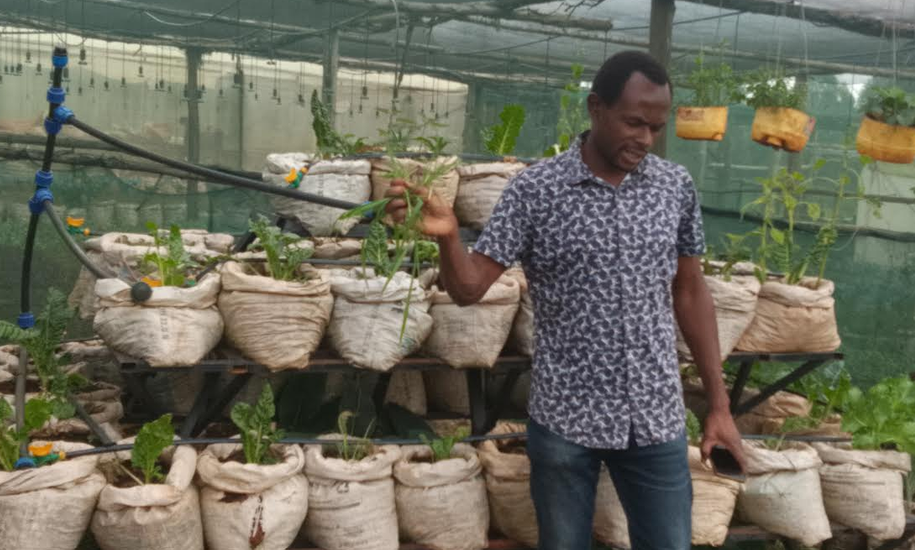
Aguma said during the interview that members have embraced modern technologies including drip irrigation, button drip systems and vertical farming to cope with unpredictable weather brought about by climate change.
Aguma said they advertise their produce through local markets and members from neighbouring towns and also through online platforms stating that the consumers are mainly locals making them their own brand.
“We have become a brand of our own by marketing our products online,” he said.
Aguma said the group now hopes to diversify further by venturing into fisheries and medicinal herb production.
Despite challenges such as climate change, crop diseases and inadequate irrigation equipment, the network continues to expand with support from Dueutsche Gesselschaft Für Internationale Zusammernarbeit (GIZ), the Vihiga County Government and the county departments of Agriculture and Cooperatives, stated Aguma.
Aguma said he believes agriculture has become one of the most promising economic opportunities for young people.
“If young people embrace agribusiness, they can create employment not only for themselves but also for others,” he added.
This agribusiness innovation by young agripreneurs is equally transforming beekeeping in Vihiga County where youths are embracing hard work in honey production for other products.
A young apiculture entrepreneur, Eugene Nyandiki, speaking to KNA at Wodanga said his beekeeping group has grown to about 500 members, creating opportunities for youth through value addition.
Nyandiki said that through the creativity and innovation, they produce a lot of products from apiculture whereby Instead of selling raw honey alone, members manufacture beeswax creams, lip balms and soaps enriched with natural ingredients such as rosemary and lemongrass before marketing them.
Nyandiki stated that the main challenge they face is insufficient finances to make more produce but the group has submitted funding proposals to the government to expand production and strengthen processing, but despite that they are working smart for more expansion and productivity creating employment opportunities for youths.
He said their products are marketed through various groups and initiatives that gives them a foundation and an opportunity to advertise their products.
“The products are marketed through cooperatives, Senje Organic Village Market, Royal Media and Vihiga FM, creating wider market access and new income opportunities for young entrepreneurs across the county,” stated Nyandiki.
In Busali Ward, a leader of the Kuvoka Farmers Development Group, Dennis Muchoge, said they are empowering youth through poultry farming while diversifying into Black Soldier Fly (BSF) production, vermicomposting and fisheries.
“These enterprises are promoting environmentally sustainable farming while creating alternative sources of income for young farmers,” said Muchoge.
Muchoge said they are training farmers on using environmentally sustainable farming to earn a living through providing the available agricultural equipment and suitable methods of making the farming easier and creating more markets for their products.
“Affordable financing has also become an important pillar in supporting agribusiness,” he said.
At the Lugaga Wamuluma Farmers SACCO, Bookkeeper Elizabeth Akivaga said the institution was established in 2023 to provide affordable savings and credit services to farmers and small-scale business owners.
The SACCO has since grown to 750 members, comprising 440 women, 256 youths and 54 organized groups.
Akivaga said that members play a central role in decision-making through Annual General Meetings, while a supervisory committee ensures transparency and accountability within the institution.
She said Lugaga Wamuluma SACCO provides business, education, agricultural and emergency loans at an interest rate of one per cent, supporting investments in poultry, avocado, banana, dairy and indigenous vegetable farming.
“Although loan repayment defaults and occasional leadership conflicts remain challenges, the SACCO continues to register steady growth. It has received Sh 626,000 from the government for capitalization, through National Agricultural Value Chain Development Project (NAVCDP) while members have mobilized an additional Sh 720,000 through their own savings,” said Akivaga.
She said that she encourages young agripreneurs to join the SACCO and invest more in agribusiness for it is a tool for wealth creation among young generation.
Akivaga said that Lugaga Wamuluma Farmers sacco is highly comprised of youth and women who show much interest in the culture of saving, while investing in agribusiness and this is creating a good picture to the young people and this is also attracting more funding from the county government for them to continue growing.
The stories of these young entrepreneurs demonstrate that agriculture in Vihiga is no longer defined by traditional farming alone but It is increasingly becoming an industry driven by technology, innovation, partnerships and entrepreneurship.
With stronger farmer organizations, improved access to finance, expanding markets and continued government support, young people are proving that farming can be both profitable and transformational.
For Vihiga’s youth, agribusiness is no longer simply a means of survival, but it is a pathway to economic empowerment, job creation and sustainable development.
By Clara Simiyu