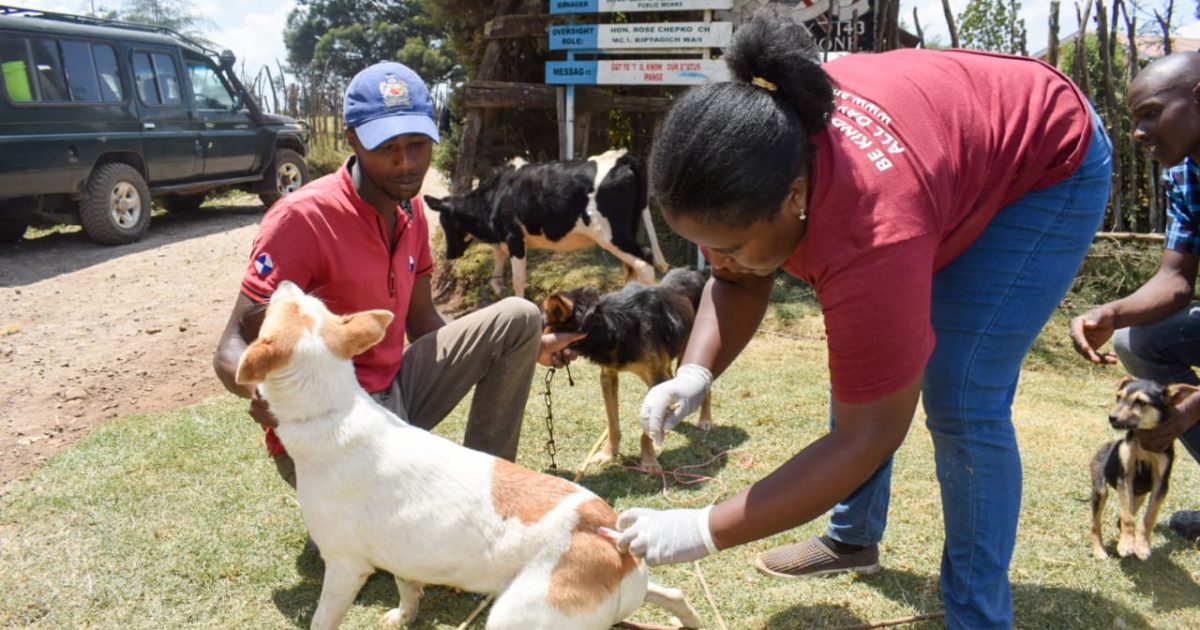
The County Government of Nakuru has begun a mass vaccination of dogs to curb the spread of rabies in the region.
According to the devolved unit’s administration a total 492 dogs received the anti-rabies jab on the first day the exercise kicked off in Molo and Naivasha Sub-Counties.
Data from the Nakuru County Government Veterinary Department indicates that the broader domestic dog population in the county exceeds 50,000 dogs.
According to Chief Officer in charge of Livestock, Fisheries, and Veterinary Services Dr. Michael Kiplangat Cheruiyot the county government is also educating members of the public on managing dogs to reduce cases of bites.
“We are raising awareness so that members of the public take ownership of the dogs. We are also working to have male dogs castrated and the reproductive system surgically removed from the female dogs to control their population,” said Dr Cheruiyot.
Speaking at the County headquarters in Nakuru Town, Dr. Cheruiyot cautioned members of the public to be vigilant and report any cases of the disease and any stray dog bites immediately for action.
“In Biashara Ward, within Naivasha Sub-County, veterinary officers successfully vaccinated 279 dogs against rabies at Kwa Ben Centre, helping protect both pets and residents from the disease while in Molo Ward, within Molo Sub-County, another 213 dogs received anti-rabies vaccinations,” explained the Chief Officer.
He pledged that the County Government remains committed to safeguarding public health by preventing the spread of rabies through routine vaccination, training on responsible pet ownership and increased community awareness.
The Chief Officer explained that besides rabies, dogs can spread a range of other disease-causing organisms, including salmonella. He added that there is also Toxocara canis, a parasite that can cause blindness to humans.
“To protect dogs from diseases, dog owners should keep up with vaccination routines. With vaccination, one can prevent diseases like rabies, worms, bordetella, Lyme disease, parvovirus, leptospirosis and distemper,” noted Dr Cheruiyot.
Rabies is caused by a virus that is nearly always transmitted to humans through bites and scratches from rabid animals.
Without appropriate intervention to prevent the development of clinical disease, rabies is 100 percent fatal.
In Kenya, an estimated 2,000 people die annually of rabies due to bites from rabid dogs. Africa accounts for 36 per cent of the 59,000 rabies deaths in humans annually.
According to the World Health Organization and the World Animal Protection, by 2020, Kenya was recording up to 75,000 dog bites every year. Out of these, 500 to 1,000 dog bites resulted in death.
Globally, the World Organization for Animal Health estimates that about 59,000 lives are lost to rabies every year. About 40 per cent of these victims are children, the majority of whom are in underdeveloped countries.
Currently, researchers estimate that more than 1 million people will die from rabies globally between 2020 and 2035 if vaccination rates and immediate treatment for dog bites are not scaled upwards.
Dr. Cheruiyot indicated that mass dog vaccinations covering 70 per cent of the dog population are a cost-effective way to break dog-to-dog rabies transmission, in addition to human inoculation.
He advised dog bite victims to immediately wash the wound with clean running water for at least 15 minutes and visit a health facility to receive the full dose of the recommended five post-exposure vaccines.
“From the first day of the dog bite, the anti-rabies injections are normally given on the first, third, seventh, 14th and 28th day after exposure. After a dog bite, it is a race against time to prevent the virus from travelling from the bite wound to the brain of the patient, a stage of the disease that has no known cure and results in a horrifying death,” the Chief Officer pointed out.
Dr. Cheruiyot stated that the County Government was educating communities on rabies and enhancing capacity for health workers with regard to rabies exposure assessment, diagnosis, administration and judicious use of the rabies vaccines.
He added that his department had tightened surveillance, risk assessment and reporting compliance to make accurate data available.
A majority of rabies deaths are in children because they are more likely to play with dogs, and, when bitten, tend not to report to their parents for action.
In 2014, Kenya adopted a strategic plan for eliminating human rabies, in line with the global target of eliminating dog-mediated human rabies by 2030.
“Kenya is actively executing the Strategic Plan for the Elimination of Human Rabies in Kenya (2014–2030), a layout closely aligned with the WHO global roadmap to achieve zero dog-mediated human rabies deaths by 2030,” the Chief Officer pointed out.
Dr. Cheruiyot also urged all residents of Nakuru to ensure that all meat offered for consumption is slaughtered in the approved slaughterhouses, duly inspected, stamped and transported in strict compliance with the Ministry of Health’s regulations.
“Low dog vaccination coverage often results from lack of information on the proportion of dogs inoculated during mass vaccination campaigns and logistical challenges. Poor knowledge on disease transmission and prevention however remains the main challenge,” explained the Chief Officer.
Dog vaccinations in Nakuru can be acquired through private veterinary clinics, mobile vet services and regional agricultural offices.
The County Government of Nakuru also holds recurring free or subsidized mass vaccination campaigns against rabies.
By Jane Ngugi and Jefther Afuyo