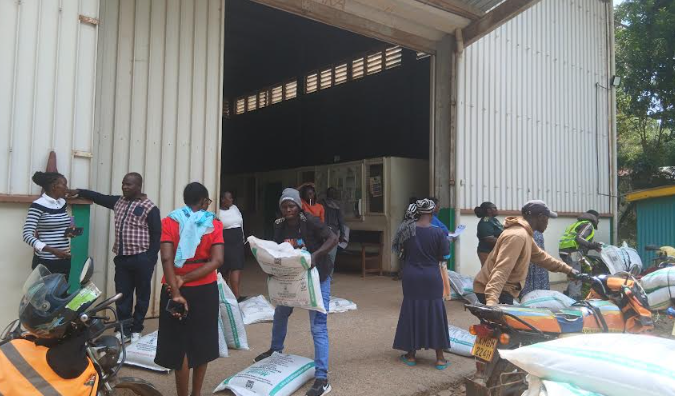
Hundreds of smallholder farmers across Vihiga and neighboring Nandi counties are benefiting from the ongoing Presidential Fertilizer Subsidy Programme at the National Cereals and Produce Board (NCPB) Hamisi Depot, Vihiga County, following a steady supply of planting and top-dressing fertilizers for the short rains cropping season.
National Cereals and Produce Board Hamisi Depot Manager Dorothy Awuor Odhiambo stated that the depot recorded a high turnover during the main long rain season, having successfully received and distributed over 15,000 bags of subsidized fertilizer to local farmers in the region.
The NCPB Hamisi Depot is rolling out government-subsidized fertilizer to farmers for the short cropping season. According to the depot manager, the depot distributed 15,000 bags of planting fertilizer and 10,000 bags of top-dressing fertilizer during the last long rains.
“For this season, the depot opened on July 1, 2026, with nearly 5,000 bags in stock and stocks various blends under the subsidy scheme, including MAVUNO planting and tea fertilizer formulations. The top-dressing fertilizers available include tea top-dressing, urea, and maize top-dressing,” the manager affirmed.
Odhiambo added that farmers have expressed a preference for Mavuno fertilizer due to its effectiveness on maize and beans. The depot expects to serve over 6,000 farmers from Vihiga, Nandi, and Kisumu counties with the subsidized fertilizer priced at Sh 2,500 per 50-kilogram bag.
Odhiambo explained that with the short rain season having officially commenced on July 1, 2026, the depot opened with an initial inventory of nearly 5,000 bags, supported by continuous truck deliveries to meet rising demand. She added that the facility expects to serve over 6,000 farmers during the current short season cycle.
To cater to diverse agricultural needs, the manager noted that the depot stocks various crop-specific fertilizer blends under the government subsidy scheme. These include NPK, OCP, and Elgon formulations tailored for staple maize, beans and others, which was distributed during long season
Although situated in Vihiga County alongside smaller local hubs, Odhiambo observed that the Hamisi Depot has become a crucial supply point for farmers crossing over from neighboring Nandi County due to its strategic accessibility compared to alternative depots like Kobujoi or Mosoriot in Nandi County.
Expressing appreciation for the distribution process, Bonita Oundo, a farmer hailing from Nandi County who travels to the Hamisi Depot for agricultural inputs, praised the administrative efficiency and cross-border convenience of the hub.
Oundo noted that the services at the depot were fast and well-organized, adding that Hamisi was much closer for farmers from his area, enabling them to acquire genuine subsidized fertilizer without unnecessary delays.
Echoing similar sentiments, Wycliffe Ouma, a farmer from Banja in Hamisi Sub-county who collects fertilizer for his 1.3-acre farm, highlighted the significant financial relief the government subsidy offers compared to commercial agro-vets.
Ouma explained that purchasing inputs from a commercial stockist was extremely costly, particularly when buying small quantities over time.
He pointed out that acquiring a full bag at Sh 2,500 at the NCPB depot allowed farmers to secure both planting and top-dressing inputs for a total of Sh 5,000, thereby significantly lowering their overall production cost.
Ouma, who engages in maize farming and livestock rearing, cautioned fellow smallholders against relying solely on farmyard manure.
He encouraged a balanced application of organic manure combined with inorganic fertilizers to effectively restore soil fertility and boost crop yields.
The farmer also offered practical agronomic advice regarding proper fertilizer placement during planting to prevent seed damage in dry weather.
He explained that farmers must apply fertilizers correctly by avoiding direct contact between seeds and chemical fertilizers, noting that if rains delay for several days, soil acidity can harm the seed.
Ouma advised that slightly separating the seed from the fertilizer during planting ensures proper germination and healthy crop development.
By Convivian Khasoha and Maureen Imbayi