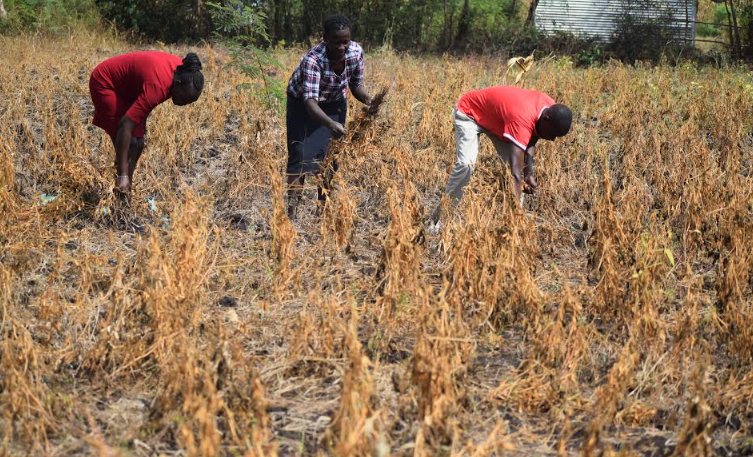
Soya bean farming is gaining momentum in Homa Bay County as government and development partners intensify efforts to empower young farmers through climate-smart agriculture, access to finance, quality seeds, and guaranteed markets.
The initiative is being implemented under the Empowering Sustainable Aquaculture (ESA) programme, led by Farm Africa and funded by the Mastercard Foundation, with the aim of strengthening aquaculture and related value chains, including soya bean production.
Farm Africa’s Aquaculture Programme Manager, Dr. Bundi Muguna, who spoke in the God Jope trading center in Suba, said the ESA programme is being implemented by a consortium of seven partners, with Farm Africa serving as the lead organization.
The program is being implemented in six counties, including Homa Bay, with a key focus on young men and women and People with Disabilities (PWDs).
“Kenya currently produces only about 2,000 metric tonnes of soya annually against a national demand of more than 200,000 metric tonnes. This means the country is producing only about two to three percent of its requirements,” he said.
He added that the programme seeks to bridge this gap by expanding soya production while promoting climate-resilient varieties capable of withstanding erratic weather conditions.
Farm Africa is also working with village-based agents to multiply and distribute improved seed varieties, with a target of producing between 50,000 and 60,000 kilograms of seed for the next planting season.
Homa Bay County has around 6,000 young soya bean farmers, with village-based aggregation agents being a key link between farmers and markets.
Elijah Odondo, a village-based soya bean agent in Lambwe, said farmers deliver their harvest to aggregation centres where the produce is weighed, assessed for quality, and paid for accordingly.
Odondo said the agents also support farmers beyond marketing by providing training, facilitating access to interest-free loans and supplying climate-resilient seed varieties. The loans are recovered during harvest when farmers sell their produce.
“We encourage farmers to plant early-maturing varieties that take about three months to mature instead of four months. These varieties are more resilient to changing weather patterns and help farmers reduce losses caused by unreliable rainfall,” he said.
Homa Bay County Director of Agriculture, Kennedy Opiyo, said the county government continues to work closely with development partners to improve farmers’ incomes through agribusiness.
He noted that the county has about 240,000 farmers, making partnerships essential due to limited public resources.
“Our focus is to ensure farming becomes a profitable business that puts money into farmers’ pockets. Programmes like ESA have enabled us to support young people and women through quality seed, extension services, and capacity building,” he said.
Opiyo said Homa Bay has identified soya bean as one of its priority value chains because of their short maturity period, resilience to climate change, and strong market demand.
The county is promoting climate-resilient varieties such as Saga and SP8, which mature within two-and-a-half to three months, making them suitable for areas affected by changing rainfall patterns.
According to 2025 Kenya National Bureau of Statistics (KNBS) data, Homa Bay County is currently the country’s leading producer of soya beans.
However, Opiyo cited the country’s large supply deficit as evidence of the crop’s commercial potential.
“Kenya produces only a small fraction of the soya it requires, meaning there is a ready market for every farmer who grows the crop. Homa Bay has favourable climatic conditions, and with more partnerships, we can significantly increase production while improving household incomes,” he said.
By Sitna Omar