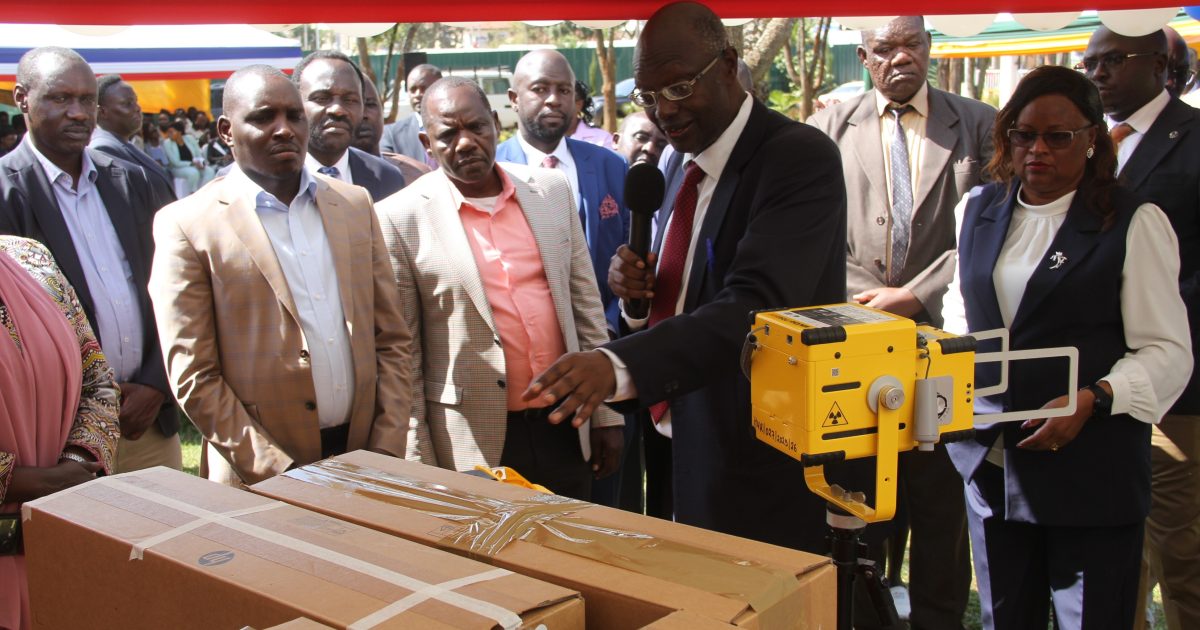
The County Government of Uasin Gishu has received medical equipment worth Sh61.7 million from The Academic Model Providing Access to Healthcare (AMPATH) Uzima as part of a major transition programme aimed at strengthening HIV care and ensuring continuity of health services as donor-funded programmes gradually shift to government management.
The handover, conducted at the County Headquarters in Eldoret on Friday, also marked the beginning of the transfer of key health systems, digital infrastructure and programme operations from AMPATH Uzima to the county government under the Government-to-Government (G2G) transition framework between Kenya and the United States.
Speaking during the ceremony, AMPATH Uzima Chief of Party Prof. Sylvester Kimaiyo described the event as a significant milestone in the county’s healthcare journey, saying it represented more than the transfer of equipment but the gradual transition of systems that have supported HIV prevention, treatment and care for more than two decades.
Prof. Kimaiyo said AMPATH Uzima has partnered with Uasin Gishu County for the past 24 years, helping transform HIV care from a period when an HIV diagnosis was regarded as a death sentence to an era in which thousands of patients are living healthy and productive lives through access to life-saving treatment and quality healthcare services.
He disclosed that Uasin Gishu currently has 35,507 people living with HIV, of whom 21,407 receive treatment in county health facilities while approximately 14,000 are enrolled at Moi Teaching and Referral Hospital.
According to Prof. Kimaiyo, the county has attained a 95 per cent viral load suppression rate, one of the highest in the country, demonstrating that the majority of patients receiving treatment are responding well to antiretroviral therapy.
He also commended the county for its progress in preventing mother-to-child transmission of HIV, noting that Uasin Gishu recently recorded a transmission rate of 6.3 per cent, placing it among the country’s best-performing counties and bringing it closer to the World Health Organization target of less than five per cent.
Prof. Kimaiyo said the transition is being implemented under the Government-to-Government arrangement through which the United States Government will continue financing critical programme staff for a limited period as both the national and county governments progressively assume responsibility for the programme.
He revealed that more than 100 health workers, including clinical officers, nurses, counsellors, laboratory technologists, health records officers, social workers and programme management staff, will continue serving under the transition arrangement before eventual absorption into government systems.
The AMPATH Uzima Chief of Party also officially handed over the AMPATH Medical Record System (AMRS), a web-based electronic medical records platform developed in Uasin Gishu to improve patient management and continuity of care.
He explained that the digital system enables healthcare workers to securely access patient records from participating health facilities, improving efficiency, reducing duplication of services and enhancing treatment outcomes.
Prof. Kimaiyo praised the Uasin Gishu County Government for supporting the retention and expansion of the AMRS platform, saying county officials had played a vital role in ensuring the locally developed innovation remains part of Kenya’s national digital health strategy.
Among the assets handed over were a portable digital X-ray machine capable of supporting tuberculosis screening in remote areas, 29 three-in-one desktop computers, laptops and other information and communication technology equipment aimed at strengthening health information management across county health facilities.
He noted that although AMPATH Uzima had received a six-month extension of support from the United States Department of State, the organization was preparing for a smooth transition while continuing to provide technical support to the county government.
Receiving the equipment, Uasin Gishu Governor Dr. Jonathan Bii Chelilim thanked AMPATH Uzima for its longstanding partnership in strengthening HIV prevention, treatment and healthcare delivery across the county.
The governor said the donated equipment would significantly improve service delivery in dispensaries, health centres and hospitals by enhancing HIV testing, diagnosis, treatment and patient monitoring services.
Dr. Bii acknowledged the changing global donor funding environment and said the county government was prepared to assume greater responsibility for sustaining HIV programmes through prudent planning, increased investment and efficient allocation of resources.
He reaffirmed his administration’s commitment to strengthening the healthcare workforce through capacity building, recruitment and continuous professional development to ensure residents continue receiving quality healthcare services.
The governor observed that Uasin Gishu has established itself as one of Kenya’s leading healthcare hubs, attracting patients from across the country because of its strong referral services and specialized medical care.
He expressed confidence that continued collaboration between the county government, AMPATH Uzima, Moi University and Moi Teaching and Referral Hospital would further strengthen healthcare delivery, research, innovation and training for health professionals.
Dr. Bii emphasized that the transition should not be viewed as the end of donor support but as an opportunity for the county and national governments to strengthen local ownership of health programmes while safeguarding the gains made in HIV prevention and treatment over the past two decades.
He said the county remains committed to ensuring uninterrupted access to HIV services and other essential healthcare programmes, adding that the partnership with AMPATH Uzima will continue through technical collaboration even after the transition is completed.
By Ekuwam Sylvester