Agriculture and Livestock Development Cabinet Secretary, Mutahi Kagwe has assured smallholder tea farmers that their earnings will not be negatively affected by the newly introduced tea levy.
Kagwe has clarified that the levy will neither be imposed as a tax on farmers nor will it be deducted from the tea factories that the farmers are affiliated to. He said that the levy will be charged on overseas tea buyers importing Kenyan tea and will be charged at a rate of 0.8 per cent.
While clearing the air on the controversial charge, CS Kagwe said that the levy is a strategic investment that is aimed at positioning the country’s tea in the global tea market.
“I want to explain that it is good to read the Act and Regulations because they are extremely clear that the Tea levy is not a tax first and foremost. Secondly it doesn’t affect the farmer earning because the farmer earning is not going to be deducted at all. It doesn’t affect the factory earnings because the factory earnings are not deducted at all,” said Kagwe.
“The tax is essentially for the buyer who imports. And it is not also for the local consumer, it is for exporter so that the exporter, the person who is buying say from the UK or elsewhere in the world pays a small levy of 0.8 per cent which is supposed to help us to help Kenya with the operationalization of the Tea Act 2020 which essentially is money that we want to use for promotion of Kenya Tea overseas and marketing of Kenya Tea, “he added
The Tea(Levy)Regulations 2026 which came into effect on May 1 this year, imposes a tea levy at the point of export and import. Tea exporters will be expected to pay 0.8 per cent of the auction value for direct sales. This amount is payable at the point of export translating to Sh 2.28 per kilogram of made tea.
On the other hand, tea imports will attract a 100 per cent levy for each consignment of made tea.
In a move that is aimed at promoting value addition of local tea, the Regulations exempt value added tea packaged in packets or containers holding no more than 10 kilograms and tea extracts. Kenyan tea that is value added in Export Processing Zones and Special Economic Zone for local consumption are equally exempted from the levy.
The levy is projected to generate about Sh 1.42 billion annually. The money collected will be administered by the sub-sector regulator, Tea Board of Kenya(TBK) and will be used for the revitalization of the tea sub-sector.
The Regulations provide that 50 per cent of the money goes towards income and price stabilization for tea growers,20 per cent goes towards supporting tea research through the Tea Research Institute while 15 per cent will go towards supporting the regulatory function through TBK.
The remaining 15 per cent will go towards infrastructure development which will include construction and maintenance of feeder and county roads, tea buying centres and other facilities within the tea catchment areas in tea growing counties.
Kagwe told tea farmers that the levy will be collected and managed by the TBK as provided under the Tea Act 2020.He noted that the levy will particularly facilitate the promotion and marketing of Kenyan tea as a brand therefore unlocking its demand in the global markets.
He said that despite being a producer of some of the world’s premium teas, Kenya has for years relied on this reputation without making a deliberate investment in stamping its authority in the global tea market adding that the sector must now focus on deliberately promoting Kenyan tea if the country wants a share of the premium prices.
“There is a tendency to think that because we know we produce very good tea here in Kenya that everybody in the world knows about it. We must make it a fact and the only way we can do that is by ensuring that we are present in those areas. The branding of Kenya tea must be so high,” he said.
“It is the way that for example Colombia coffee is famous in the United States. But if you go to the United States and talk about Kenya tea, nobody knows about it so we need to be out there and the only way we can do it is by spending a little money to get that done so that our tea can fetch premium brands and have a bigger demand,” he added.
The CS noted that Kenya is not the first country to charge the levy as a similar tax is being charged by other tea producing countries such as Sri Lanka (2 per cent) and India (5 per cent) with the aim of promoting their tea industries. He however noted that Kenya charges the lowest within the tea markets.
Kagwe said that in addition to revitalizing the tea sector, the levy will facilitate the implementation of the market development strategy and eventually open up new and emerging tea markets in China, West Africa, Russia, North America, Asia and the Commonwealth of Independent States.
“As we open new markets, for instance the Chinese market we must have a kitty by which we are going to promote our tea out there. We must also promote our geographical indicators so that Kenya tea becomes a known brand in the world, “he emphasized.
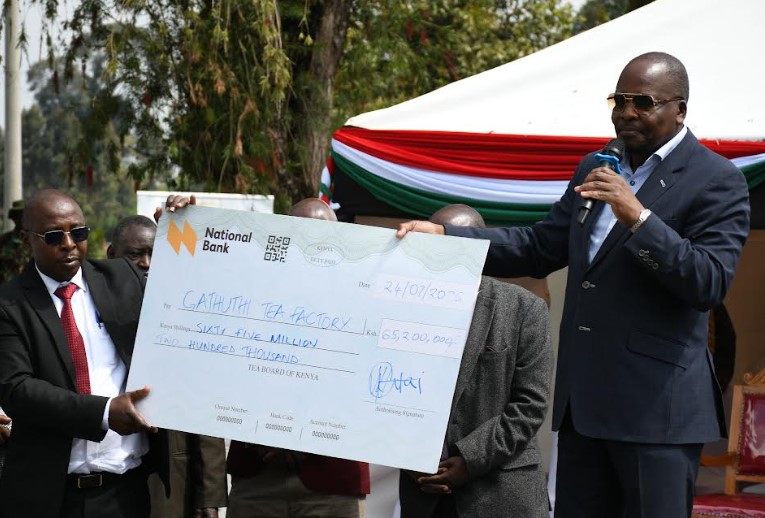
The CS spoke at Gathuthi Tea factory in Tetu, Nyeri county where he delivered a Sh 65.2 million cheque to the factory. The money is a grant from the National government and will support the construction of an automatic withering plant. Once complete, the facility will expand the factory’s operations by enhancing production of more tea and increase value addition.
“As a ministry we have been around the country supporting tea farmers and tea factories so that we can ensure that we continuously improve the quality of our tea, “said Kagwe.
The CS was accompanied by TBK board chair, Ndung’u Gathinji,TBK chief executive officer, Willy Mutai, Kenya Tea Development Agency(KTDA) Manager Sustainability and Certifications Kanja Thuku among other directors from various tea agencies.
The Tea Board of Kenya board chair said that the regulator is partnering with KTDA, the National Treasury and the Ministry of Agriculture to implement a factory modernization programme. He said the initiative which is being undertaken throughout the tea growing counties aims to address challenges facing factories arising from aging processing equipment, rising production costs and increased competition in the global tea market.
He reiterated that TBK will continue providing oversight to ensure that implementation of the factory modernization programme and the Tea Act will be transparent, accountable, and focused on delivering value to the farmers.
“I wish to assure farmers that the board will continue promoting the policies and programs that improve tea quality, expand the market, strengthen sustainability, and enhance your return,” said Gathinji.
By Wangari Mwangi and Stephen Nderito