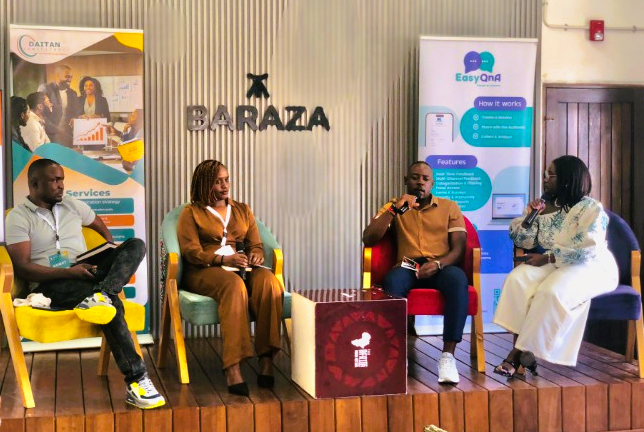
Artificial intelligence (AI) acts as a powerful support tool for traditional media rather than a complete substitute, a Mombasa media forum heard.
While AI excels at rapid data processing and routine tasks human journalists remain essential for deep ethical judgment, original reporting, and public trust.
Journalists, authors and technology experts meeting in Mombasa say Artificial Intelligence (AI) should be treated as a tool that supports storytelling rather than a threat to jobs, and called for more training to help media practitioners use it with confidence.
The panel discussion, dubbed “Conversations that Matter,” was held at Baraza Media Lab’s Mombasa hub, one of three regional hubs the organization has opened outside Nairobi to support ethical media practice in the regions.
Mombasa Press Club chairman Omar Abdalla assured journalists that AI adoption would not come at the cost of their livelihoods, announcing plans for workshops to build newsroom skills around the technology.
“AI is not here to steal your jobs,” Abdalla said, adding that the planned workshops would equip journalists with practical knowledge on how to use AI tools responsibly and effectively in their day-to-day work.
Sarah Ouma, representing Slum Dwellers International, said AI should be seen as an aid to journalists, not a replacement.
“AI is here to offer assistance, not to steal our jobs,” Ouma said.
She said the greater threat to the profession is the pressure to publish first, which she argued undermines core journalistic standards.
“The first person to break the news is the first to get more likes and attention. This undermines the underlying principles that guide professional journalism — verification, ethics, and accountability,” Ouma said, adding that trained journalists remain necessary to filter noise generated by both AI and citizen reporting.
AI ethics specialist Bokaya Sharamo called for greater public awareness of the ethical guidelines around AI use.
“AI is not a creator; it is a tool. People need to be informed about the ethical guidelines behind it. We must learn how to create authentic stories that resonate with us — stories that are not entirely manufactured by machines,” Sharamo said, cautioning that AI content produced without human oversight risks eroding the human experience and emotion central to storytelling.
Author Dr. Sarah Nyakinyua, affiliated with Qwani Firm and publisher of more than 18 books, urged writers to reclaim African narratives from algorithm-driven content.
“We must write the African stories that resonate with us. Not stories that simply entertain, but stories that reflect our realities, our struggles, and our triumphs,” Nyakinyua said, crediting her career to persistence and recalling her first ISBN as a mark of legitimacy in the literary world.
Micah Balucci, CEO of Albanaverse, urged businesses to integrate AI into their operations rather than resist it.
“We need to learn how to integrate AI into our businesses rather than seeing it as a threat. The companies that will thrive in the coming decade are those that embrace AI as a collaborator, not a competitor,” Balucci said, citing data analysis and content generation as functions AI can take on to free up human creativity.
The panelists agreed that structured training, rather than avoidance, was the surest way to ease anxiety among journalists and creatives over AI’s growing role in their work, with Nyakinyua noting that technology cannot replace the human element behind a story.
“Our stories are our legacy. Let us write them with integrity, whether by pen or by processor,” Nyakinyua said.
By Joan Kinuthia