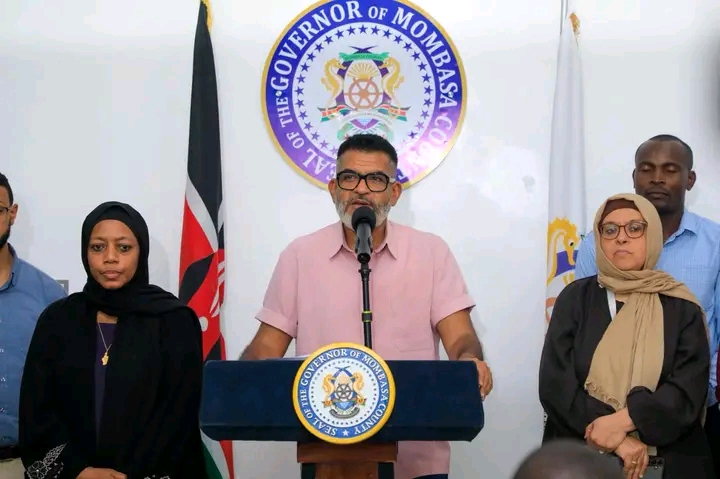
Mombasa Governor, Abdulswamad Nassir, has directed the County Public Service Board to immediately begin the recruitment of 573 nurses on contract, to ensure uninterrupted healthcare services as the nationwide nurses’ strike continues to disrupt operations in public health facilities.
The industrial action, called by the Kenya National Union of Nurses and Midwives (KNUNM), after issuing a seven-day strike notice, began, Wednesday, and has affected public health services in all 47 counties.
Speaking during a press briefing in Mombasa in his capacity as Chairperson of the Council of Governors’ Health Committee and later as Mombasa Governor, Nassir said the strike was a national issue requiring a coordinated response from both the National and County governments.
“This does not concern Mombasa County alone. It is a matter that affects all 47 counties,” said the Governor.
He noted that County governments remained committed to resolving the dispute through dialogue but stressed that they also had a constitutional obligation to ensure Kenyans continued accessing essential healthcare services.
The Governor explained that the emergency recruitment would cushion public hospitals from staff shortages and enable them to continue providing critical services, while negotiations with the nurses’ union continued.
The KNUNM, in a letter signed by General Secretary, Seth Panyako, and addressed to the Council of Governors and other state agencies, listed five key grievances behind the strike.
These include the delayed conclusion of the 2025–2029 Collective Bargaining Agreement (CBA), failure to implement the 2017 Return-to-Work Formula, unresolved employment terms for Universal Health Coverage (UHC) staff, delayed implementation of career progression guidelines for nurses and the failure by Kisii County to reinstate 46 nurses dismissed in 2021.
However, Nassir dismissed claims that negotiations over the new CBA had stalled, saying discussions had already commenced under the Public Service Board, before the Union proceeded with the industrial action.
“You cannot go on strike, saying CBA negotiations haven’t started when, three days earlier, those negotiations had already begun,” he said.
On the status of UHC workers, the Governor said the National government had undertaken to continue paying their salaries until the Division of Revenue Act (DORA), is amended to provide counties with adequate funding.
He argued that counties could not absorb UHC staff into permanent and pensionable terms, without an additional Sh8.8 billion to meet the wage bill.
Nassir further said a previous court ruling had established that the Public Service Commission had no legal mandate over nursing career progression guidelines.
He said County governments, through the Council of Governors, intended to develop harmonised career progression guidelines to address the concerns raised by nurses.
While acknowledging that nurses have a constitutional right to strike, the Governor maintained that patients should not suffer because of the industrial action.
“What we cannot accept is any patient being turned away from hospital,” he said, adding that the recruitment of 573 nurses would help bridge staffing gaps created by the strike and ensure continuity of healthcare services.
He appealed to striking nurses to resume duty while negotiations continued, saying labour rights should be balanced with the constitutional right of citizens to access healthcare.
“Mombasa belongs to all of us. Come back to work. However, if you feel you do not want to come back to work, we will respect your constitutional right to do so. But you will also have to respect our constitutional obligation to ensure everyone has access to healthcare,” he said.
Nassir further disclosed that the Council of Governors would move to court seeking legal guidance on the strike, including clarification on county salary ceilings and other issues affecting the management of the health workforce.
He expressed confidence that judicial intervention, coupled with continued dialogue, would help resolve the dispute and pave the way for lasting solutions to the nurses’ grievances.
“It is your constitutional right to agitate, but it is my constitutional responsibility to ensure our hospitals remain open and continue serving the people,” he said.
By Ramadhan Nassib