The government has unveiled an ambitious programme to more than double Kenya’s bixa production by expanding the number of farmers cultivating the crop and fully utilising the country’s existing processing capacity, a move expected to create thousands of jobs, increase exports and significantly improve incomes for smallholder farmers.
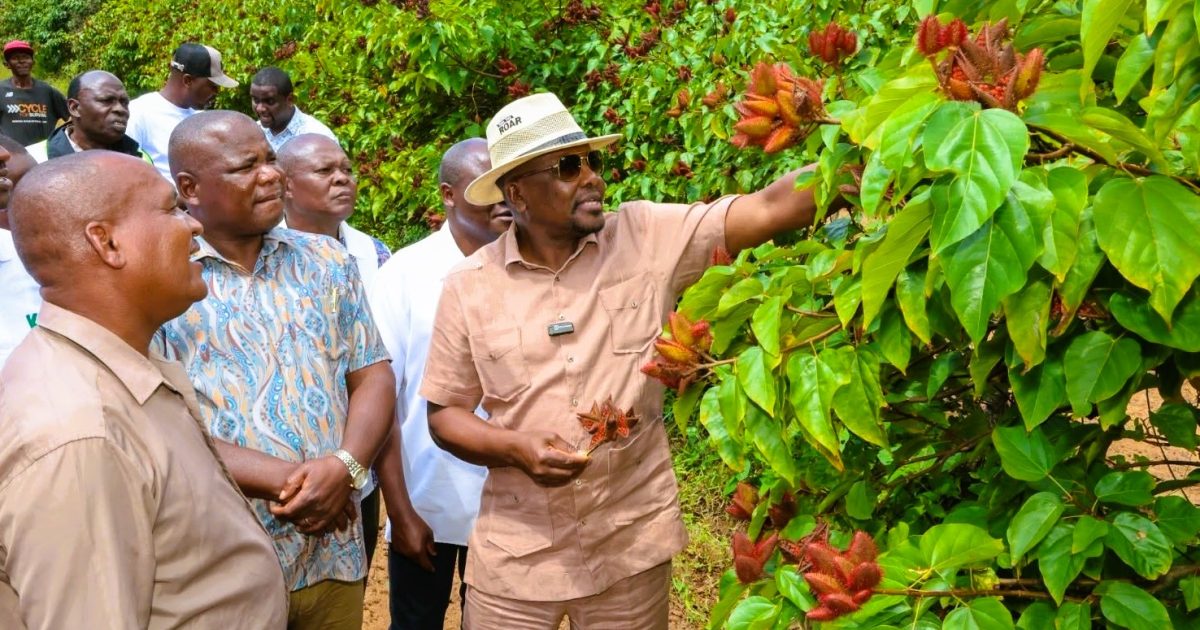
Agriculture and Livestock Development Cabinet Secretary Mutahi Kagwe announced the initiative during a visit to Kenya Bixa Limited in Kwale County, where he outlined a comprehensive strategy to transform bixa into one of Kenya’s leading high-value commercial crops.
The programme will be implemented through collaboration between the Agriculture and Food Authority (AFA), county governments in the Coast region, farmer cooperatives and private sector stakeholders.
Under the initiative, farmers will receive certified seedlings, enhanced agricultural extension services, improved access to affordable financing and support to establish cooperative societies that will strengthen production and marketing.
Speaking during the visit, Kagwe said Kenya already possesses the processing infrastructure, export markets and internationally recognised manufacturing standards required to compete effectively in the global bixa industry.
He noted that the government’s immediate priority is to substantially increase farm production in order to maximise the country’s processing capacity while improving livelihoods in rural areas.
“What is now needed is to rapidly increase production from the farm to enhance its contribution to livelihoods and the economy,” said Kagwe.
Bixa, locally known along the Coast as mrangi or the “lipstick tree,” is cultivated for its bright red seed pods that produce a natural orange-red dye widely used in food processing, pharmaceuticals and cosmetic manufacturing.
Global demand for natural food colourants has continued to rise as manufacturers increasingly replace synthetic additives with plant-based ingredients.
Kenya Bixa Limited currently processes between 1,000 and 1,400 tonnes of raw bixa annually despite having the capacity to process up to 3,000 tonnes every year.
The factory therefore operates at less than half of its installed capacity due to an inadequate supply of raw materials.
Current production comes from between 7,000 and 10,000 contracted smallholder farmers spread across Kwale, Kilifi and Lamu Counties.
Kagwe said the government intends to substantially increase the number of contracted growers by distributing more certified seedlings through AFA and encouraging more farmers to venture into the crop.
“Since bixa is a scheduled crop, the Authority will play a central role in regulating planting materials, supporting farmers and expanding acreage to supply the additional raw materials needed by the factory,” he said.
The Cabinet Secretary said expanding the value chain is not only about increasing production but also about creating sustainable employment opportunities and improving household incomes across rural communities.
“This is not just about increasing production. It is about bringing more farmers into a profitable value chain, creating more jobs and putting more money into rural households,” he added.
The expansion programme is expected to create employment opportunities throughout the value chain, including seed multiplication, transport, aggregation, processing, logistics and exports.
Kenya Bixa Limited currently employs about 150 workers directly while supporting hundreds of additional livelihoods through contract farming, transport services and supply chains.
Officials said operating the factory at full capacity would significantly increase employment across the Coast region.
According to production data presented during the visit, one acre accommodates approximately 160 bixa trees planted at the recommended spacing of five metres by five metres.
Each mature tree produces an average of 10 kilogrammes of seed annually, translating to roughly 1,600 kilogrammes per acre.
At the current farm-gate price of approximately Sh95 per kilogramme, farmers can earn about Sh152,000 annually from a single acre of bixa.
Unlike many commercial crops, bixa does not compete directly with food production because of its wide spacing.
Farmers are encouraged to intercrop the trees with maize, beans, pigeon peas, cassava, cowpeas and citrus fruits, enabling them to harvest both food and cash crops from the same land.
Kagwe said the dual-income model strengthens household food security while increasing farmers’ earnings.
“The most important thing is to put money into farmers’ pockets, and that is our priority,” he said.
To improve farmers’ bargaining power, the Cabinet Secretary directed growers to establish strong cooperative societies capable of collectively marketing produce and negotiating better prices.
He noted that organised cooperatives would also improve access to affordable credit through the Agricultural Finance Corporation (AFC) and other financial institutions.
Kagwe further urged AFA to intensify farmer education programmes focusing on the commercial aspects of bixa farming to enable producers to maximise returns from the growing market.
He encouraged farmers in both traditional and non-traditional growing regions to embrace the crop, saying expansion into new areas would help bridge the gap between current production and processing capacity.
“If we fill the gap between the current 1,000–1,400 tonnes and the 3,000-tonne capacity, we will not only increase exports and value addition, but also bring thousands more farmers into the bixa value chain, create more jobs and inject millions of shillings into rural economies every year,” Kagwe said.
Supporting the government’s strategy, AFA Acting Director General Calistus Kundu announced that the authority had been directed to establish a dedicated support structure for the bixa sub-sector.
The unit will coordinate seed distribution, farmer registration, extension services, production monitoring and market development.
Earlier, Kenya Bixa Limited Managing Director Dr David Kisa said the company had invested heavily in modern processing technologies and international quality standards and was ready to process significantly larger volumes if production increased.
He said the company, established in 1979 with an annual processing capacity of only 250 tonnes, has expanded twelve-fold to its current capacity of 3,000 tonnes.
The factory processes bixa into natural food colourants—bixin and norbixin—which are supplied to both local and international markets.
These extracts are widely used in dairy products, processed meat, confectionery, beverages, pharmaceuticals and cosmetics.
Dr Kisa said Kenya Bixa Limited has attained internationally recognised certifications, including FSSC 22000 Version 6, ISO 9001:2015, Halal, Kosher, United States Food and Drug Administration (FDA) compliance, the Kenya Bureau of Standards (KEBS) Diamond Mark and membership in the United Nations Global Compact.
These certifications have enabled the company to access premium international export markets.
The company is also investing in innovation through trials of a portable bixa pod threshing machine that can be transported on motorcycles to farms, helping reduce post-harvest losses and improve harvesting efficiency.
Beyond commercial production, Kenya Bixa Limited distributes more than 100,000 seedlings annually, provides extension services to farmers, supports community water projects and partners with hospitals and children’s homes through its corporate social responsibility programmes.
By Hussein Abdullahi