Prolonged drought has hard-pressed Flowerland Nursery, a horticultural business in Eldoret that has been operating for over 10 years.
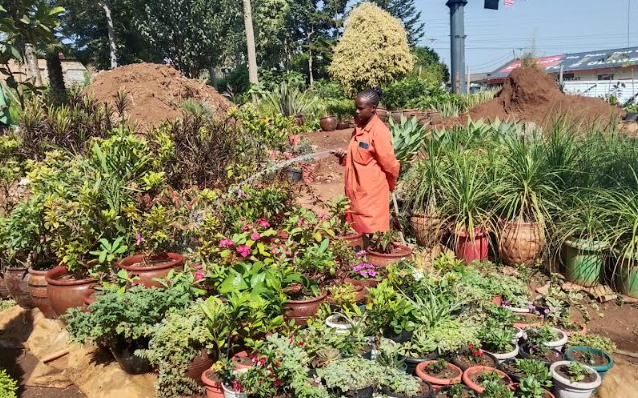
The horticulture farm has been forced to spend more on irrigation to keep its flowers, fruit trees and indigenous seedlings alive.
Billy Mwanyika, Farm Manager at Flowerland, said the rising cost of water and irrigation is one of the biggest challenges the farm is facing this season.
“Because of the prolonged drought we have had to dig deeper into our pockets due to the cost of irrigation,” Mwanyika said during an interview at the farm.
Despite the challenges, the business continues to supply ornamental trees like cypress, bottlebrush, lemon and roses, indigenous trees, and fruit trees, including pomegranate, tree tomatoes, avocados, lemons, oranges, tangerines, pawpaw and yellow passion.
They also sell flowers such as roses, balsam, Ashanti, snow white and mountain snow.
Mwanyika said the farm has put special focus on indigenous trees because of their medicinal value and cultural importance.
“Some tribes believe certain trees bring certain values, like the Nandi flame,” he noted.
The Nandi Flame Tree (Spathodea campanulata) is one of our most admired indigenous ornamental trees.
He also highlighted the growing demand for giant bamboo, which he said is strong and widely used for eco-friendly roofing and fencing. Unlike eucalyptus, he added, bamboo conserves ground water instead of draining it.
“Eucalyptus draws water from the ground. But bamboo helps conserve the ground from becoming dry,” Mwanyika said.
The farm manager urged Kenyans to embrace tree planting in line with the President’s manifesto to increase forest cover and attract rainfall.
He called on the government to support businesses like Flowerland by buying from them so they can expand and create more jobs for young people.
“We need to plant trees, plant fruits for a better tomorrow,” he said. “The biggest support the government can provide is by buying from us. Through that we can expand more and create more job opportunities for young people.”
Mwanyika encouraged the youth to take up jobs in landscaping and tree farming, saying the sector is creative and profitable.
The farm also offers free advice to farmers on landscaping, where to plant trees, and which species are best for different locations.
He said most of their customers are homestead owners looking to beautify their lawns and farmers who plant certain trees in the middle of farms to help with nitrogen fixation.
The farm is also open to schools and university students who want to carry out projects on site.
A worker at Flowerland, Hannah Mungai emphasized on the environmental benefits of growing trees and plants.
“Trees beautify the environment. They also enhance bee farming and honey production because bees collect nectar from the flowers,” Hannah said.
She noted that during the drought, bees rely on flowers for both nectar and water.
“When customers come here, the first thing they notice is the beauty,” Hannah said. “They comment on the flowers and how cool and fresh the environment is.”
She urged citizens to conserve the environment by keeping it clean and called on women not to wait for formal employment.
“Women should not complain that jobs aren’t there. This is a job they can engage in, and it’s a good job,” she said.
Flowerland says it remains committed to promoting tree planting, landscaping and environmental conservation as ways to adapt to climate change.
By Shaline Jeruto