The long-awaited Muruny (Siyoi) Dam project in West Pokot County has reached 86.7 per cent completion, raising hopes that residents will finally access reliable and safe water after years of delays that have seen the project miss several completion deadlines.
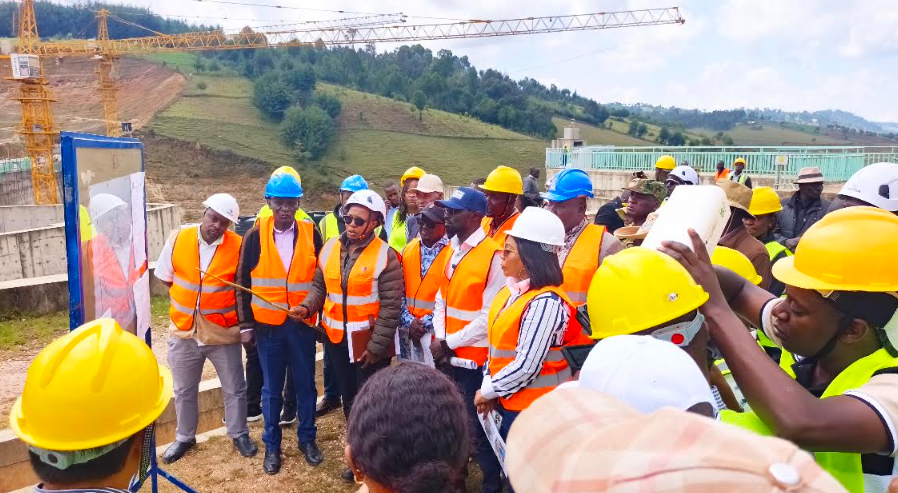
Cabinet Secretary for Water, Sanitation and Irrigation Eng. Eric Mugaa inspected the multi-billion-shilling project in Lelan Ward near Kapsait Primary School, accompanied by the Chief Executive Officer Eng. Julius K. Mugun and Board Chairperson Dr. Jane Mwikali of the National Water Harvesting and Storage Authority (NWHSA), West Pokot Deputy Governor Robert Komolle and Resident Engineer Tabitha Kimani amongst national administration representatives and other stakeholders.
The project, funded by the Government of Kenya through the Ministry of Water, Sanitation and Irrigation and implemented by the National Water Harvesting and Storage Authority, commenced on March 30, 2015 and was initially scheduled for completion within 36 months by March 2018.
However, repeated funding delays and work stoppages have pushed the completion date several times, with the latest target now set for December 2026.
Once complete, the project is expected to supply clean and safe water to about 350,000 people by 2035, benefiting residents of Kapenguria, Chepareria, Keringet, Kishaunet, Murkwijit and surrounding areas through an extensive transmission and distribution network.
Speaking during the inspection, Eng. Mugaa described the project as one of the flagship investments under the government’s Bottom-Up Economic Transformation Agenda (BETA).
“The Bottom-Up Economic Transformation Agenda prioritises investments that strengthen agriculture, create jobs and uplift communities from the grassroots, and the Siyoi Muruny Dam is a clear demonstration of this commitment,” said Mugaa.
The Cabinet Secretary said the project comprises two major components, which are the dam works and the water supply infrastructure.
Lot One includes the dam, a bridge across the reservoir, access roads, two community water projects and corporate social responsibility initiatives, while Lot Two comprises a conventional water treatment plant at Kabichbich, storage tanks and bulk transmission and distribution pipelines.
He noted that upon completion, the dam will store 8.9 billion cubic metres of water and will be supported by a modern treatment plant capable of purifying more than 38 million litres of water daily.
“The facility will provide clean and safe water for domestic use, irrigation, livestock watering and many other economic activities that will transform livelihoods in this region,” he said.
Mugaa acknowledged the frustrations that residents have endured over the years due to the prolonged construction period but assured them that the government had renewed its commitment to completing the project.
“Many people had already given up hope that this project would ever be completed, but I want to assure them that we shall closely follow up and take the necessary measures to ensure it is finished,” he said.
The CS disclosed that the government allocated slightly over Sh1 billion to the project during the previous financial year and a further Sh1.16 billion in the current budget to accelerate the remaining works.
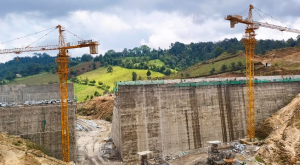
He, however, expressed concern over the pace of construction, particularly the remaining section of the dam wall.
“I have been shown a very optimistic timeline. I have evaluated the plans, the equipment available on site and the remaining work, especially the approximately 15-metre gap that still requires completion. The contractor must deploy more resources if these timelines are to be achieved,” Mugaa said.
He further directed the implementing agency to ensure the contractor works within a properly resourced programme.
“The agency must ensure the contractor works within the contract and has a well-resourced programme of works. Adequate equipment and manpower must be deployed to actualise the timelines,” he added.
Mugaa said the government was increasingly investing in water harvesting infrastructure due to changing climate patterns.
“Climate patterns have changed drastically over recent years, resulting in unpredictable rainfall. We therefore have a responsibility to harvest and conserve water to support irrigated agriculture and guarantee water security for our people,” he said.
He appealed to residents to remain patient, saying the project was now closer to completion than ever before.
“The commitment is there, the goodwill is there and the work is progressing. I urge residents to be a little more patient because this project is now nearer completion than ever before,” he said.
NWHSA Chief Executive Officer Eng. Julius Mugun said the national government remained fully committed to ensuring the project is completed within the revised timelines.
“The President has prioritised this project and demonstrated that commitment by ensuring adequate funding is allocated to fast-track its completion,” said Mugun.
He admitted the project had taken longer than anticipated but assured residents that only a small portion of work remained.
“Most of the major components, including the treatment works, pipelines and storage tanks, have already been completed. What remains is mainly the concrete embankment of the dam. Once that is done, we expect the project to be fully completed by December and become operational,” he said.
West Pokot Deputy Governor Robert Komolle welcomed the government’s renewed focus on completing the project, saying it would significantly improve access to water and stimulate economic development across the county.
Resident Engineer Tabitha Kimani briefed the Cabinet Secretary on the technical progress of the project, explaining that construction currently stands at 86.7 per cent despite numerous interruptions caused largely by delayed payments, which resulted in repeated suspension of works.
She noted that the prolonged contract extensions had also increased project costs and strained public resources.
Rev. Jackson Alukusia, the County Director for Peace and a resident of the area, thanked the national government for sustaining the project despite the delays.
“On behalf of the community, I thank the Cabinet Secretary for personally coming to inspect the project and for demonstrating the government’s commitment to completing it,” he said.
Alukusia said residents eagerly awaited the commissioning of the dam, noting that reliable water would transform livelihoods in an area that has experienced persistent water shortages.
“The water harvested here will benefit not only communities around the dam but also many other areas that have suffered perennial water scarcity,” he said.
He also appealed to the National Water Harvesting and Storage Authority to fulfil the corporate social responsibility commitments made to the host community.
“We request the implementing agency to honour the promised CSR projects, including roads, a school and a dispensary, so that the host community also benefits directly from this national investment,” he said.
The Muruny (Siyoi) Dam lies within the Rift Valley drainage basin and is fed by River Muruny, which originates from the Cherangany Hills before draining into Lake Turkana. Upon completion, it is expected to become one of the largest water infrastructure projects in the North Rift region, supporting domestic water supply, agriculture, livestock production and socio-economic development across West Pokot County.
By Parklea Ivor