In the bustling, often overlooked corners of Oyugis town in Homa Bay County, specifically in the densely populated informal settlement known as A Thousand Streets, stories of hardship are abounding. But stories of transformation like Lucy Achieng’s stand out as powerful reminders of hope and change.
At 27, Lucy is a mother of three. Today, she is a growing entrepreneur, a responsible parent, and a woman reclaiming her dignity. But her journey has been anything but easy. “I was not the person I am today,” Lucy says, her voice calm but heavy with memory.
“There was a time my children feared me. I could not take care of them, and I did not care about my home.”
Before her transformation, Lucy struggled with alcohol abuse. Her life was unstable, marked by neglect of her responsibilities and frequent conflict within her household.
Her behavior became so reckless that she was considered unsafe to be around her own children. “I was completely lost,” she admits. “I had no direction. I was not a mother, not a wife. I was just surviving each day without thinking about tomorrow.”
Her turning point came when she enrolled in a social-emotional skills training programme targeting youth and young adults in informal settlements. At first, she joined without fully understanding its impact, but the experience would soon reshape her life.
“The training opened my eyes,” Lucy explains. “I learned how to manage my emotions, how to communicate with people, and how to make better choices for my life.”
Alongside emotional and social skills, Lucy gained practical knowledge in business management and financial literacy. For the first time, she began saving money, something she had never imagined possible before.
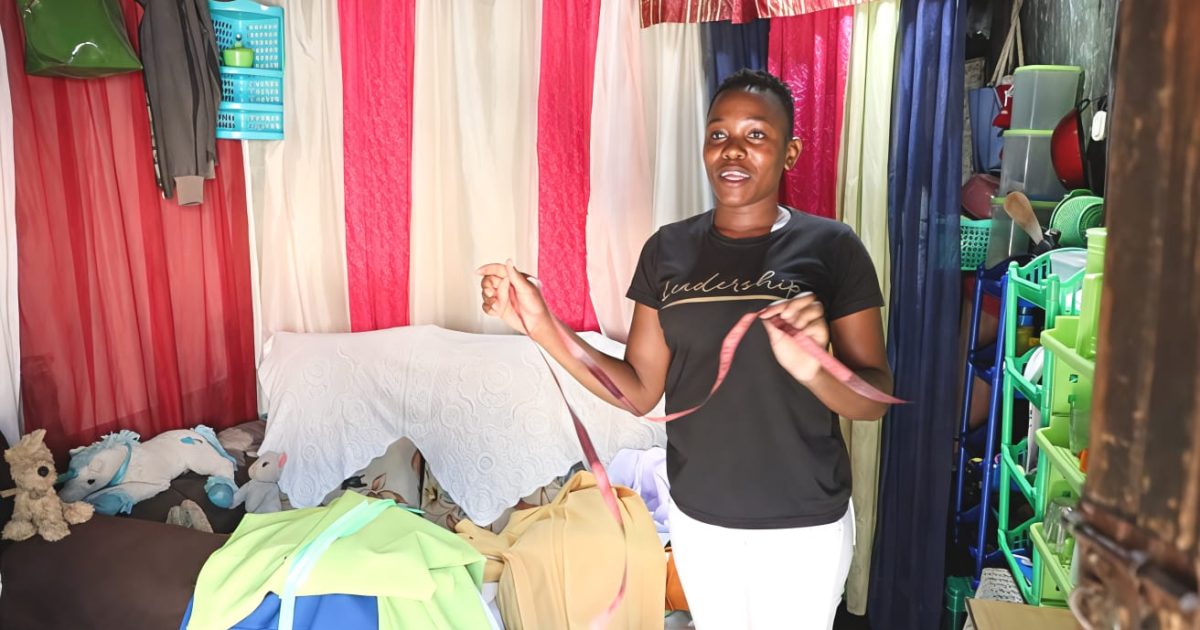
“I started saving little by little,” she recalls. “It was not easy, but I stayed consistent. And one day, I realized I had enough to invest in myself.” With her savings, Lucy purchased a second-hand sewing machine and started a tailoring business. Today, that small step has grown into a promising source of income.
Currently, she is designing church garments for members of the Legio Maria faith, a niche that is helping her business steadily grow.
“I feel proud when I see people wearing clothes I have made,” she says with a smile. “It gives me confidence and hope that I can go even further.”
Her improved financial stability has transformed her household. Lucy now budgets her income, supports her family, and maintains a stable and peaceful home environment. Her relationships with her husband, her children, and her customers have significantly improved.
“I can now sit with my children, guide them, and show them love,” she says. “I speak well with my husband, and I treat my customers with respect. People trust me again.”
Despite her progress, Lucy remains focused on the future. She dreams of advancing her skills and expanding her business.
“If I get the opportunity, I would like to join a TVET institution,” she says. “I want to improve my tailoring skills and become a professional fashion designer. I also hope to buy a new sewing machine to make my work easier and faster.”
Lucy’s journey from despair to determination is a powerful testament to what can happen when opportunity meets willingness to change. In a place like A Thousand Streets, where challenges are many, her story shines as a beacon of possibility.
“I am still growing,” she reflects. “But I am no longer the woman I used to be. I have hope now. I have a purpose.”
And for Lucy Achieng, that purpose is stitched into every piece of fabric she creates and every step she takes toward a better future.
Lucy’s transformation is one of many stories emerging from the Social Emotional Skills Training (SEST) programme implemented under the Second Kenya Informal Settlements Improvement Project (KISIP II) through the National Youth Opportunities Towards Advancement (NYOTA).
The programme, implemented under the project’s Socio-Economic Inclusion component, is designed to equip young people and vulnerable residents of informal settlements with life skills, financial literacy, entrepreneurship knowledge, and emotional resilience, empowering them to overcome social and economic challenges and build sustainable livelihoods.
Beyond transforming individual lives, KISIP II is reshaping informal settlements across Homa Bay County through strategic infrastructure investments.
The project is upgrading roads to bitumen standards, constructing drainage systems, vending platforms, ablution blocks and children’s playgrounds, while also installing street lighting and solar high-mast lights to improve security and economic activity.
These interventions are being implemented across A Thousand Streets in Oyugis, as well as Nyandiwa, Rusinga Old Town, Sofia, Shauri Yako, and Makongeni informal settlements.
The project’s impact extends beyond physical infrastructure. Through its Land Tenure Regularization component, KISIP II has supported residents of Kendu Bay, Kijijini, and Ndhiwa informal settlements to obtain lease titles, providing long-awaited security of tenure.
With formal ownership documents, beneficiaries can now use their properties as collateral to access credit, unlocking new opportunities for investment, business growth, and improved livelihoods.
KISIP II is implemented by the County Government of Homa Bay in partnership with the national government, with support from development partners including the World Bank, the European Union, and the Agence Française de Développement (AFD).
Through its integrated approach of combining infrastructure development, socio-economic empowerment, and land tenure security, the project is not only transforming settlements but also restoring dignity, creating opportunity, and enabling stories of hope like Lucy Achieng’s to flourish.
By Davis Langat