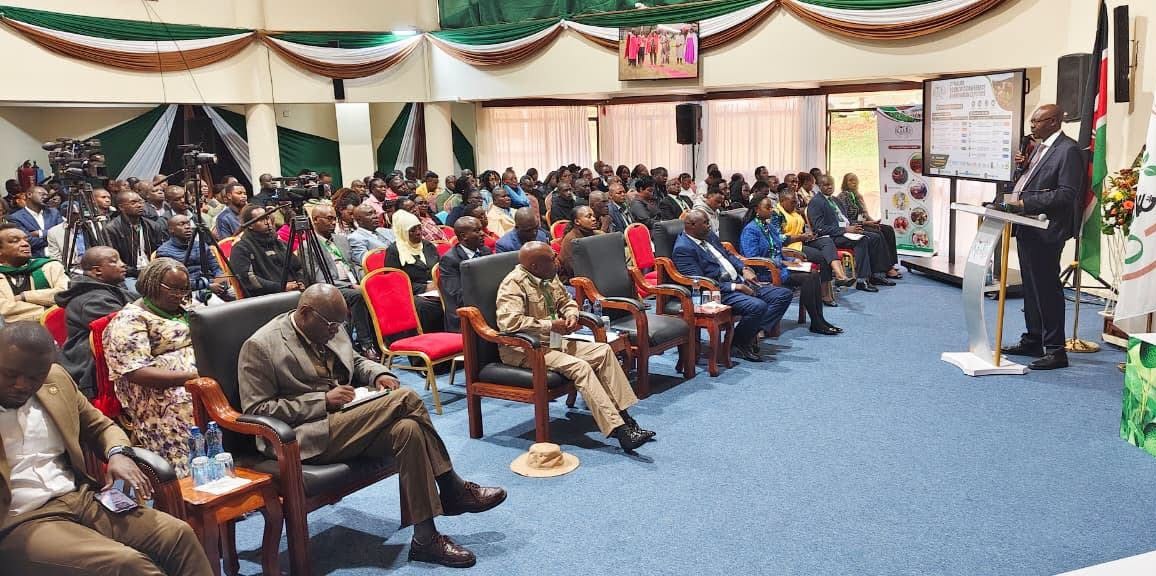
The Kenya National Chamber of Commerce and Industry (KNCCI) has called for accelerated commercialization of agriculture and stronger adoption of technology to boost productivity, value addition and export competitiveness.
Speaking during the Kenya Agricultural and Livestock Research Organization (KALRO) Scientific Conference and Innovation Expo 2026, KNCCI President Dr. Erick Rutto said many smallholder farmers are still not benefiting from available modern technologies despite agriculture contributing about 22.47 percent of GDP and accounting for nearly 65 percent of export earnings.
He said innovations such as precision farming, automated irrigation systems, and digital monitoring tools are already transforming large-scale production but have yet to be widely adopted by smallholders.

“Technology and commercialization must go hand in hand if we are to transform agriculture into a true engine of economic growth,” Dr. Rutto said, calling for greater mechanization and investment in climate-smart agriculture, particularly in Arid and Semi-Arid Lands (ASALs).
He also urged the government to maintain tax incentives on agricultural inputs and clean energy technologies, warning that higher taxation could discourage investment in the sector.
Dr. Rutto outlined a transformation agenda focused on value addition and agro-processing, agribusiness skills development, enhanced technology transfer through international partnerships, and stronger cooperative models to enable farmers to access modern equipment.
At the same time, KNCCI and KALRO pledged closer collaboration to bridge the gap between research and industry, ensuring innovations are effectively commercialized and reach both local and international markets.
Dr. Rutto said KNCCI’s nationwide network of 47 county chambers and more than 60,000 members positions it to connect researchers with markets, noting that about 80 percent of the chamber’s 1,500 active exporters operate in the agricultural sector.
He also cited Kenya’s success in tea and horticultural exports as evidence of the role of research in driving competitiveness but warned that limited value addition continues to constrain earnings.
“Although tea generates about Sh187 billion annually, nearly 95 percent is exported in raw form.
There is significant opportunity to move into value-added tea products and other agro-based industries if research is effectively linked to markets,” he said.
Dr. Rutto also highlighted emerging opportunities in livestock exports, noting strong demand from Gulf Cooperation Council (GCC) countries, which import about 90 percent of their meat requirements and face an estimated 20 percent supply gap.
He said Kenya, however, must address challenges related to production volumes, quality standards, and consistency to fully tap into these markets.
“We are seeing international demand for livestock, but local production systems must be strengthened to meet required specifications,” he said.
The KNCCI president further pointed to ongoing initiatives such as the Jiinue Growth Programme, which supports agribusiness financing, and the Climate Smart Dairy Project, which promotes sustainable farming practices and resilience.
He added that recent trade missions to Saudi Arabia and Namibia have opened new opportunities for agricultural exports, investment, and technology transfer.
Dr. Rutto reaffirmed KNCCI’s commitment to working with KALRO and other stakeholders to ensure research translates into commercial opportunities, stronger exports, and improved livelihoods for farmers.
“Kenya must turn its agricultural potential into a highly competitive and commercialized sector that drives long-term economic resilience,” he said.
The 2nd KALRO Scientific Conference & Innovation Expo began on Monday and will end tomorrow. Themed “Innovations for Sustainable Agri-food Systems, Climate Change Resilience, and Improved Livelihoods, the event brought together researchers, farmers, and agribusinesses to showcase breakthroughs in agriculture.
By Wangari Ndirangu