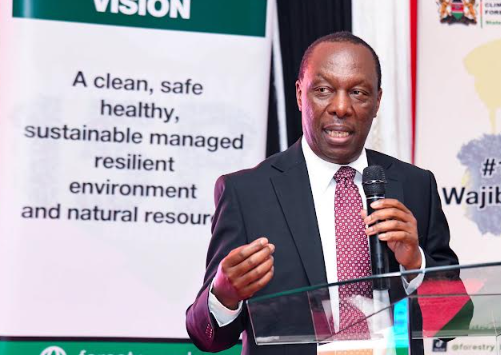
The State Department for Forestry has urged stronger collaboration among government agencies, private investors, development partners, researchers, and communities to unlock bamboo’s potential for climate action, ecosystem restoration, job creation, and green economic growth.
Forestry Principal Secretary (PS) Gitonga Mugambi made the call on Tuesday, August 18, 2026, while presiding over the National Bamboo Stakeholders’ Breakfast Meeting in Nairobi.
He said coordinated investment, research, supportive policies, and market development were critical to building a sustainable and competitive bamboo value chain.
Mugambi said Kenya has more than 130,000 hectares of natural and planted bamboo, which plays an important role in soil stabilisation, erosion control, riverbank protection, and restoration of degraded landscapes.
He added that bamboo’s rapid growth and carbon sequestration capacity make it an important nature-based resource for advancing climate mitigation under the government’s 15 billion Trees Growing Initiative.
The PS also highlighted bamboo’s growing contribution to rural livelihoods and the green economy, citing opportunities in sustainable construction, renewable energy, furniture manufacturing, ecotourism, and value-added processing.
Mugambi said bamboo would support the transformation of Kenya’s industrial wood sector under the Industrial Wood Sector Vision 2050 while creating employment and attracting new investments.
To expand the country’s bamboo resource base, he disclosed that the State Department is targeting an additional 150,000 hectares under the National Bamboo Development Strategy and Action Plan 2025–2035.
The expansion will be complemented by the National Landscape and Ecosystem Restoration Strategy 2023–2032, National Agroforestry Strategy 2025–2035, and National Commercial Forestry Strategy 2025–2035.
Mugambi further announced that preparations are underway for the National Bamboo Expo and World Bamboo Day celebrations, scheduled for September 16–18, 2026, at Meru University of Science and Technology in Meru County.
He said the expo will provide a platform for policy dialogue, technology transfer, research and innovation, trade, investment, and business-to-business engagements to strengthen Kenya’s bamboo value chain.
The meeting brought together stakeholders from government, research institutions, and other sectors involved in bamboo development.
Among those present were Kenya Forestry Research Institute (KEFRI) Chief Executive Officer Dr. Jane Njuguna, Secretary for Forest Development George Tarus, and Secretary for Administration Patrick Meso.
The stakeholders echoed the need to position bamboo as a strategic resource for forest restoration, climate resilience, green employment, and sustainable economic development.
By Michael Omondi