The government will import 25 million 90 kg bags of maize to bridge an anticipated food deficit and protect the country from a possible shortage caused by drought and other climate-related challenges that have affected production in major maize-growing regions.
Agriculture and Livestock Development Cabinet Secretary (CS) Mutahi Kagwe said the government has already put in place arrangements to facilitate the imports, assuring Kenyans that the country has sufficient measures in place to guarantee food security despite the turn of events.
Observers contend the country consumes approximately 75 million bags of maize annually while domestic production is estimated at between 34 to 42 million bags.
However, reduced harvests in several food-producing regions are expected to create a shortfall of nearly 25M bags, prompting the government to intervene through strategic imports to stabilize supplies and protect consumers from potential price fluctuations.
“We will import maize. We have already made arrangements for that. We will manage the country. Our people are not going to go hungry,” said Kagwe.
CS Kagwe noted that while maize imports will provide an immediate solution to the projected shortage, the government is simultaneously implementing long-term interventions aimed at strengthening local food production and reducing the country’s vulnerability to climate change.
He said among the key interventions is the expansion of irrigation projects such as the Galana Kulalu scheme, which is expected to boost agricultural productivity, increase resilience against drought, and reduce dependence on rain-fed farming.
The agriculture CS also said the government will collaborate with the National Treasury to streamline taxes and address bureaucratic challenges affecting farmers and agribusinesses in an effort to make the agricultural sector more competitive and profitable.
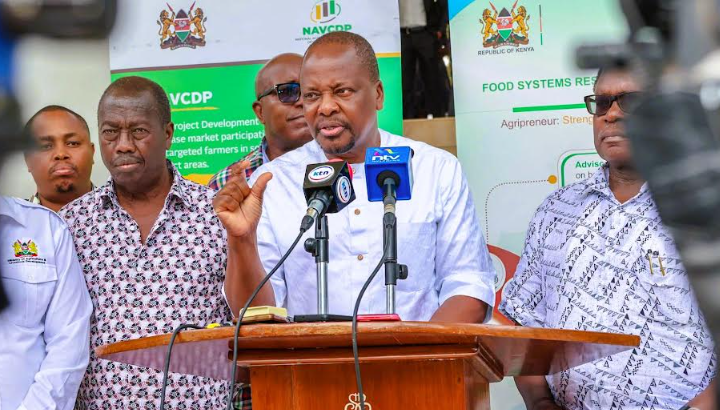
At the same time, youth employment emerged as a key priority during the Fifth Joint Consultative Meeting of County Executive Committee Members (CECMs) in Mombasa, where the Ministry officially launched consultations for the upcoming Agri-Connect Compact Programme.
CS Kagwe said thousands of jobs could be created through the programme as the government seeks to transform agriculture from a subsistence activity into a modern, technology-driven, and commercially viable sector.
The meeting, which brought together leaders from the national government, county governments, and the World Bank Group, reviewed the progress achieved under the Food Systems Resilience Program (FSRP) and the National Agricultural Value Chain Development Project (NAVCDP), both of which will transition into the AgriConnect Compact Programme.
According to Kagwe, the programme will be anchored on three key pillars: increasing agricultural productivity, promoting value addition, and creating sustainable employment opportunities through agribusiness.
He appreciated the commendable progress of both NAVCDP and FSRP towards achieving the project objectives.
“Through the two projects we have reached over 2 million farmers with promising and productivity-improving technologies, and over 1 million farmers are accessing various government services and financial and market linkages through digital platforms. 7.3 M farmers have been registered through Kenya Integrated Agriculture Management Information System (KIAMIS) and are benefiting from digital agricultural advisories services; agronomics, agro-weather, and markets advisories via mobile phone service,” he said.
The CS disclosed that 9770 young agripreneurs, the “Green Army,” have been deployed at the sublocation level to provide extension services to farmers.
He said the young professionals are already conducting farm visits, providing soil testing and soil health services, linking farmers to markets and financial services, and providing livestock vaccination services, thus enriching the delivery of extension services.
The CS also announced that over 20 million livestock have been vaccinated through the government subsidy program costing Sh429 million.
“We are moving closer to reducing disease incidences and strengthening livestock health as we enhance access to global markets. I request counties to intensify investments in livestock feed reserves to avoid the very discouraging cycle of livestock losses,” he noted.
He emphasized that agriculture should no longer be viewed as a last resort for survival but rather as an engine for wealth creation, investment, and job generation, particularly for young people.
“We recently launched the National Agri-food Systems Investment Plan (NASIP 2026-2030), which provides a comprehensive framework to translate the national vision into coordinated action, ensuring that the country’s agri-food sector remains a driver of inclusive growth, food security, and climate resilience,” he said.
The programme will also champion the digitization of agriculture, the adoption of artificial intelligence, and the integration of modern farming technologies to improve productivity and make the sector more attractive to the next generation.
The consultative meeting further provided a platform for stakeholders to share their views and contribute to the development of a roadmap that will guide the implementation of the programme and shape future agricultural policies.
CS Kagwe was accompanied by Dr. Kipronoh Ronoh, the Principal Secretary (PS) for the State Department for Agriculture, Governors Kenneth Lusaka (Bungoma), Benjamin Cheboi (Baringo), Dr. Andrew Mwadime (Taita Taveta), Simon Kachapin (West Pokot), Ali Mohamed (Marsabit), Nathif Jama (Garissa), Amos Nyaribo (Nyamira), and Ochillo Ayacko (Migori) and World Bank Group representative Ghada Elabed.
By Hussein Abdullahi