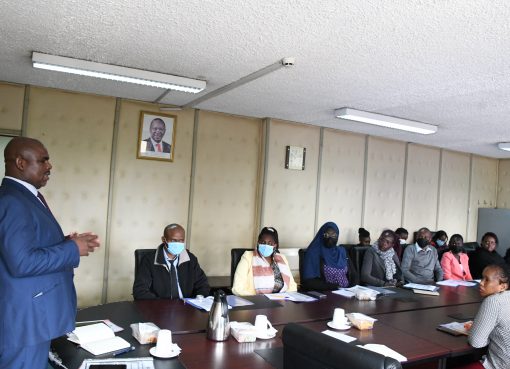
Agriculture Cabinet Secretary Mutahi Kagwe has ordered a nationwide crackdown on illegal and unsafe pesticides, warning that Kenya will not become a dumping ground for products banned in other countries.
Kagwe said the Government would tighten controls at border points and across the domestic market to protect farmers, consumers and the food chain from hazardous chemicals.
“My pronouncement is clear: a pesticide banned anywhere in the world will be banned in Kenya,” Kagwe said.
He added that countries within the East African Community (EAC) should adopt a common position on banned pesticides, with Kenya also pushing for similar harmonisation across the Common Market for Eastern and Southern Africa (COMESA).
The CS said Kenya had a responsibility to protect its population from pesticides associated with serious health risks, particularly where scientific evidence raises concerns about long-term exposure.
The Government’s tough stance comes as the Pest Control Products Board (PCPB) reports a 95 per cent reduction in unauthorised and smuggled pesticides entering the country.
PCPB Chief Executive Fredrick Muchiri told the Senate Standing Committee on Agriculture, Livestock and Fisheries that the regulator had deployed officers to 10 major gazetted border points and ports.
The development marks a significant shift from 2024, when the regulator had no permanent officers stationed at the country’s points of entry.
Enhanced surveillance, including monitoring of porous sections of the Loitoktok border, has helped disrupt routes previously used by pesticide smugglers.
The figures were presented during engagements between the Senate committee and the Ministry of Agriculture and Livestock Development, led by Kagwe, in Malindi.
The crackdown follows a scientific review by PCPB covering 430 end-use pesticide products.
The review resulted in 77 products being withdrawn from the Kenyan market, while 202 products were restricted for use on various crops and 151 others placed under further review.
Kagwe said the measures were necessary to ensure Kenya does not become a destination for pesticides rejected by other jurisdictions.
“We should not be a destination for products that have been rejected elsewhere,” the CS said, arguing that harmonised regulations across the region would prevent banned products from simply being diverted to neighbouring markets.
The enforcement drive has now shifted beyond the borders to agrovet shops and other points of sale.
Kagwe directed PCPB to intensify nationwide inspections to ensure pesticides on the market are properly registered, genuine, compliant with regulations and within their approved shelf life.
Expired, counterfeit, smuggled and unauthorised products found on shelves will be removed, with offenders facing enforcement action.
PCPB is also deploying spectrometer technology to identify counterfeit and non-conforming products, while more than 80 per cent of cases arising from arrests have reportedly been successfully prosecuted.
Enforcement officers are undergoing specialised training at the Directorate of Criminal Investigations Training School to strengthen their capacity in investigations, evidence collection and prosecution.
The pesticide crackdown comes amid growing public concern over reports of pesticide residues in food.
Muchiri cautioned against automatically equating the detection of pesticide residues with unsafe food, saying food safety must be determined against established Maximum Residue Limits (MRLs).
He said about 80 per cent of reported samples met the required standards, while all samples assessed against applicable MRLs were within prescribed safety limits.
Muchiri also urged researchers to consult regulatory agencies before publishing findings that could unnecessarily alarm consumers, hurt farmers or damage Kenya’s agricultural exports.
Senators, led by Agriculture Committee chairperson David Wakoli, called for clearer and more accessible information on banned, restricted and authorised pesticides to reach farmers.
In response, PCPB has begun training county agricultural extension officers on pesticide regulation, identification of illegal products, responsible pesticide use and food-safety requirements.
The extension officers are expected to serve as a critical link between the regulator and farmers by providing information at the grassroots.
Despite the progress, Muchiri said funding and staffing remained major challenges for the regulator.
PCPB’s Exchequer allocation has increased from about Sh114 million in 2024 to Sh216 million in the current financial year, while its approved staff establishment has expanded from approximately 60 to 275 positions.
The Board is seeking about Sh350 million in additional Exchequer support to recruit and deploy more personnel and strengthen border surveillance, agrovet inspections and enforcement.
The Government is now expected to sustain the gains made at the borders while widening inspections of agrovet outlets and intensifying farmer awareness campaigns.
Kenya will also push for common pesticide-control measures across the EAC and COMESA, in a bid to close regional loopholes that allow prohibited products to move from one market to another.
The measures are intended to strengthen pesticide safety, protect consumers and farmers, safeguard Kenya’s food supply and preserve the country’s agricultural export markets.
By Joseph Ng’ang’a