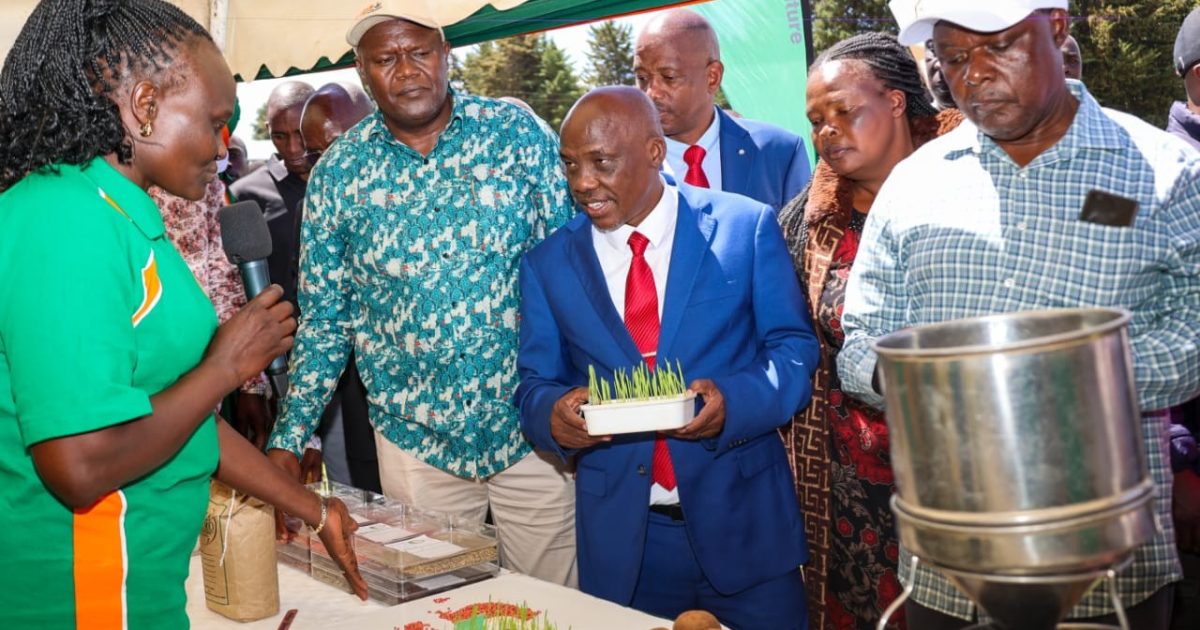
The Government will transform the Kenya Agricultural and Livestock Research Organization (KALRO) Marindas Centre in Kuresoi North, Nakuru County, into a potato seed production, research and farmer training hub to address the shortage of certified seed.
Principal Secretary, State Department for Agriculture, Dr. Kiprono Ronoh, said the Government would work with KALRO to transform the 600-acre facility into a centre of excellence for certified potato seed production, agricultural research and farmer training.
Ronoh said inadequate access to certified seed remained one of the major constraints to potato production in the country, noting that KALRO currently meets only about one per cent of the national demand.
“We still have a huge demand for potato seeds to be produced,” he said during the commissioning of the KALRO-Marindas Seed Potato Centre.
The PS said Nakuru was strategically placed to lead the transformation of the potato value chain due to its favourable soils and climate, as well as its long history of potato production.
He said the investment in Marindas was part of the Government’s broader plan to revitalise 15 priority agricultural value chains, increase productivity and raise farmers’ incomes.
According to KALRO Director General Dr. Patrick Ketiem, Kenya requires about 150,000 tonnes of certified potato seed annually but produces only about 24,000 tonnes, leaving a deficit of 126,000 tonnes.
Ketiem said the shortage had forced many farmers to recycle seed from previous harvests, increasing the risk of pests and diseases while compromising yields and farmers’ incomes.
“KALRO’s vision is to use this land to produce certified seed for farmers,” said Ketiem.
He said the 630-acre Marindas facility would have about 300 acres under rotational production each season to minimise the build-up of soil-borne pests and diseases while ensuring a steady supply of clean planting material.
Farmers in Kuresoi, Molo, Njoro and other parts of Nakuru County are expected to benefit from improved access to certified seed at affordable prices once the facility becomes fully operational.
Ketiem said KALRO would require increased investment in water, irrigation, mechanisation, seed storage and cold-room facilities to enable Marindas to produce certified seed on a large scale.
The DG said KALRO’s potato research centre at Tigoni had already developed high-yielding and disease-resistant varieties, including Unica, Wanjiku, Nyota, Chulu and Lenana, with yield potential of up to 40 tonnes per hectare. He appealed to partners and stakeholders to support investment in the facility.
He said the Marindas facility would complement the research work and ensure improved technologies and planting materials reached farmers more efficiently.
The centre will also undertake research and production activities in livestock, including sheep and dairy cattle, while providing a national platform for farmer training on modern agricultural technologies and production practices.
Meanwhile, PS Ronoh directed KALRO, the Nakuru County Government and administration to safeguard Government land at Marindas against encroachment.
He said individuals occupying sections of the land had been directed to vacate to allow the Government to fence and develop the facility.
“I have given notice to all the individuals who have, in one way or another, occupied some part of this Government land to immediately move out,” said Ronoh.
The Government plans to establish a multipurpose agricultural centre at Marindas to support fertilizer distribution, value addition and processing of agricultural commodities, including potatoes, coffee and avocado.
Dr. Juma Mukhwana, PS, State Department for Industry, said his department would work with relevant partners to establish a value-addition centre or small processing factory at the facility.
He added that the Government was also constructing a county aggregation and industrial park at Egerton University in Njoro, which was about 70 per cent complete, as it sought to move industrialisation closer to agricultural producers so that farmers could benefit from value addition instead of selling raw produce.
PS Mukhwana urged farmers and private investors to explore opportunities in small-scale manufacturing, including yoghurt and potato processing, saying the Government’s role was to create a conducive policy and regulatory environment for businesses to thrive.
“We want to encourage people to take good products, put them in the machine, and make goods that we can sell to East Africa, West Africa, Africa, and the rest of the world,” he said.
Meanwhile, Kuresoi North MP Alfred Mutai welcomed the revival and upgrading of the Marindas facility, saying it would ease farmers’ access to certified potato seed and strengthen agricultural training in the constituency.
Mutai said the facility’s performance had declined in recent years following the suspension of potato seed production, forcing farmers to travel as far as Meru to obtain certified seed.
“This is a relief to farmers in this area because we will no longer have to travel as far as Meru to acquire certified potato seed,” he said, expressing optimism that locally produced certified seed would be available to farmers within the next three months.
The MP also welcomed plans to turn Marindas into a farmers’ training centre, saying farmers would be equipped with practical knowledge to improve productivity.
“Farmers have been doing farming through guesswork. Turning this facility into a training centre will enable them to farm based on knowledge,” he said.
Mutai further urged farmers to adopt certified seed and called for their continued involvement in the management of the facility.
He commended the local community for protecting the Marindas farm over the years and said the 600-acre facility had significant potential to contribute to food security and employment if fully utilised.
The development of Marindas is expected to strengthen certified potato seed multiplication, agricultural research, farmer training and value addition, positioning Nakuru as a major hub for Kenya’s potato industry.
By Wangari Ndirangu