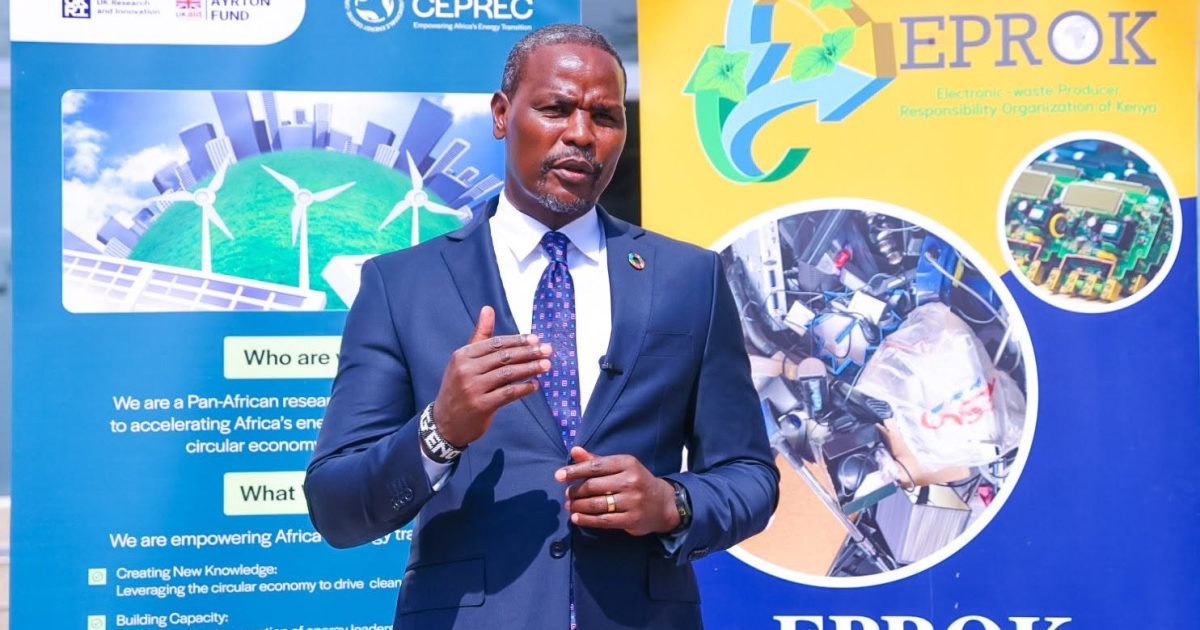
Kenya is stepping up efforts to promote circular innovation in the clean energy sector as the country seeks to address the growing challenge of electronic and renewable energy waste.
Principal Secretary for Environment and Climate Change, Dr. Eng. Festus Ng’eno said Africa’s transition to clean energy must go beyond the installation and deployment of renewable energy technologies to include responsible management of equipment at the end of its useful life.
Dr. Ng’eno spoke on Monday at Strathmore University during the CEPREC Kenya International Summit 2026, which brought together researchers, innovators, policymakers, industry leaders and development partners from Africa and beyond.
The summit was held under the theme, “Sustainable Futures Reimagined: Sustaining Africa’s Clean Energy System through Circular Innovation, Inclusion and Impact.”
The PS said the rapid expansion of clean energy technologies presented both opportunities and challenges, particularly in the management of discarded solar panels, electric vehicle batteries, power electronics and other equipment.
He said circular innovation would be critical in ensuring that the transition to clean energy does not create a new environmental burden.
“Kenya generated an estimated 56,000 tonnes of electrical and electronic waste in 2025, with volumes increasing annually,” Dr. Ng’eno said, noting that the growing waste stream could also provide opportunities for economic development.
He said valuable materials could be recovered from discarded equipment while creating jobs and new industries through reuse, repair, refurbishment, remanufacturing and recycling.
According to the PS, the Government has continued to strengthen the policy and regulatory framework governing sustainable waste management.
Among the measures are the Sustainable Waste Management Act, the Climate Change Act and the Extended Producer Responsibility Regulations.
The policies seek to shift the country’s approach to waste management from treating waste primarily as a disposal problem to recognising it as a resource for which producers and other stakeholders have responsibility.
Dr. Ng’eno called on stakeholders to embrace their role in promoting sustainable energy practices and responsible consumption.
He urged individuals, institutions, businesses and communities to raise awareness and encourage responsible energy choices as Kenya accelerates its transition towards cleaner energy.
The PS said collaboration among governments, researchers, innovators, industry and development partners would be essential in developing solutions that combine clean energy expansion with environmental sustainability and economic inclusion.
The summit provided a platform for stakeholders to explore innovative approaches to sustaining Africa’s clean energy systems while maximising the economic and environmental benefits of circularity.
By Joseph Ng’ang’a