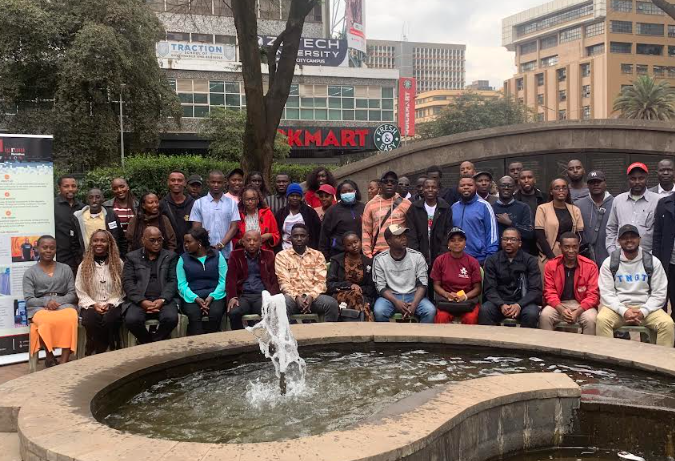
Refugees living in Nairobi have been tipped on digital security and data privacy during a one-day training which equipped them with the necessary skills and agility to safely navigate digital and physical interactions, especially now that tough immigration tensions have continued to escalate in Kenya.
The workshop, held at the August 7th Memorial Park in Nairobi and organized by Migrant Narratives Africa in partnership with the European Union through DW Akademie under the TrustLab Kenya Project, was aimed at equipping refugee communities with practical tools to protect their personal information and digital identities.
The training comes at a time when undocumented migrants face heightened scrutiny, following government directives ordering foreign traders to close businesses and regularize their status within 90 days.
Reports of harassment, profiling, and exploitation have increased, particularly among Burundian and Congolese traders. Against this backdrop, the session sought to empower refugees with knowledge to safeguard their data and avoid falling victim to scams, extortion, or digital manipulation.
Dr. Michael Waema Kimwele, a senior lecturer at the Jomo Kenyatta University of Agriculture and Technology, during the digital security session, emphasized that for vulnerable communities, a compromised phone or account can have consequences far beyond financial loss.
“It is about protecting relationships, privacy, and dignity,” he told participants. His session covered device protection, account security, and human behavior, highlighting the importance of strong passwords, multi-factor authentication, and cautious online practices.
Refugees were introduced to password managers, secure messaging apps, and the STOP protocol—Stop, Think, Observe, Proceed—as a way to respond safely to suspicious digital interactions.
Diana Kemunto Nyarang’o, an advocate of the High Court and data protection officer, delivered the data privacy component.
She explained the rights refugees hold under Kenyan law, including the right to be informed, to access and correct data, to object to processing, and to request deletion.
“You do not lose your rights because you are a migrant,” she stressed.
Her session focused on practical scenarios, such as how to respond when asked to share documents in public queues, how to protect sensitive information on WhatsApp, and how to verify the identity of officials or aid workers, before handing over personal details.
The training also addressed gender-specific risks. Refugee women, who often disclose sensitive personal details to access aid or healthcare, were cautioned about the dangers of mishandled information.
Trainers highlighted community-based, women-led approaches to data protection as effective strategies for safeguarding vulnerable groups.
Participants were also guided through emergency protocols for digital crises, including steps to take if a phone is lost or stolen, if a messaging account is compromised, or if a suspicious link is clicked.
Refugees were taught to lock devices remotely, revoke sessions, change passwords, and report thefts through appropriate channels.
They were also advised on how to respond to online harassment, including documenting evidence, blocking attackers, and seeking legal support.
The training included the development of personal digital security action plans. Each participant was asked to identify their most important account and device, commit to protecting them with strong passwords and multi-factor authentication, and adopt at least one new privacy habit.
The trainers reinforced ten golden rules of digital security, including locking devices, enabling MFA, keeping systems updated, thinking carefully before sharing information, and having a plan for emergencies.
The TrustLab Kenya Project, under which the training was conducted, is part of a wider EU-funded initiative to strengthen digital democracy in Kenya.
It equips civil society and media organizations with tools to combat digital threats, misinformation, and online violence.
DW Akademie’s representative, Rose Mwangi, present in the training, urged the trainees to be ambassadors to other refugee communities.
“Now that you are receiving this training, we call upon you to be our ambassadors to other refugee communities. Share this knowledge, training materials, and tools that you are getting from here to also help them protect themselves,” rallied Mwangi.
The session provided not only technical skills but also reassurance that their rights and dignity matter in the digital space. As one participant noted, “We are often told to register, to share, to give our details, but no one tells us how to protect ourselves. Today, we learned that our data is our identity, and it is our responsibility.”
The training ended with a call for continued vigilance and community solidarity.
Migrant Narratives Africa is a digital publication using multimedia journalism to provide a platform for the migrant community to tell their own stories while covering migration news across Africa.
It has also partnered with the European Union represented by DW Akademie to undertake a project safeguarding refugee private data in Nairobi, Kenya, while connecting them to organizations that provide legitimate work and scholarship opportunities, as well as legitimate relocation programs, while preserving their data.
By Michael Omondi