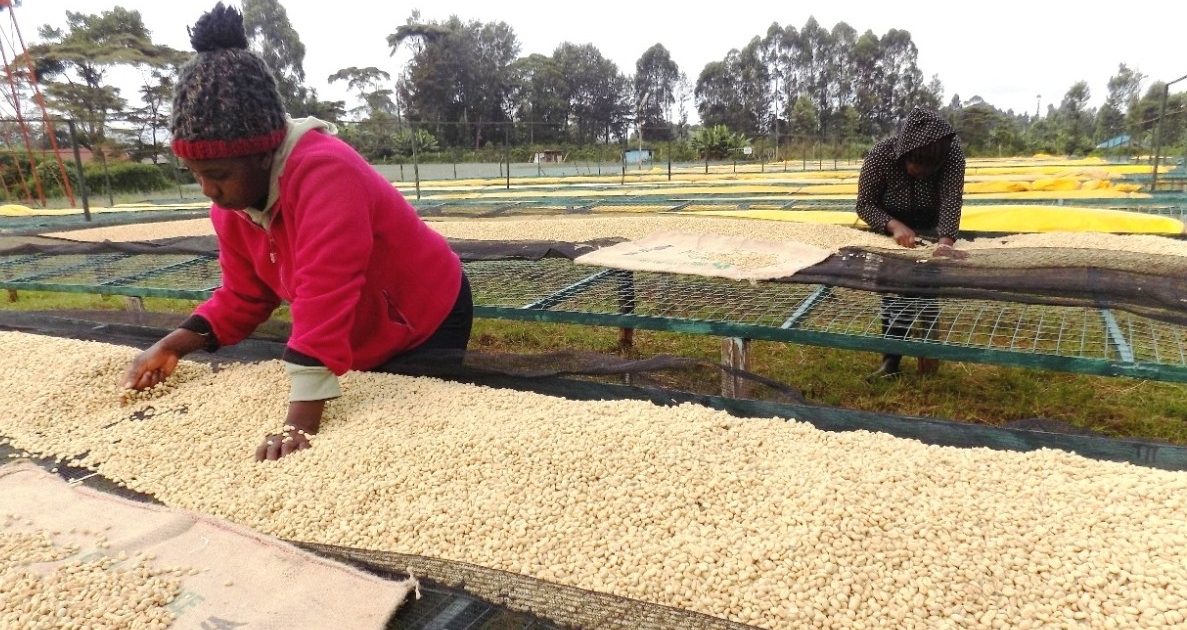
Coffee prices at the Nairobi Coffee Exchange (NCE) softened in Sale 40 of the 2025/26 coffee year, with 17,013 bags of clean coffee fetching Sh860 million at Tuesday’s auction.
The coffee weighed 1,050,107 kilogrammes, translating to an average price of Sh40,931 per 50-kilogramme bag or about Sh819 per kilogramme of clean coffee.
At the farm level, the average translates to approximately Sh126 per kilogramme of cherry before milling; marketing costs, levies, and cooperative society deductions are taken into account.
The top price was achieved by Kikima Farmers’ Cooperative Society’s Mulima Factory, whose 66 bags of AB grade, brokered by New Kenya Planters’ Cooperative Union (New KPCU), sold at Sh52,848 per 50-kilogramme bag.
Kikima’s Kyuu Factory followed closely, with 73 bags fetching Sh50,646 per bag through Kenyacof LTD.
A four-bag lot of Rainforest Alliance-certified AA coffee from Kiandu shared the second-highest price after selling at Sh50,646 per bag.
Thiririka Farmers’ Cooperative Society also recorded a strong performance, with six bags selling at Sh50,510 each, while Sorwot coffee fetched Sh50,387 per bag for its 29-bag lot.
New KPCU dominated trading among brokers, handling 5,804 bags, equivalent to 34 percent of the day’s total volume, and earning Sh299 million.
Alliance Berries was second with 2,247 bags worth Sh113 million, followed by KCCE with 1,537 bags valued at Sh73.6 million.
Kipkelion Limited traded 1,523 bags for Sh84 million, while Kirinyaga Slopes Coffee Brokerage Company sold 1,139 bags worth Sh53 million.
Smaller catalogues recorded some of the stronger average returns. Mt. Elgon sold 911 bags for Sh51.6 million, while Caffora Coffee Company traded 712 bags valued at Sh38.9 million. Coffee Estates Bourgeoisie Brokers sold 889 bags for Sh38.5 million.
On the buyers’ side, demand remained highly concentrated among a few firms, with Ibero Kenya taking the largest share at 3,859 bags, representing 23 percent of the total volume sold.
C. Dorman SEZ accounted for 18 percent, while Global Mark Foods bought 15 percent. Kenyacof took nine percent, Sasini eight percent, and Mumbi Coffee Merchants six percent.
The six buyers collectively absorbed 79 percent of the coffee traded during the sale, underscoring the significant influence of major buyers on the auction.
AB remained the dominant grade, accounting for 41 percent of the bags sold. C grade followed at 22 percent, while AA represented 13 percent. Combined, the three grades accounted for 76 percent of the total volume traded.
The performance comes as Kenya continues to position its auction system and reforms in the coffee value chain around improving returns to farmers, strengthening market access and enhancing the quality and traceability of Kenyan coffee.
Kenya’s coffee sector remains an important source of foreign exchange and livelihood for thousands of smallholder farmers, with auction prices influenced by coffee quality, global demand, production volumes and prevailing international market conditions.
By Bernard Munyao