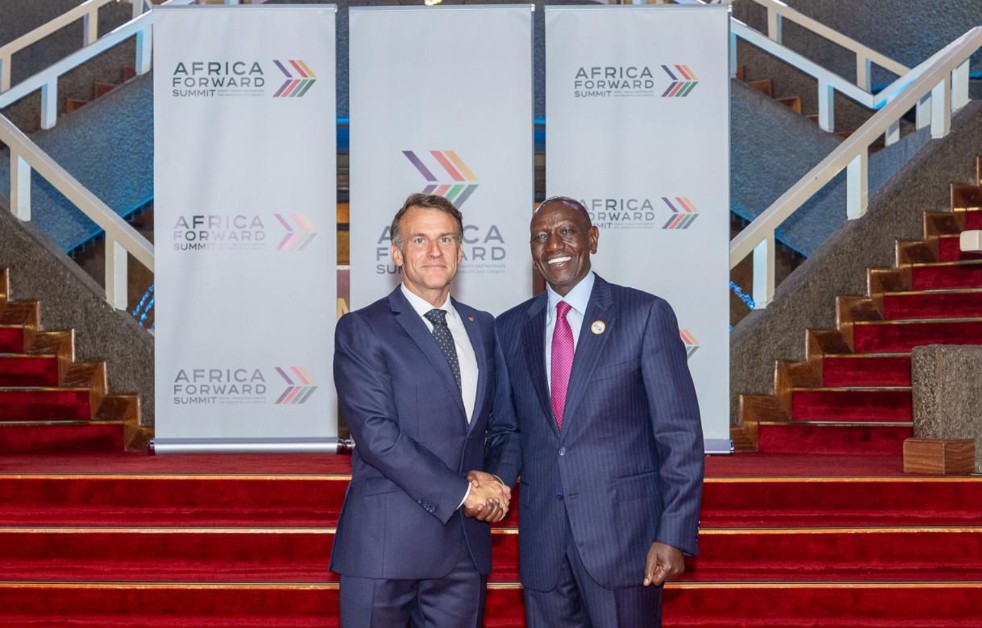
In an effort to fulfill commitment and strengthen partnerships at the Africa Forward Summit, Heads of State from France and African countries convened a high-level meeting alongside senior representatives from key global financial institutions at the Kenyatta International Convention Centre (KICC) in Nairobi.
The leaders adopted a comprehensive joint structure built around three key pillars: Building a Partnership of Equals, Reforming Development Cooperation and Mobilising More Capital for Africa.
The global financial institutions present in the meeting included the International Monetary Fund (IMF), the World Bank Group, the African Development Bank Group (AfDB), the European Bank for Reconstruction and Development (EBRD), the European Investment Bank (EIB), the Green Climate Fund (GCF), the West African Development Bank (BOAD) and other development actors such as the Agence Française de Développement group (AFD) and the Pact for Prosperity, People and the Planet (4P).
On building a Partnership of Equals, global leaders said mutual relations are now more important than ever, calling for stronger collective resilience. They cited the ongoing conflict in the Middle East, noting that its consequences have extended far beyond the region.
“We acknowledge the destabilizing effects of the conflict on the global economy, its financial stability, and very especially on global energy markets, which have driven up costs for African economies and disrupted agricultural inputs, compounding existing vulnerabilities in food security across the continent,” it was noted.
They stated that going forward, France and Europe trade and economic relations with Africa will remain a source of collective stability and shared prosperity.
They strongly emphasized that the future of Africa’s development lies in a partnership of equals serving mutual interests and shared prosperity.
While reaffirming that Official Development Assistance (ODA) remains a critical component of international support, leaders said that development cooperation should be aligned with nationally determined priorities and development strategies, as well as country ownership principles.
“We therefore commit to advancing a renewed approach of international partnerships, moving towards mutually beneficial partnerships based on shared priorities; co-creation and co-investment,” the leaders agreed.
They said the partnership should integrate the specific challenges of the poorest and the most vulnerable African partners that are exposed to external shocks, constrained fiscal space, geographic remoteness, limited access to capital markets and conflict-affected contexts.
On unlocking more capital for Africa, the leaders affirmed the need for coordinated and decisive action at the global, regional and national levels.
“We reaffirm our shared commitment to accelerating sustainable development, economic transformation and the fight against climate change and its consequences in Africa, leaving no one behind,” they stated.
The international development cooperation landscape is at a decisive moment, marked by increased fragmentation, a historic contraction of public resources, and pressing global challenges.
In response, the leaders recognised that Official Development Assistance (ODA) must be complemented by a renewed commitment to international development cooperation, based on mutually beneficial partnerships, and shift away from a traditional aid-based paradigm.
“We reaffirm the importance of concessional financing, which is essential for funding solidarity policies and meeting basic needs in the most vulnerable contexts, and our support for ODA, which remains a key metric of donors’ budgetary efforts and concessional support. We, however, acknowledge the importance of mobilising private capital has become even more crucial and that ODA does not capture the full spectrum of financial flows contributing to development in partner countries,” said the head of states.
They said partnerships must contribute to mobilising all forms of development finance, international and domestic, public and private, including innovative sources to increase self-resilience and sovereignty, based on partners’ ownership and at a scale commensurate with the continent’s needs.
To deliver and address growing needs, the leaders said they needed a more efficient, resilient and inclusive financial architecture for Africa, one that relies on a broader donor base, concentrates concessional resources where they are most needed, and better aligns all forms of financial flows with sustainable development goals.
They also emphasized the importance of a predictable international economic, trade and financial environment in supporting investor confidence and enabling investment at scale.
They said strengthening public domestic resource mobilization (DRM) was an essential target to finance sustainable development, improve the business climate and build trust.
“We acknowledge that improving DRM should not only target stronger public revenue collection on current formal economic actors but also contribute to broadening the tax base by a reduction of the informal sector, enhancing the use of digitalisation and technology to boost collection and ease procedures and tax administration in order to fight against tax evasion and illicit financial flows.
Meeting such preconditions is not sufficient, and the continent faces a specific constraint on allocation and pricing of risk. In order to overcome this challenge, strategic actions will be required in several key areas,” they stated.
The forum pointed out that fragmentation and competition between institutions was detrimental to an efficient architecture for development financing and called on all actors to work as a system and ensure possible streamlining, interoperability and simplification of procedures.
The last point on the agenda was advancing the new African financial architecture, where leaders underscored the need for African countries to improve access to guarantee schemes, concessional financing and long-term investment.
The leaders commended the role of the International Monetary Fund (IMF) in Africa and welcomed the World Bank Group to continue focusing on job creation for Africa by enabling infrastructure; supporting business-ready policies; and mobilising private sector capital, in particular in critical sectors such as energy and infrastructure, agribusiness, healthcare, tourism, and value-added manufacturing.
“We welcome ongoing sector-specific partnerships such as Mission 300 (M300), AgriConnect and the Africa Initiative for Medical Access and Manufacturing (AIM2030), as well as the support to local entrepreneurs throughout Africa with the expansion of local champions’ initiatives.
They further invited the African Development Bank Group (AfDB) to advance the New African Financial Architecture for Development together with other development partners.
“We welcome a number of other initiatives undertaken to strengthen financing for Africa, including the following: a call for the AfDB to increase its involvement, cooperation and synergies with the African Trade and Development Insurance (ATIDI); further involvement of regional and non-regional partners to reinforce the balance sheet of ATIDI, such as the support of the EIB to expand African countries’ membership in ATIDI for instance,” they proposed.
By Ian Chepkuto