Restoring trust in global institutions requires confronting massive delivery gaps and ensuring that Africa is recognised as an equal co-architect of the multilateral system, UN Under-Secretary-General and Special Adviser on Africa Ahunna Eziakonwa has said.
Delivering the keynote address on ‘The post-UNGA 81 Opportunity and the UN’s Trust Agenda’ in Nairobi, Eziakonwa emphasised that international cooperation must move beyond rhetoric.
“Trust is not given; it is earned,” Eziakonwa pronounced during the Pre-Summit Leadership Breakfast for The Trust Summit: Nairobi Dialogue on Global Trust.
“If trust is earned, the ultimate test is what we deliver, and we must be honest about what stands in our way,” she added.
Further, Eziakonwa pointed out that international climate and development commitments face profound delivery gaps, while the continent remains under-represented in global decision-making.
Urging African nations to leverage their strengths, she added, “Africa is not waiting to be rescued. International diplomacy has become highly transactional, and Africa must act with full awareness of its strength—its youth, resources, markets, and ideas.”
Notably, the high-level engagement served as a vital precursor to the upcoming Trust Summit 2026, scheduled for October 21–23, 2026, bringing together senior government officials, diplomatic missions, development partners, and co-conveners.
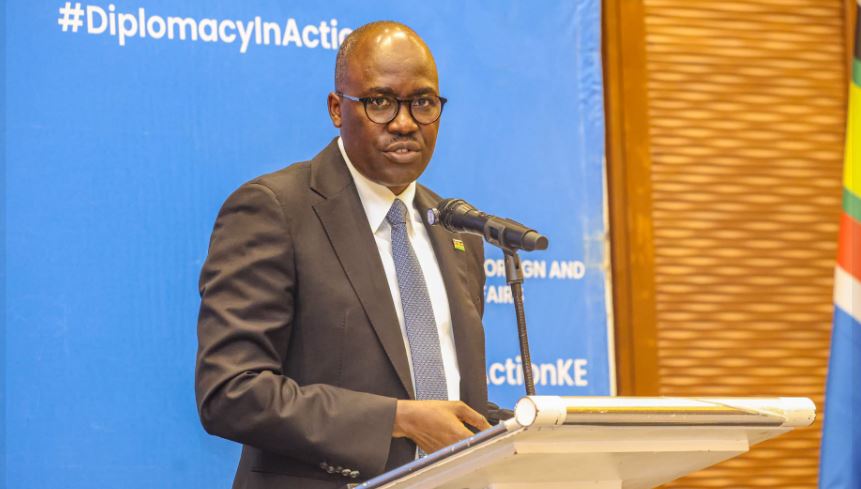
Highlighting historical inequities in international governance during his opening remarks on ‘Kenya’s Vision for a Trust Agenda in Diplomacy’, Principal Secretary (PS) for Foreign Affairs Dr Korir Sing’Oei noted that post-WWII frameworks and Bretton Woods institutions have left Africa vulnerable and under-represented.
“Excellencies, ladies and gentlemen, we have a political juncture both on the political side and also on the financing side. This political juncture compels us to ask difficult questions. And one of those questions is, shall we just remain on this road, the path where we meet and the path where we travel? Which suggests to us that given the changing threat landscape, given the new challenges that confront us, we will surely lead us to peril,” posed Dr Sing’Oei.
He added, “Or, we can choose to reform these institutions so that they can respond to the present reality, including ensuring that they are more globally sound and equitably represented in these institutions. Because without doing that, not only will the limited trust that remains with respect to natural resources falter, but who will be able to sustain the global order as we do it?”
Opening the dialogue, Trust Summit Chief Executive Officer (CEO) Awel Uwihanganye underscored global research indicating that less than 50 per cent of citizens trust public institutions.
He also highlighted the disruptive impact of digital technology, remarking, “The information integrity in the age of technology has become a big challenge. What you see is not always the case… we need to show how we can build a network instead of causing chaos and confusion in our countries.”
Equally, the event featured an interactive panel session moderated by Africa Leadership and Dialogue Institute (ALADI) CEO Julie Gichuru, alongside Principal Secretary Dr. Korir Sing’Oei and UN Under-Secretary-General Ahunna Eziakonwa, exploring multi-dimensional strategies to enhance transparency, accountability, and citizen participation.
Speaking on behalf of UN Resident Coordinator Dr. Garry Conille, Head of OHCHR Kenya Charles Kwemoi closed the programme by stressing that trust in multilateralism is tested at the grassroots level rather than in conference halls.
“Trust is not earned in General Assembly halls. It is earned in villages, in counties, in courtrooms, in clinics, and in markets,” Kwemoi reiterated.
“A mother in Turkana does not experience multilateralism as a resolution. She experiences it as a clinic that is open, a water point that works, and a complaint that gets an answer. The UN cannot ask the world to trust multilateralism if we do not deliver where we work,” he illustrated.
In this regard, Kwemoi announced that the UN in Kenya will open its performance to full public scrutiny, concluding, “This summit will be judged by what it adopts next week. The UN in Kenya will be judged by something simpler: whether a mother in Turkana finds the clinic open, whether a young person in Mombasa who files a complaint gets an answer, and whether a farmer in Makueni hears the drought warning in time to act. That is where trust in multilateralism will be won or lost”.
In the meantime, the outcomes of the leadership breakfast are set to feed directly into the deliberations of the upcoming Trust Summit.
By Lilian Gichohi and Celine Mwende