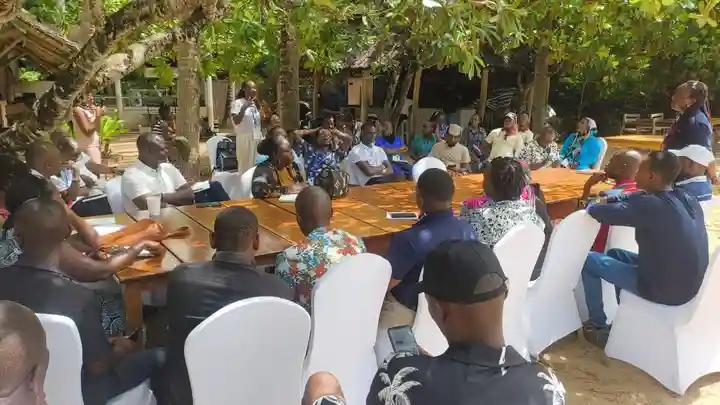
Journalists, conservationists, fishers, and blue economy stakeholders gathered at Vipingo Ridge in Kilifi County for the Second Annual Environmental Media Dialogue, calling for more accurate and community-centered reporting on ocean conservation in Kenya’s coastal region.
The forum, organized by Media for Nature in partnership with Blue Radio, brought together stakeholders from across the maritime sector to address gaps in environmental journalism and highlight grassroots conservation efforts that largely go unreported.
Speaking at the event, Mazera Thomas Ndurya, co-founder of Media for Nature, said the dialogue was anchored on a clear theme, reporting ocean issues through the eyes of the community.
“Communities hold a wealth of indigenous knowledge that is not found in any book or archive. If journalists do not record and preserve it, the generations that come will not know what was happening. That responsibility lies with us,” Ndurya said.
She cited a recent engagement with elders on the subject of dugongs, whose existence many Kenyans, particularly children, dismiss as fiction, underscoring the urgent need for journalists to bridge the gap between traditional ecological knowledge and public awareness.
Maureen Mudi, Coast Regional Coordinator of the Media Council of Kenya, echoed the call, noting that environmental stories are too often sidelined in newsrooms due to a lack of specialized knowledge among reporters.
“We regularly train journalists and partner with sector stakeholders to ensure that when they report on the environment, their stories are accurate. A media house that partners with conservation actors is doing something important for this country,” Mudi said.
The dialogue also highlighted the Blue Peace Programme, a partnership between TechnoServe and the MasterCard Foundation targeting economic transformation along the coast.
Immaculate Muthoni, the programme’s Communications Advisor, said the initiative has so far trained 13,683 young women and men across the five coastal counties of Kilifi, Mombasa, Lamu, Tana River, and Kwale.
“70 per cent of our participants are women; we are building enterprises in fisheries, aquaculture, mariculture, beekeeping, and coconut farming. This will reduce pressure on ocean resources rather than exploit them,” Muthoni said.
Mariam Chitsaka Jabali, Chairperson of the Kuruwitu Conservation and Welfare, appealed to the government and development partners to formally recognize Community-Based Organisations (CBOs) doing frontline marine conservation work.
“We are the ones protecting the shoreline, building coral reefs, and restoring life to the sea, yet the government bypasses us and goes directly to the Beach Management Units (BMUs). Our work must be recognised,” she said.
Charles Nyale, President of the West Indian Ocean LLMA Alliance and Kilifi BMU Chairperson, called for structured collaboration between BMUs and CBOs, warning that jurisdictional confusion undermines conservation efforts.
Rashid Matano Bemaronda, who founded the Kuruwitu Conservation and Welfare Association in 2006, said the community’s journey from receiving seed funding from the International Union for Conservation of Nature (IUCN) to global recognition through the United Nations Development Programme (UNDP) Equator Initiative proved that ordinary people could achieve extraordinary outcomes.
“We are here to conserve and bring back the promise of the sea,” he said.
By Ramadhan Nassib