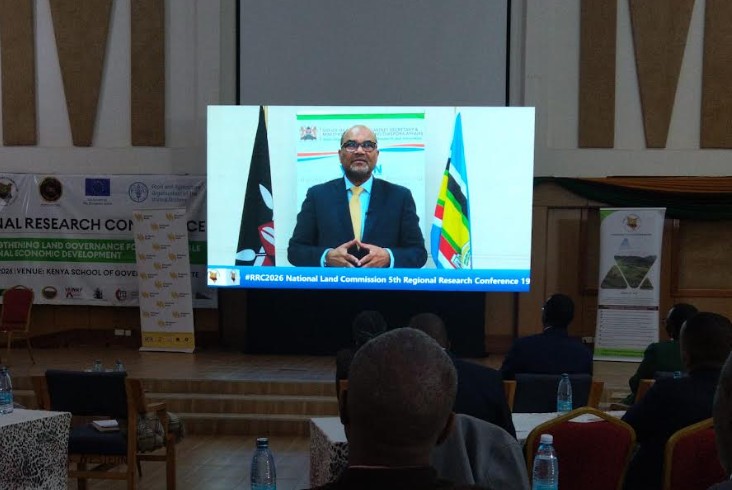
Government leaders, policymakers and international development partners have called for the integration of artificial intelligence (AI), geospatial data and emerging technologies into Kenya’s land administration systems to drive sustainable economic growth.
The call was made during the Fifth Regional Research Conference on Land and Natural Resources held at the Kenya School of Government in Kabete, Nairobi, under the theme “Strengthening Land Governance for Sustainable National Economic Development”.
The two-day conference focused on aligning spatial planning and secure land tenure with national economic priorities, food security and urban development.
Opening the key addresses, Vision 2030 Delivery Board Chairman Dr Emmanuel Kombe Nzai highlighted progress made by the government under the Bottom-up Economic Transformation Agenda (BETA), noting a 102.3 per cent increase in annual title deed issuance.
He said title deed issuance had risen from 412,562 in 2022 to 834,875, benefiting more than two million landowners across the country.
“Land tenure security is a foundational pillar for national development. By doubling our title deed output and digitising registries, we are empowering citizens and creating a predictable environment for economic investment,” Nzai said.
He also cited other milestones, including the construction of more than 260,000 housing units under the Affordable Housing Programme and operationalisation of the National Land Information System in counties such as Nairobi, Kiambu and Mombasa.
However, Nzai cautioned that persistent challenges, including land fragmentation in agricultural zones and the absence of spatial land-use plans in more than 40 per cent of counties, required an urgent review of the National Land Policy.
Speaking via video link, Principal Secretary for Science, Research and Innovation Prof Abdulrazak Shaukat said traditional approaches to land administration could no longer adequately serve a national population projected to reach 84 million by 2050.
“The land governance system of yesterday cannot adequately serve the economy of tomorrow. We are entering an era in which data, science, research and emerging technology must become central instruments of land governance,” Shaukat said.
He called for predictive land governance powered by satellite imagery, drones and artificial intelligence to help manage rapid urban growth while protecting vital agricultural corridors.
Shaukat also outlined priority areas for the land sector, including development of a single national land data ecosystem, embedded policy research, citizen-centred digital services and strengthening local technical capacity.
Addressing urban management, Nairobi City County Deputy Governor James Njoroge Muchiri said effective land governance was critical in tackling resource shortages and other challenges facing the capital.
Citing a daily water deficit of 375 million litres, more than 3,000 tonnes of waste generated daily and an annual housing deficit exceeding 200,000 units, Muchiri said the challenges demonstrated the importance of proper land-use planning and management.
“Every one of these challenges leads back to one issue: how we plan and manage our land. When we talk about land governance, we are talking about whether a family can find a decent home, whether a child can go to school, and whether public land is protected for public good,” he said.
Muchiri highlighted ongoing urban renewal initiatives in Pangani, Woodley and Jericho, as well as county plans to deploy a comprehensive digital Land Management System (LMS) to safeguard public land assets and integrate them with the national land portal.
The Deputy Governor said digital systems would improve the management of public land while enhancing transparency, accountability and access to land-related information.
Meanwhile, Food and Agriculture Organization (FAO) Representative to Kenya Farayi Constance Zimudzi commended the EU-FAO co-funded Digital Land Governance Programme (DLGP), saying secure land rights were essential to sustainable development.
“Land governance lies at the heart of sustainable development. Secure land rights encourage investment, increase productivity, improve access to finance, reduce conflict, and strengthen resilience against economic and climate shocks,” Zimudzi said.
She noted that secure land tenure directly affected agricultural productivity and climate resilience, particularly among women farmers and pastoralist communities.
Zimudzi observed that 2026 coincides with the UN International Year of Rangelands and Pastoralists and the International Year of the Woman Farmer, providing an opportunity to strengthen attention to land rights and sustainable management of natural resources.
Wrapping up the key presentations, Principal Secretary for Basic Education John Ololtuaa revealed that a recent Ministry of Education survey established that only 27 per cent of public primary and secondary schools in Kenya possess title deeds.
He warned that the absence of title documentation exposed public school land to encroachment, land grabbing and disputes.
“The absence of title documentation exposes public school land to the risk of encroachment, land grabbing, and public disputes,” Ololtuaa said, adding that securing public school land was an investment in Kenya’s future that would protect public assets and safeguard learning spaces.
In a speech read on his behalf by Lilian Karanja Mwai, a Senior Education Officer in the Ministry of Education, Ololtuaa said the Ministry was collaborating with the National Land Commission and the Ministry of Lands to accelerate the issuance of title deeds to public educational institutions.
He said securing school land would help protect learning environments and ensure that public education facilities remain available for current and future generations.
The conference also highlighted the need for stronger coordination between national and county governments, research institutions, development partners and communities in addressing emerging land governance challenges.
Delegates noted that technological advancement presented an opportunity to improve land registration, planning, monitoring and dispute resolution while reducing delays and enhancing access to services.
They also stressed the importance of ensuring that digital land systems remained accessible to citizens and were supported by adequate technical expertise and reliable data.
The conference concluded with delegates agreeing to align land research, digital infrastructure and policy frameworks with the long-term economic objectives of Vision 2030.
By Lilian Gichohi