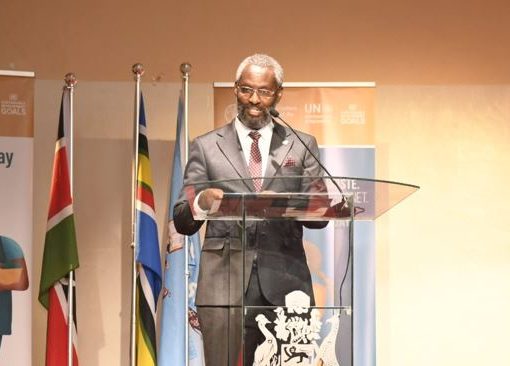
Deputy President Prof Kithure Kindiki has underscored that government reforms in agriculture and sustained investments in road infrastructure are raising farmers’ incomes, lowering production costs and improving connectivity across key economic corridors, reinforcing the country’s economic transformation agenda.
While addressing an interdenominational church service in Soliat Ward, Soin/Sigowet Constituency, Kericho County, Prof Kindiki outlined that agriculture remains a central pillar to the government’s economic transformation agenda, anchored on reducing the cost of farm inputs, eliminating cartels and improving market access for farmers.
“When President Ruto took office in 2022, a bag of fertilizer was retailing at about Sh7,000.
Today, after nearly three years, farmers can buy the same bag at Sh2,500. As we move forward, we are working on ways of reducing the price even further,” Kindiki noted.
Meanwhile, the fertilizer subsidy programme has lowered production costs, increased farm productivity and strengthened the country’s food security.
Addressing sugarcane farmers, the Deputy President said reforms had revived the sector after years of factory closures and delayed payments, with all previously stalled sugar factories now operational and growers receiving more consistent payments.
Additionally, he announced that the price of sugarcane had increased from Sh3,500 to Sh4,500 per metric ton following policy interventions aimed at improving efficiency, protecting farmers and restoring confidence in the industry.
Turning to coffee farming, Kindiki said the crop was increasingly complementing sugarcane as farmers diversified into higher-value agriculture following the elimination of brokers and cartels, strengthening of cooperative societies and improved access to international markets.
“Coffee has become like gold to our farmers. I encourage you to increase the acreage under coffee farming,” he remarked.
The deputy president stated that government interventions had increased coffee prices from about Sh50 per kilogram to between Sh120 and Sh160 per kilogram.
“Within the next year, we aim to raise those earnings further to between Sh250 and Sh300 per kilogram through subsidized seedlings, pesticides and expanded production,” he said.
Shifting to infrastructure development, the Deputy President said the government had prioritized completion of stalled road projects after clearing pending bills amounting to Sh177 billion, which had left more than 6,000 kilometres of roads incomplete across the country.
He added that settlement of the pending bills enabled contractors to return to project sites, while an additional Sh25 billion mobilized through securitization and Sh60 billion allocated in the national budget had increased annual investment in the roads sector to about Sh260 billion.
Among the flagship projects, Kindiki highlighted progress on the Limuru–Naivasha–Nakuru–Mau Summit highway and its branches to Kericho–Kisumu and Eldoret–Malaba, saying the corridors would ease traffic congestion, improve transport efficiency and strengthen regional connectivity.
Following requests from MP Justice Kemei and Senator Aaron Cheruiyot, Kindiki confirmed that additional road projects will be implemented especially the construction of the Chemaluk–Sokohuru–Soliat–
On rail transport, he explained that construction of the Standard Gauge Railway had resumed beyond Naivasha and would pass through Suswa, Narok, Bomet, Kericho, Nyamira and Kisumu before reaching Malaba, where it will enhance regional trade by linking Kenya with Uganda.
Addressing trade infrastructure, the Deputy President cited that the government is investing heavily in modern markets with 400 modern markets constructed across the country to improve the business environment for small-scale traders.
“Kericho County has already received six modern markets. Construction of the seventh market at Kipsitet has begun at a cost of approximately Sh. 275 million, which may be revised to Sh. 300 million,” Kindiki stated.
He announced another modern market for Londiani worth about Sh 300 million set to begin which would provide safe, organized and dignified trading spaces for small-scale traders, including mama mboga and hawkers who have for years operated in informal and harsh conditions.
In health sector, Prof. Kindiki explained that previously, only about eight million Kenyans were registered under NHIF but today over 31 million Kenyans are registered under the Social Health Authority (SHA) with the beneficiaries already receiving treatment worth between Sh. 50,0000 up to even 200,000.
He further said that the government aims to register all 55 million Kenyans so that families will no longer be forced to sell land, livestock or organize Harambees to pay hospital bills.
The Deputy President said the government has revived construction of sports facilities after decades of limited investment, noting that Talanta Stadium is nearing completion as the country’s first international-standard stadium since the completion of Moi International Sports Centre, Kasarani, in 1987.
He added that 31 stadiums are under construction nationwide, including Kapkatet Stadium and Kericho Green Stadium in Kericho County, where new contractors have been engaged to fast-track the projects.
“The contractor at Kapkatet Stadium was replaced, and the Kenya Defence Forces are now supervising the project, which will be completed within a few months. The Kericho Green Stadium contractor was also replaced, and the new contractor is the same company constructing Talanta Stadium,” he said.
On youth empowerment, Kindiki announced the rollout of the second phase of the NYOTA Programme, saying more than 100,000 young people across all 47 counties will begin receiving support from Tuesday, with each ward benefiting from at least 70 beneficiaries.
The Deputy President concluded by highlighting the National Infrastructure Fund as a new financing model aimed at accelerating development without imposing new taxes or increasing public debt.
He said the fund is supported through partial divestiture of government shareholding in key state assets, including Safaricom, from which the government realized about Sh245 billion, and the Kenya Pipeline Company, which generated about Sh106 billion, bringing total proceeds to approximately Sh350 billion.
The initiative is expected to leverage about Sh3.5 trillion through Public-Private Partnerships to finance roads, railways, dams, irrigation, airports and other critical infrastructure projects across the country.
Among those present were Kericho Governor, Dr Erick Mutai, Senate Majority Leader and Kericho Senator Aaron Cheruiyot, Kericho Woman Representative Beatrice Kemei, Bomet Woman Representative Linet Chepkorir, the Speaker of the Kericho County Assembly, Members of Parliament, Members of County Assembly, church leaders and congregants drawn from 108 churches in Soliat Ward.
By Dominic Cheres and Kelox Mutai