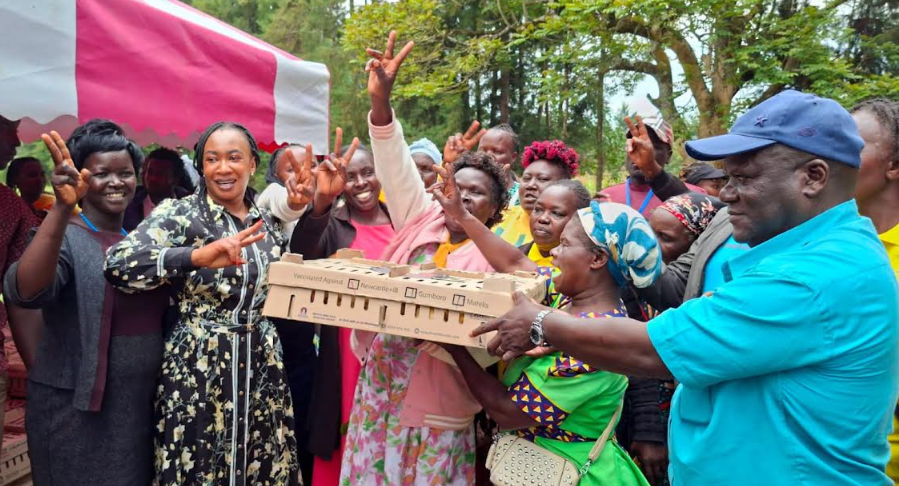
The government has distributed 4,000 improved indigenous chicken day-old chicks to smallholder farmers in Trans Nzoia County in a bid to boost food security and enhance income generation.
The chicks distributed through the Ministry of Agriculture and Livestock Development were handed over to 31 self-help groups at Mateket Primary School, Motosiet Ward, Cherangany Sub County.
Representing Principal Secretary for Livestock Development Jonathan Mueke, Deputy Director of Livestock Production, Josephat Smollo said the programme was designed to transform the livestock sector by empowering smallholder farmers with improved poultry breeds capable of generating food and income at the household level.
Smollo said the improved indigenous breed combines the hardiness and adaptability of indigenous chickens with enhanced productivity traits such as faster growth, increased egg production, and improved resistance to diseases.
He noted that the improved chicks can produce between 200 and 220 eggs per year, compared to indigenous chickens, which produce about 45 eggs annually.
The improved birds attain a mature weight of approximately two kilogrammes in three and a half months, compared to indigenous chickens, which take about eight months to attain a weight of approximately 1.5 kilogrammes.
Smollo said the initiative targets women, youth, and vulnerable groups, with the government seeking to strengthen food security at the household level while creating opportunities for income generation and self-employment.
“If we can stabilise food security at the farm level, we will be able to put food on the table and money in the pocket of every household,” he said.
He urged the beneficiaries to take good care of the chicks and utilise the knowledge provided through training to ensure the project becomes sustainable.
Trans Nzoia County Woman Representative Lilian Siyoi said the distribution of the chicks was a practical way of empowering women and other vulnerable groups by giving them an opportunity to establish income-generating activities.
Siyoi thanked the national government for supporting farmers through programmes under the Bottom-Up Economic Transformation Agenda (BETA), saying the initiative would help create employment and improve livelihoods.
She said beneficiaries had been trained on how to rear the chicks, adding that once the birds mature, farmers would be able to sell them or their products to generate income.
Siyoi noted that poultry farming would enable beneficiaries to become self-employed while contributing to improved food and nutrition security in their households.
Teresia Cherotich, a beneficiary thanked the national government for choosing to empower farmers with productive assets, saying the chicks would give her a sustainable source of income compared to receiving a small amount of cash.
“If you give me Sh100, it will not help me for long. But if you give me these chicks, I can rear them, and when they multiply, I can sell some to get money,” she said.
She explained that the poultry project would enable her to meet urgent family needs, including paying school fees whenever her children are sent home, while also providing food for her household.
Cherotich said the project gives her hope of becoming financially independent, as she would be able to raise the chicks, sell them when necessary, and reinvest the proceeds into the poultry enterprise.
By Isaiah Nayika and Winnie Jelagat