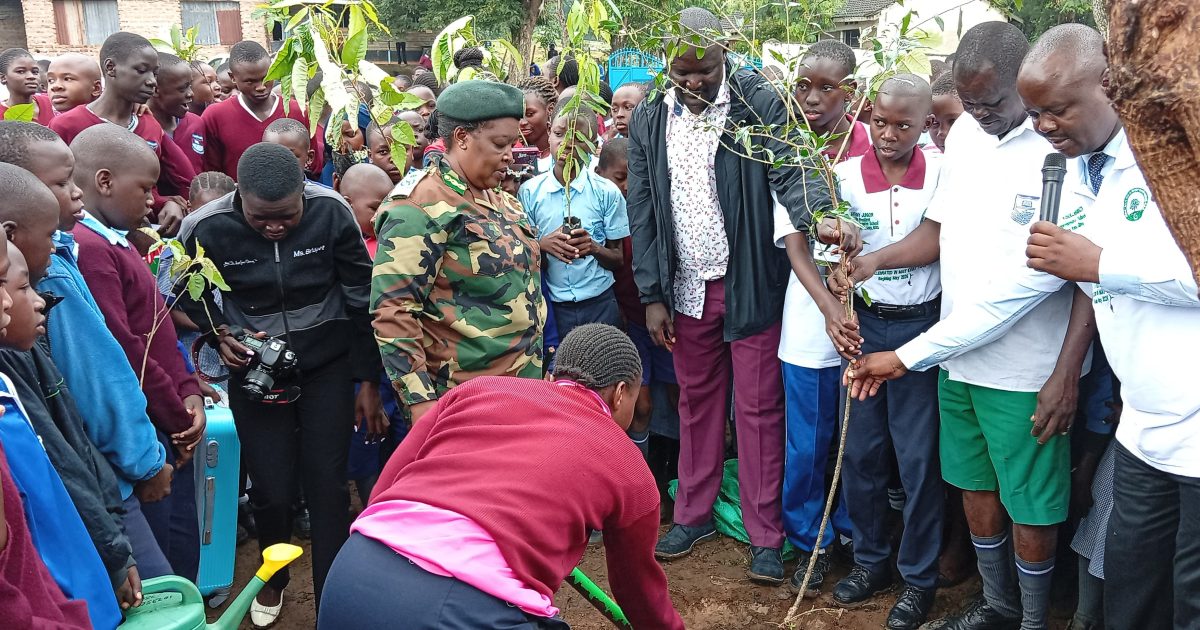
Kenya Forest Service has intensified efforts to restore degraded forests in Homa Bay County amid growing challenges posed by invasive plant species particularly Lantana camara.
Speaking during a ‘Back to School with a Seedling’ tree planting initiative at Lake Primary School in Homa Bay town, County Conservator of Forests Sharon Cheluget said invasive species continue to threaten several forest stations in the county.
According to Cheluget, forests most affected include Wire, Kodera, and Homa Hills forest stations, where illegal activities such as deforestation and charcoal burning have further undermined conservation efforts.
She noted that inadequate resources and limited monitoring have also affected the survival rate of planted trees in some areas.
“To address these challenges, stakeholders are working together to clear affected areas and promote sustainable planting practices. Nonetheless, we are working tirelessly to ensure the challenge of invasive species is overcome. We will continue bringing stakeholders on board to help clear the affected land,” she said.
She added that KFS has stepped in to support restoration efforts through seedling production, establishment of tree nurseries, and provision of technical guidance.
The Conservator was accompanied by Plant Trees for Better Environment CBO Patron, Nuhu Omollo Abdul Masoud and Commissioner Eli Kisulu, the Chairman of the Kenya Comprehensive Schools Association Homa Bay County, where the forest service donated more than 100 tree seedlings for planting.
Cheluget highlighted major progress made in the restoration of Lambwe Forest Station, where approximately 420 hectares of the 703-hectare forest have been replanted since 2024.
“If the rains continue as expected, by the end of this rainy season we will have cleared the remaining less than 300 hectares. Lambwe will be completely reforested,” she said.
Wire Forest Station is undergoing similar restoration through multi-sectoral stakeholder initiatives.
Early this week, she said, Kenya Electricity Transmission Company (KETRACO) planted trees on 20 hectares, while Community Forest Associations continue participating actively in reforestation efforts.
At Kodera Forest Station, at least 10 hectares had been replanted by the end of last year.
Cheluget said some forest areas, including Gembe and parts of Gwassi in Suba have been earmarked for natural regeneration instead of intensive plantation programs.
“We realised the best way to restore these stations is to allow natural regeneration. If protected, the forests can recover naturally without the high costs associated with tree planting,” she explained.
She further disclosed that Kinjororio area in Gwassi had previously been invaded by illegal cultivators of cannabis in 2024. However, a joint security operation led by former County Commissioner Moses Lilan successfully flushed out the illegal farmers.
“Today, Kinjororio is recovering well through natural regeneration. Through collaboration with stakeholders and security agencies, a security camp has been established to ensure the illegal farmers do not return,” she said.
Cheluget called on residents, parents, teachers, learners, and the wider community to actively participate in tree planting and nurturing initiatives to help the country achieve its target of 15 billion tree coverage by 2032.
Homa Bay County currently has a tree cover of 12.8 percent and forest cover of 3.4 percent, far below the required targets of 30 percent tree cover and 10 percent forest cover.
“The county seeks to plant up to 15 million trees by 2032, with at least 1.5 million seedlings expected to be planted annually. So far, more than 1.5 million trees have already been planted since the campaign began,” she added.
Cheluget warned that climate change effects such as flooding and disease outbreaks are increasing due to environmental degradation and carbon emissions.
“The only thing that can capture carbon from the atmosphere is trees. By planting trees, we are reversing the effects of climate change,” she said.
Masoud on his part urged learners to embrace planting culture by actively engaging in tree planting and ensuring environmental conservation.
“There is a need to create awareness among young people on the importance of protecting natural resources and controlling drought through afforestation,” he said.
He further encouraged former students to return to their schools and plant trees as a way of giving back to society while protecting the environment.
By Barasa Irene and Sitna Omar