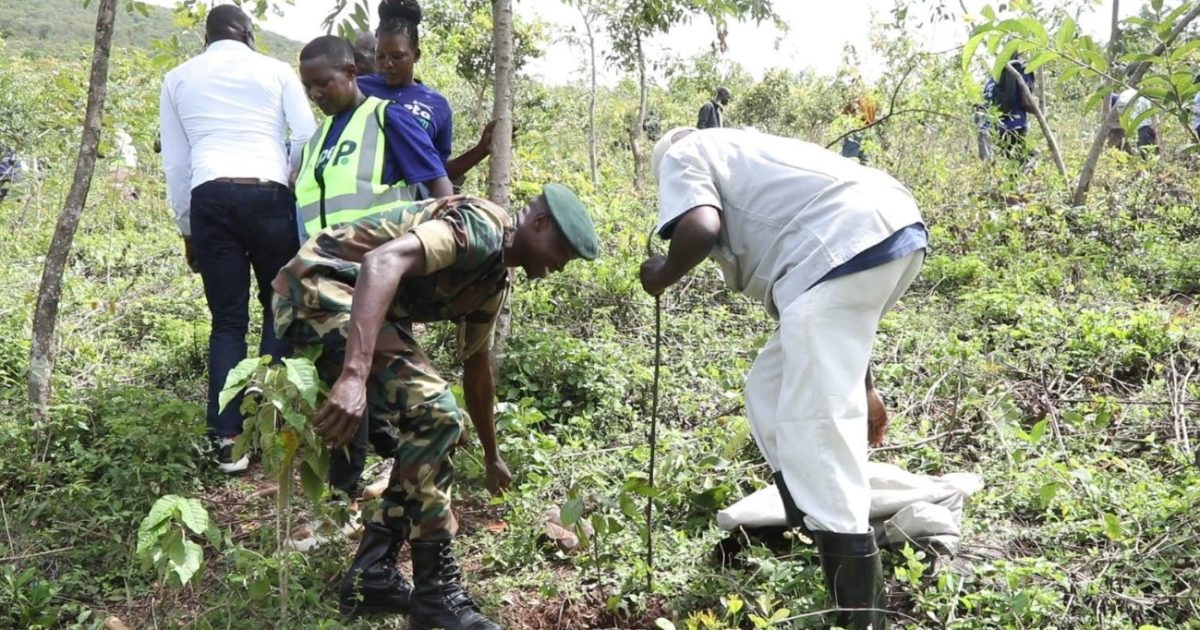
Homa Bay County has stepped up efforts to increase its forest cover as part of the national Government’s initiative to plant 15 billion trees by 2032, with officials and community members converging at Wire Forest for a large-scale tree-planting exercise.
Speaking during the event, County Director of Environment and Forestry Stacey Atieno said the county’s current tree cover stands at 10.4 per cent, significantly below the national target of 30 per cent.
She noted that Homa Bay aims to raise its forest cover to 21 per cent by 2032 by planting 149 million trees to combat climate change.
“This marks a significant step towards regreening our county. We appreciate the support from our communities and partners who continue to work with us to achieve this goal,” said Atieno.
Homa Bay is expected to plant at least 14 million trees yearly to achieve the target by 2032.
The exercise, held at Wire Forest in Kasipul, brought together government officials, community groups, and development partners.
The forest, which spans approximately 387 hectares, is among several targeted areas for restoration under the county’s landscape restoration programme. Other sites include Kodera Forest and Gwasi, Gembe and Homa Hills.
Forest Station Manager Frederick Ndega explained that the activity focused on enrichment planting in degraded sections of the natural forest. “We are filling gaps in areas where the forest has been depleted to restore ecological balance,” he said.
According to organisers, about 6,000 seedlings were planted during the exercise, with 2,000 planted within the forest and 4,000 distributed to local communities and institutions.
Alan Awinja, Founder and CEO of the Trees for Tomorrow Foundation, said the initiative goes beyond planting trees to ensuring their survival.
“We are working with over 20 women groups, supporting alternative livelihoods such as poultry farming and beekeeping to reduce reliance on charcoal burning,” he said.
Community Forest Associations (CFAs) are also playing a key role in conservation efforts, with Crispin Osunga, Chairperson of the local CFA, saying the group has been involved in restoring about 100 hectares of degraded forest land while promoting nature-based enterprises.
“These initiatives provide alternative sources of income and help reduce pressure on forest resources,” Osunga said.
On their part, local leaders emphasized the broader socio-economic benefits of reforestation with Festus Juma, noting that forest conservation can drive economic growth through agriculture, water projects, and emerging green enterprises.
Residents were also urged to take personal responsibility in the initiative.
“Every household should plant at least a few trees each year. It is a simple but powerful way to secure our environment,” said Silas Onyango, a resident.
The county government, with support from national programmes such as the Financing Locally-Led Climate Action (FLLoCA) initiative, is currently supporting more than 80 community groups in raising tree seedlings.
The officials echoed that sustained collaboration between government, communities, and partners will be key to achieving the county’s long-term environmental and climate resilience goals.
By Sitna Omar