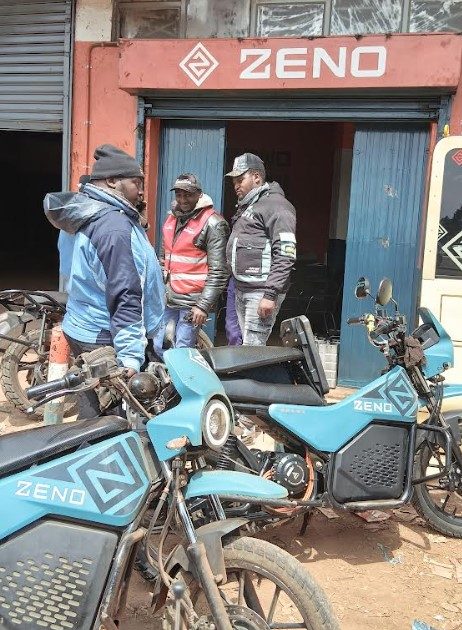
The familiar roar of petrol-powered motorcycles is slowly giving way to a quieter hum across the streets of Nyeri.
As fuel prices continue to soar and Kenyans search for affordable transport alternatives, electric motorbikes are emerging as a practical solution, offering riders lower operating costs, reduced maintenance expenses, and a cleaner environment.
The transition from petrol to electric power isn’t just a trend but also a necessity. Electric motorbikes are part of this shift, promising zero emissions and an efficient, eco-friendly mode of transport.
Unlike traditional motorcycles that rely on combustion engines and emit harmful gases, electric bikes are powered by rechargeable lithium-ion batteries that produce no tailpipe emissions.
In urban areas where traffic congestion and pollution are at their peak, electric motorbikes stand out as a cleaner, quieter alternative. Their ability to reduce pollution in high-density areas has made them popular in many places.
Most electric motorbikes have instant torque, meaning they can accelerate quickly and smoothly, without the need for shifting gears. This gives riders a unique, responsive experience.
Some high-end models even rival the performance of traditional motorcycles, achieving speeds over 100 mph, making them a viable option for those looking for both power and sustainability.
Moreover, with fewer moving parts, electric motorbikes require less maintenance than their petrol counterparts.
There’s no need for oil changes or dealing with complicated mechanical issues related to the engine, making electric bikes easier and more cost-effective to maintain in the long run.
At the heart of this transition is Zeno Motors Limited, a company that has rapidly expanded its presence in Nyeri since launching operations in late 2024.
What began with only three electric motorcycles has grown into a fleet of 120 bikes operating across the county by 2026—a clear indication that electric mobility is steadily gaining acceptance.
According to Kelvin Wamae, a salesperson at Zeno Motors in Nyeri, the company was inspired by the need to provide an economical alternative to conventional petrol-powered motorcycles.
“The inspiration came from the economic aspect of these electric bikes because fuel prices have continued to rise. People are now embracing electric mobility because it saves them money,” says Wamae.
The company’s main customers are conventional motorcycle riders seeking to switch from petrol bikes.
Most are young men aged between 25 and 35 years, many of whom depend on motorcycles for their daily livelihoods.
For these riders, the biggest attraction is affordability. Unlike petrol-powered motorcycles that require frequent re-fueling and expensive maintenance, electric bikes significantly reduce operating costs.
Wamae explains that riders can travel approximately 50 kilometers after spending only about Sh100 on charging, making the bikes considerably cheaper to operate over long distances.
Besides saving money, the motorcycles require less maintenance because they have fewer moving parts than conventional engines.
“The bikes are very economical, they are not noisy and they have very comfortable seats,” he explains.
The savings become even more evident when comparing fuel costs.
According to Wamae, charging an electric bike at approximately Sh.190 enables a rider to travel up to 90 kilometers, while spending the same amount on petrol only covers about 50 kilometers.
A fully charged battery typically lasts about 100 kilometers before requiring another recharge. Maintenance costs are equally favourable.
“Motor oil for an electric bike goes for about Sh100 while that of a petrol bike costs around Sh600,” he notes.
Beyond affordability, electric motorcycles are helping reduce environmental pollution.
Unlike petrol-powered motorcycles that emit exhaust gases contributing to air pollution, electric bikes produce no exhaust pipe emissions during operation.
Their quiet electric motors also reduce noise pollution, creating a more peaceful urban environment for both riders and residents.
To support its growing customer base, Zeno Motors has established four charging substations across Nyeri.
Each station serves approximately 20 motorcycles and is equipped with six charging points.
For now, Wamae says the infrastructure is adequate.
“The charging stations are sufficient for the meantime, but if demand continues to rise, we will definitely increase the number of substations.” he points out.
The company offers customers two purchasing options designed to suit different financial needs.
The first package costs Sh300, 000 and includes the motorcycle, two batteries and a charger.
Owners under this package charge their batteries at home, but they are responsible for any battery repairs or replacement costs.
They also cannot swap batteries at Zeno stations.
The second package costs Sh189, 000 for the motorcycle, while the battery and charger are acquired separately.
Under this arrangement, riders enjoy battery-swapping services whenever the battery runs low or becomes depleted.
They can exchange batteries at any Zeno charging station across the country, ensuring uninterrupted operations.
Battery-swapping charges range up to Sh270 depending on the battery’s remaining charge, while standard charging costs approximately Sh190.
One feature that has particularly impressed customers is the battery’s reserve capacity.
“Even at zero percent charge, the battery can still take you for another 13 kilometers before it completely dies,” Wamae says.
The company has also invested heavily in customer support through a nationwide network of technicians and readily available spare parts, making maintenance accessible for riders across the country.
As demand continues to grow, Wamae believes Kenya’s transport sector is undergoing a significant transformation.
“The future of Nyeri and Kenya generally is being redefined by electric mobility in a very great way,” says Kelvin.
The figures appear to support his optimism. Growing from only three electric motorcycles in 2024 to 120 motorcycles in Nyeri by 2026 demonstrates how quickly riders are embracing the technology.
However, Wamae believes government intervention could accelerate this transition even further.
“If they reduce importation tax, then bringing the bikes in will be a lot easier and we will be able to supply the demand and many people will be able to afford them,” says Wamae.
He also calls on the government to reduce import costs on spare parts to make them more affordable and readily available within the country.
Despite the advantages, riders acknowledge that electric motorcycles are not without limitations.
John Kinyua, one of the riders who recently switched from a petrol-powered motorcycle, says the savings have significantly improved his earnings.
“Since I switched from the conventional motorbikes, I have witnessed the economical part of the electric bike. Compared to fuel prices, this one is much more affordable because charging is cheaper and also the bike has no noise,” he says.
However, he points out one challenge. “These bikes cannot be ridden effectively on rough roads and this makes work a bit difficult if you have to access such areas unlike petrol-driven motorcycles. It seems like they were designed for good roads,” he notes.
Even with that limitation, many riders believe the benefits far outweigh the drawbacks.
And as Kenya continues pursuing cleaner energy solutions and affordable transport, electric motorcycles are steadily becoming more than just an alternative—they are shaping the future of mobility.
With lower operating costs, minimal maintenance, reduced air and noise pollution, and growing public acceptance, the quiet revolution rolling through the streets of Nyeri could soon become the new normal across the country.
Moreover, the upfront cost of electric motorbikes is often higher than their petrol counterparts due to the cost of batteries and technology.
Limited charging infrastructure is also a deep concern because it is still not as widespread or convenient as petrol stations, especially in rural areas.
Be as it may, electric motorbikes are more than just a passing trend, they’re part of a larger movement towards sustainability and smarter, cleaner transportation.
With their low environmental impact, thrilling performance, and increasing affordability, they’re poised to become a common sight on the roads in the years to come.
By Samuel Maina/Patience Wangechi