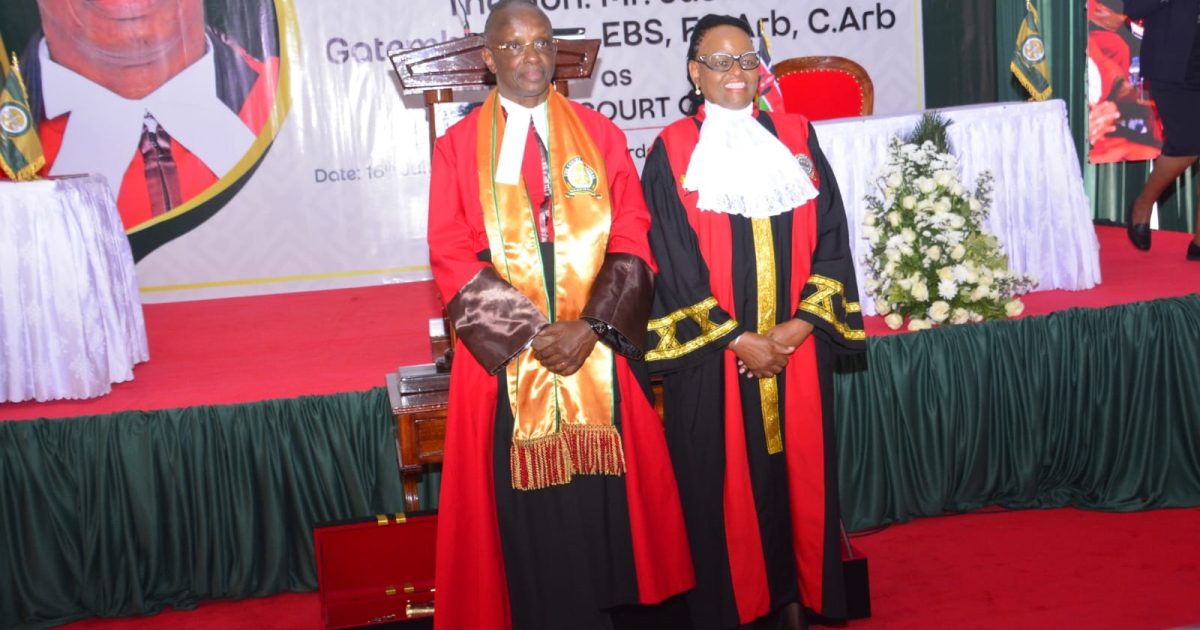
Justice Gatembu Kairu has officially assumed office as the new President of the Court of Appeal and promised to prioritize the reduction of a massive case backlog at the country’s second-highest court.
Justice Kairu succeeds Justice Daniel Musinga, whose five-year non-renewable term has ended. He assumed office at a colorful installation ceremony presided over by Chief Justice Martha Koome at the Supreme Court building on Thursday.
Justice Kairu, who was elected by his fellow Court of appeal judges, on 22nd June 2026, pledged to run his office with transparency, inclusivity, fidelity to the Constitution, and the rule of law.
“The task ahead of us is enormous, our decisions shape the law, guide the lower courts, and influence governance, commerce, and the daily lives of millions,” he said
The new President highlighted the acute case backlog crisis, noting that as of July 14, 2026, pending civil appeals stood just short of 12,000 cases nationally with Nairobi alone accounting for nearly 5,000 cases. He pointed out that the Nairobi court is currently handling cases filed in 2020, representing a five-year delay.
Justice Kairu singled out the “famous 5-2-B applications” (applications seeking stay of execution or injunctions) for clogging the system and pledged to first tackle those applications as a short-term measure to clear the way for actual appeals.
Justice Kairu appealed for infrastructural support, requesting Chief Justice Koome and the Judicial Service Commission (JSC) to expedite the completion of 11 working chambers identified for judges in Nairobi to resolve space constraints.
On her part, Chief Justice Martha Koome praised the democratic transition and commended the Court of Appeal for electing a highly competent leader.
She noted that while the court has witnessed unprecedented growth, expanding from 13 judges in 2021 to 41 judges today, the challenge of delayed justice remains a critical issue.
Koome revealed that the Court of Appeal had 16,336 pending appeals at the close of the last financial year, of which 61 percent constituted a backlog. “Let your legacy be the transformation of the court into a truly real-time, affluent court, one capable of hearing and determining appeals within one year of their filing,” Koome challenged the incoming President.
Speaking on behalf of the Senior Counsel Bar, Senior Counsel (SC), Philip Murgor, praised Justice Kairu’s elevation, describing it as an event of profound constitutional significance.
Murgor, noted he has known the new President for over five decades since their school days, lauding Kairu’s extensive career which entailed academia and arbitration.
“Your election by your brothers and sister judges of the Court of Appeal is a profound vote of confidence. It is a powerful affirmation of the esteem in which you are held by those who have sat with you in court,” Murgor stated.
He noted that Justice Kairu’s judgments have consistently reflected “careful scholarship, fidelity to precedent, balanced reasoning, and clarity of expression”.
Murgor raised critical issues of judicial accountability on behalf of the bar, noting that advocates are keenly watching discussions surrounding the publication of yearly performance results for judges.
“Our judges are expected to be accountable in their yearly outputs as public servants. The outcome of that debate is one that the Law Society and the Senior Bar watches with great interest,” Murgor said.
He assured the new President of the Senior Bar’s unwavering support, especially as the country approaches another General Election where the court’s independence and integrity will be vital to resolving high-stakes public disputes peacefully.
The outgoing President, Daniel Musinga, expressed deep gratitude for his five-year tenure, describing it as “the greatest honor of my professional life”.
He credited his administration with expanding the court’s geographical footprint from four permanent stations to eight by establishing registries in Nakuru, Eldoret, Meru, and Kakamega.
“Guard the independence of the court fiercely, protect its integrity, and always place the needs of the Kenyan people at the center of your administrative decisions,” Musinga advised his successor.
The transition marks a pivotal step in the judiciary’s Social Transformation through Access to Justice (STAJ) blueprint, focusing on collective leadership, technology integration, and alternative dispute resolution.
By Ian Maina and Doreen Kasung’wa