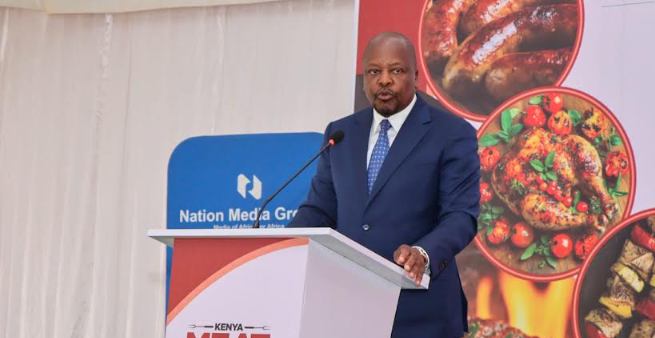
Kenya must move away from traditional livestock production methods and embrace high-value, technology-driven commercial meat processing to unlock the potential in the sector worth billions of shillings, Cabinet Secretary (CS) Mutahi Kagwe has said.
Kagwe asserted that the livestock sector in Kenya has the potential to attract and create huge investments, thus generating numerous jobs and decent profits through exports and local sales.
Speaking Wednesday, during the opening of the Fifth Kenya Meat Expo 2026, at the Kenyatta International Convention Centre (KICC), Kagwe said the country’s livestock industry had reached a critical turning point and possessed the potential to become a major regional and international supplier of meat and livestock products.
The three-day expo has brought together stakeholders from across Eastern and Central Africa under the theme “Accelerating Sustainable Growth: Empowering the Next Generation in the Meat Value Chain.”
Official ministry data shows Kenya produced about 613,627 tonnes of meat in 2024, valued at Sh397 billion, representing a 10.2 per cent increase in production volume and a 30.5 percent rise in value compared with 2023.
Beef remains the biggest contributor, accounting for approximately 260,000 tonnes valued at Sh160 billion.
“The challenge before us is not whether Kenya has the potential, because that we know. The challenge is how quickly and effectively we can convert that potential into productivity, into investment, jobs, exports, and higher incomes for our farmers and pastoralists,” Kagwe said.
The CS said reforms would target quality, safety, and traceability challenges affecting the country’s nearly 2,000 slaughter facilities, which include 49 large slaughterhouses, 322 medium-sized facilities, and more than 1,500 slaughter slabs.
At the Centre of the proposed reforms is the Animal Identification and Traceability (ANITRAC) Bill 2026, which seeks to introduce a digital livestock identification system using microchip technology.
The system, developed locally by Kenyan universities, will allow animals to be tracked from birth to slaughter and provide records on their origin, vaccination history and veterinary care.
Kagwe said the technology would not only improve food safety and help Kenya meet international export standards but would also strengthen the fight against livestock theft.
“Once this system is in place, it will be a foolproof system against animal banditry,” he said. “With a simple chip, you will be able to identify your animals and know where they are.”
He warned livestock thieves that technological reforms would make their trade increasingly difficult.
The CS challenged young Kenyans to invest in the wider meat value chain, saying opportunities existed in commercial feedlots, artificial insemination, animal genetics, feed formulation, transport, and processing.
“If you are interested in money, you should be interested in the meat sector,” Kagwe said.
Trade Principal Secretary (PS), Regina Ombam, said the future of the industry would depend on the integration of trade policy, climate-smart agriculture, and youth participation.
She said young entrepreneurs were increasingly adopting innovations such as rotational grazing, biogas production from livestock waste, and methane-reducing animal feeds.
“Doing this better calls for cutting-edge digital technology and a clear understanding of nature’s principles,” Ms. Ombam said.
The PS pledged government support in opening new export markets and improving access to green financing for businesses in the livestock sector.
Garissa Governor Nathif Jama, who chairs the Arid and Semi-Arid Lands and Disaster Management Committee at the Council of Governors, said Kenya was failing to fully exploit the enormous livestock resources found in ASAL counties.
He noted that the regions produce about 70 per cent of Kenya’s livestock, but the country still struggles to meet major export orders from international markets.
“ASAL counties produce 70 per cent of the livestock in this country, but unfortunately, that huge capacity is not being translated into properly exportable meat,” Governor Jama said.
“We keep doing a lot of talking, but we must now move into action,” he said
The governor called for faster implementation of county aggregation and industrial parks, structured feedlots, and sanitary and phytosanitary management programs through public-private partnerships.
Nation Media Group Managing Director and Chief Executive Geoffrey Odundo said the media company would continue providing platforms that link livestock producers with processors, financiers, and international buyers.
The Kenya Meat Expo, established five years ago to bring together players in the fragmented livestock sector, has so far facilitated more than Sh200 million in sector investments and generated Sh3 million in direct deals on the exhibition floor.
This year’s event features panel discussions, business-to-business networking sessions, and deal-making forums aimed at unlocking investment and expanding trade across East and Central Africa.
With Kenya’s meat industry now valued at nearly Sh400 billion, the government and industry leaders say the focus must shift from merely producing livestock to building a modern, traceable, and export-oriented value chain capable of competing in global markets.
By Lilian Gichohi