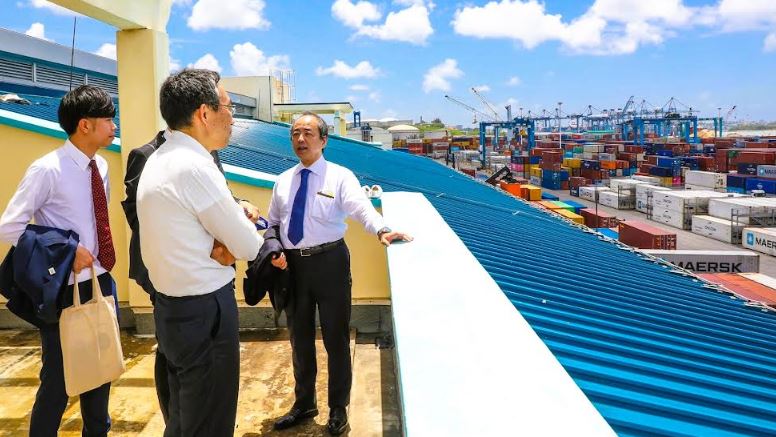
The Kenya Ports Authority (KPA) is actively seeking international strategic partnerships to enhance regional maritime trade and improve port operational efficiency.
KPA Chief Executive Officer (CEO) Capt. William Ruto says the Authority is out to modernise its port infrastructure, adopt digital technologies and expand maritime and logistics networks.
Capt. Ruto recently held a series of engagement meetings in Mombasa with representatives of trade delegations from Britain, the Netherlands, Belgium, Argentina and Japan, with discussions centering on infrastructure development, private sector investment and the need to improve operational efficiency across the maritime logistics chain.
The visiting delegations were led by their respective representatives Matt Baugh (British High Commissioner to Kenya), Simone van den Broek (Second Secretary for Trade and Investment, Embassy of the Netherlands), Tom Neijens (Belgium’s Ambassador to Kenya), Cynthia Mulville (Chargé d’Affaires from the Embassy of Argentina) and Imafuku Takao, the Director-General, International Cooperation Bureau, Ministry of Foreign Affairs of Japan.
Capt. Ruto said that the port of Mombasa, which serves as the Maritime Gateway for the East, has greatly benefited from sustained collaboration with the Japan International Cooperation Agency (JICA).
The envoys emphasised that their partnership with KPA is anchored on mutual respect, shared interests, and a common commitment to regional and global economic stability.
They emphasised that efficient port operations are vital to keeping maritime trade moving on a 24-hour basis from vessel berthing and container handling to onwards clearance.
The foreign dignitaries commended KPA’s efforts to strengthen the Port of Mombasa’s position as a regional maritime and logistics hub.
The envoys further affirmed the longstanding bilateral relations between KPA and their respective countries, highlighting the available opportunities to promote trade, investment and cooperation in the maritime sector.
In his separate meetings with the foreign diplomats, Capt. Ruto emphasised the importance of upgrading port infrastructure and technical capabilities to complement ongoing modernisation efforts at the Mombasa and Lamu seaports.
“Our engagement with foreign partners underscores the shared commitment by Kenya to strengthen maritime cooperation, enhance port efficiency, promote sustainable operations and unlock new investment opportunities across the maritime and logistics value chain,” he said.
The KPA CEO thanked the envoys for their government’s continued support for port infrastructure development through various development partner initiatives.
“We are modernising Mombasa and Lamu seaports to accommodate growing cargo volumes and operate efficiently within an increasingly technology-driven port ecosystem,” he said.
He went further: ‘The ongoing modernisation of port infrastructure and services is critical to supporting regional trade and positioning Kenya as the preferred logistics and maritime hub in Eastern and Central Africa.’
Capt. Ruto said the series of engagements also provided an opportunity to explore ways of leveraging the port infrastructure and connectivity and expanding capacity to support new and existing trade flows.
Ruto highlighted key areas of collaboration, including the Smart Gate initiative, carbon emissions reduction programmes and technology exchange, and cool logistics, among others, noting their contribution to improving port efficiency, sustainability and operational performance.
He further identified ongoing and planned infrastructure projects, including the Dongo Kundu Special Economic Zone and the Port of Lamu, as strategic investment opportunities for the public and private investors.
“We look forward to strengthening our collaboration and partnership with the UK government to attract investment into the blue economy and explore untapped opportunities in the maritime industry,” said Capt. Ruto.
He said the partnerships will seek to advance shipping, maritime trade and the blue economy sector and find practical solutions to operational challenges experienced in the sector to improve service delivery and enhance trade in the region.
The blue economy sector, also known as the sustainable ocean-based economy, encompasses fisheries, maritime biotechnology, aquaculture, tourism and marine transport and logistics.
Capt. Ruto said that the port of Mombasa, which serves as the maritime gateway for East and Central Africa, has greatly benefited from sustained collaboration with international partners.
The Port of Mombasa is the premier maritime gateway to East and Central Africa, serving as a critical trade lifeline that connects over 80 global ports to a vast landlocked hinterland.
The port serves a wide and rapidly growing hinterland consisting of Uganda, Rwanda, Burundi, South Sudan, Northern Tanzania, Democratic Republic of Congo and Ethiopia.
Mombasa port spans natural deep-water inlets, including Kilindini Harbour, Port Reitz, the old port, Port Tudor, Mbaraki, and the whole of the tidal waters encircling Mombasa Island, and has a capacity of 2.65 million (Twenty-foot Equivalent Unit) TEUs.
According to KPA, the port of Mombasa handled a record 45.45 million metric tonnes of cargo in 2025, marking a 10.9 per cent increase (up 4.46 million tonnes) compared to the 40.99 million tonnes processed in 2024.
Capt. Ruto expressed satisfaction with the progress of the construction of Dongo Kundu Berth One (DK1), a flagship component of the Special Economic Zones (SEZs) project, whose works currently stand at 16 per cent completion.
The Sh41 billion port facility is expected to be completed by December 2028, and already 94 investors have already expressed interest in establishing operations within the 3,000-acre Dongo Kundu SEZ.
The CEO said once complete and operational, the new berth will serve industries within the special economic zone, helping to reduce production and logistics costs for investors.
At the same time, he invited international partners to explore investment opportunities at the Port of Lamu, calling the facility a “game changer” with strong potential to reshape maritime trade along the Eastern African seaboard and ease congestion at the Mombasa port.
Capt. Ruto said the port of Lamu is a deep-water transshipment and maritime trade hub located in the Lamu archipelago, serving as the anchor project of the LAPSSET Corridor Program.
The Lamu port features a natural depth of 17 to 17.5 metres along the channel and up to 60 metres within the bay, allowing it to host mega-sized and super post-Panamax vessels that cannot dock at shallower ports.
The LAPSSET Corridor Program is a regional flagship project intended to provide transport and logistics infrastructure aimed at creating seamless connectivity between Kenya, Ethiopia and South Sudan.
The project connects a population of 160 million people in the three countries, and additionally, the LAPSSET Corridor is part of the larger land bridge that will ultimately connect the East African coast from Lamu Port to the West coast of Africa at Douala Port in Cameroon.
The KPA partnership with its development partners continues to support infrastructure development, digital transformation and trade facilitation efforts aimed at improving port performance and strengthening the competitiveness of regional trade corridors.
“We are willing to collaborate with KPA on potential development and business opportunities within the Special Economic Zones (SEZs), particularly in critical infrastructure needs such as power, road and rail connectivity and other key marine infrastructure,” said High Commissioner Baugh.
The British Envoy noted that efficient port operations would ensure seamless cargo movement throughout the supply chain.
Cynthia Mulville, Chargé d’Affaires from the Embassy of Argentina, said her team is undertaking a regional marketing assessment to identify new opportunities for maritime trade and economic cooperation.
She said they discussed with KPA top management on future cooperation to advance strategic collaboration in trade, maritime, shipping and logistics.
“Our discussions explored opportunities to deepen bilateral trade and strengthen collaboration in areas including port efficiency, logistics, infrastructure development and supply chain connectivity,” she said.
Ambassador Tom Neijens said Belgium’s discussion with top KPA management centred on opportunities to strengthen bilateral relations and expand collaboration in strategic sectors, including cold-chain infrastructure and the adoption of technology-driven systems to improve logistics and port operations.
The Belgium envoy said his team assessed areas of mutual interest, noting that his country is dedicated to the use of the Port of Mombasa for handling imports and exports, citing improved operational efficiency and the strong partnership that has continued to exist between Kenya and Belgium.
By Hussein Abdullahi