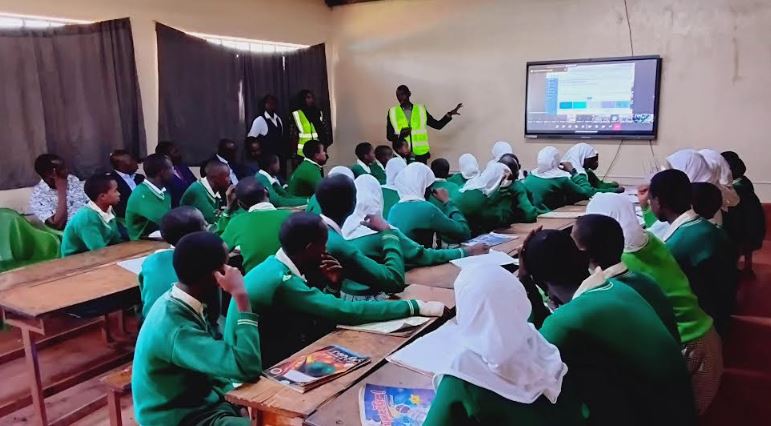
Marsabit County Commissioner (CC) Stanley Kamande has lauded the rollout of Phase Two of the Digital Literacy Programme, saying it would help address teacher shortages, expand access to specialised instruction and improve education quality in remote areas.
Kamande was speaking during the unveiling of the National Digital Class Experience Literacy Programme Phase Two under the Kenya Digital Economy Acceleration Project (KDEAP) at Marsabit Junior School in Saku Town.
The event featured an interactive digital lesson linking learners from Marsabit and others across the country with Kiminini Junior School in Trans-Nzoia County, where President Dr. William Ruto participated in a similar session.
The Kenya Digital Economy Acceleration Project (KDEAP) is a project implemented by the government of Kenya, through the Ministry of Information and Digital Economy, the Ministry of Education and the ICT Authority, with support from the World Bank, where under component 3, every public school receives an interactive smart board and teachers’ laptops to support competency-based education.
Kamande said the introduction of interactive digital smart boards marked a significant shift from traditional teaching methods, giving learners in remote areas access to educational resources and specialised teachers beyond their local schools.
“We have come from far. There was a time when learners wrote on the floor, and teachers had to contend with dusty classrooms. Today, we are embracing interactive digital technology,” he said.
The CC praised the government for extending digital learning across the country, saying learners in Marsabit deserved the same educational opportunities as those in major towns and other parts of the world.
“Our children must enjoy these opportunities on an equal footing with the rest of the country so that they are not left behind,” Kamande said.
The programme is part of the government’s broader efforts to integrate technology into teaching and learning in public junior schools and promote equitable education.
Steve Ochieng, Director of ICT at the State Department for Petroleum, said Phase One had covered approximately 10,832 public junior schools, while Phase Two was intended to reach the remaining institutions.
Ochieng said digital learning content for Grades Seven and Eight was ready for use through the education cloud, while Grade Nine content was still under development.
The resources are designed to supplement textbooks and support schools facing shortages of learning materials. Content has also been adapted for learners with visual and hearing impairments.
He added that approximately over 64,000 teachers had received training in the use of interactive smartboards, laptops and curriculum-aligned digital resources across all 47 counties.
Galgallo Fayo, Deputy Director of Corporate Communication at the ICT Authority, said the Authority had supported connectivity, device distribution and teacher training to facilitate the integration of technology into classroom instruction.
Marsabit County Director of Education Williams Kamugunah welcomed the initiative but urged teachers, school administrators and communities to safeguard the equipment provided to schools from theft and destruction.
Kamugunah warned that theft and destruction of digital devices could undermine the government’s investment and called for stronger security measures and community involvement to ensure the equipment remained available for learning.
He also commended teachers and learners in Marsabit County for maintaining peace in schools during the previous term and urged education stakeholders to sustain a peaceful learning environment as national examinations approach.
Kamugunah further appealed to national administration officers to support efforts to ensure examinations were conducted fairly and that learners received grades reflecting their actual performance.
Marsabit County Director of Teachers Service Commission Alinoor Hassan echoed the call to protect digital devices, while Abdikadir Mohamed, a director at the Ministry of ICT, highlighted electricity challenges facing some schools and proposed solar power as a possible solution.
Marsabit Primary and Junior School head teacher Fatuma Kato thanked the government for providing the school with a projector, laptop and digital interactive screen, saying the equipment would strengthen the implementation of Competency-Based Education.
Kato said digital learning was particularly important for Marsabit because of its remote location, adding that learners in the county deserved opportunities comparable to those available elsewhere in Kenya.
Meanwhile, Finn Church Aid Kenya official Abel Mutua said the organisation was implementing a last-mile digital connectivity programme targeting 27 schools in Marsabit Central Sub County.
Mutua said the organisation was also supporting schools with furniture, teacher training in ICT integration and online safety, and efforts to improve the management of digital learning resources.
Education stakeholders said the programme’s success would depend on reliable internet connectivity, trained teachers, adequate electricity and proper maintenance of school equipment.
The initiative is expected to strengthen digital skills, increase learner participation and improve access to quality education in remote and underserved communities.
By Anthony Melly