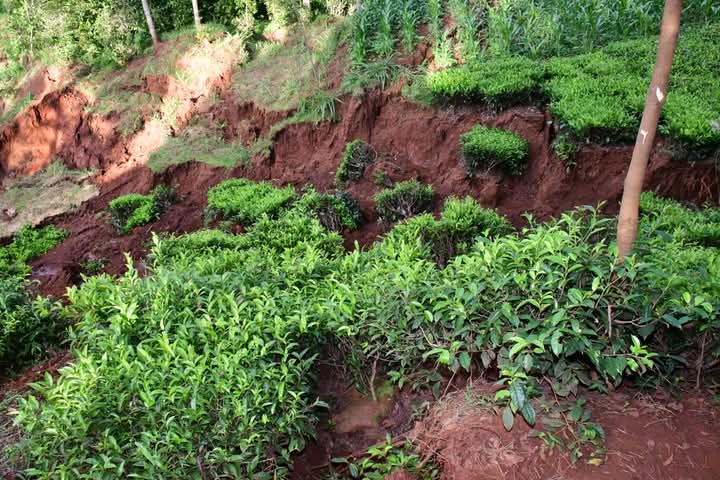
Twenty-one families displaced by landslides in Musoso village, Kangema Constituency, have appealed to the government to resettle them permanently before the onset of the expected heavy October-December rains.
The families have lived in temporary accommodation at the compound of ACK St Andrews Kiarathe Church for nearly two and a half years after landslides destroyed their homes and farmland during the March-April 2024 long rains.
They fear that continued heavy rainfall could worsen the situation at their former homes, which geological surveys have declared unsafe, and further destroy the little farmland and crops that survived the disaster.
The government conducted seismic studies and geological surveys following the disaster, which established that the area was unstable and highly seismic. The surveys recommended that the affected families be permanently relocated to safer ground.
The families, however, say they have waited too long for the government to implement the recommendations.
“This has been a long wait. With the impending El Nino rains, we are worried that what remains of our land will be washed away. While we are grateful for the shelter here at the church compound, this space cannot accommodate us forever,” said Simon Irungu, one of the displaced residents.
Irungu, 60, said he never imagined that he would spend years living in a camp with his children and grandchildren.
“We had hoped to be permanently relocated and settled earlier, but after nearly two years, our hope is quickly dwindling. At 60, I did not envision living in a camp with my children and grandchildren,” he said.
Irungu lost more than 1,200 tea bushes when the ground shifted, destroying large sections of farmland and forcing the families to leave their homes.
Lucy Mwihaki Waweru, a mother of three school-going children, said the onset of every rainy season brings renewed anxiety as memories of the April 2024 disaster remain fresh.
“Talk of El Nino rains while we are still here scares us stiff. We wish the government could speed up its promise to settle us permanently so that we can finally start rebuilding our lives with certainty,” she said.
Waweru said some residents still visit their former village during the day to tend to the small patches of farmland that escaped the landslides.
“I normally go there to work on some of the tea and coffee bushes that survived, but the land remains fragile and we do not know when it might give way again,” she said.
The families are now calling on the government to expedite the resettlement process and provide them with safer land where they can rebuild their homes and livelihoods.
Kangema MP Peter Kihungi acknowledged the plight of the displaced families and said he was following up with the government and relevant ministries to find a lasting solution.
“The people will not live in the camp indefinitely. Surveys carried out last year showed that their former land is unsafe. We are engaging the government to ensure these families are permanently relocated to safer ground before the onset of the El Nino season,” said Kihungi.
The appeal comes amid warnings of potentially heavy rainfall during the October-December 2026 short-rains season.
The World Meteorological Organization (WMO) has warned that a strong El Nino could have far-reaching global effects, including crop failures, higher food prices and disruptions to economies, energy, transport and water resources.
UN Secretary-General António Guterres has also warned of the growing risks posed by the phenomenon, noting that climate conditions are entering increasingly uncertain territory.
Scientists have cautioned that the expected El Nino could coincide with extreme heat, drought and water shortages already affecting parts of the world.
In Kenya, the Meteorological Department has placed the country on alert over the expected above-average rainfall during the October-December 2026 short rains. The department has forecast heavy rainfall across about 80 per cent of the country through the end of the year.
By Florence Kinyua