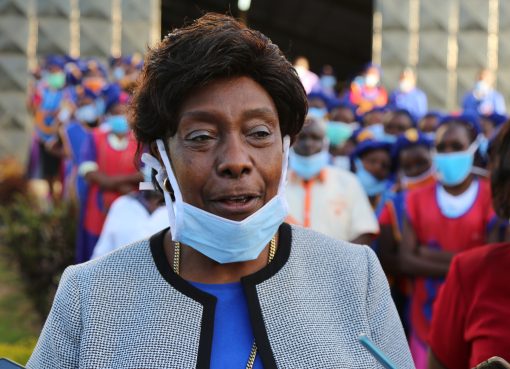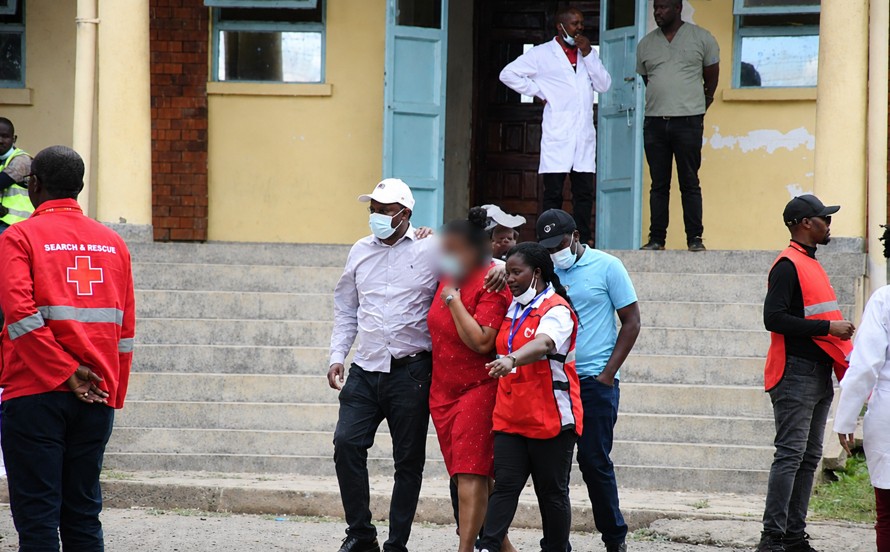
Tears flowed freely, screams pierced the air and prayers were recited on Saturday afternoon as the painful process of identifying the 16 victims of the Utumishi Academy Girls’ School fire tragedy commenced at Naivasha Sub-County Hospital mortuary.
Emotions ran high inside the mortuary as relatives, friends and media personnel covering the event struggled to come to terms with a tragedy that has raised scores of unanswered questions about school safety, fire preparedness and institutional accountability in Kenya’s boarding school system.
By the close of the exercise, only five of the 16 bodies had been positively identified, with the rest burnt beyond recognition, a grim testament to the ferocity of the blaze that tore through the girls’ dormitory.
Despite the partial identification, families of all the identified victims will be required to wait for DNA tests to be conducted on all 16 bodies before the State authorizes their release for burial, a process that authorities have warned could take considerable time.
The government simultaneously announced the formation of a joint burial committee, which will coordinate a mass funeral service at a venue yet to be confirmed.
This policy aligns with Kenya’s standard forensic protocol in mass casualty incidents.
According to the Kenya National Forensic Laboratory, DNA identification in mass fatality events typically takes between four and eight weeks, depending on the condition of remains and laboratory capacity.
Njoke Thimba, a relative from Embu who lost a niece in the fire, described the condition of the bodies as harrowing.
“Of the bodies, only three have been identified, as the others were burnt beyond recognition, and we have been told that the identification process will take time,” he said.
Thimba urged the government to expedite the process so that families could “have peace and bury their daughters with dignity”.
One Muslim family found itself in a distressing predicament, having positively identified their daughter, yet being unable to bury her immediately in accordance with Islamic religious rites, which prescribe burial within 24 hours of death.
Sheikh Hussein Were from Gilgil, confirmed that the family had identified their daughter, Zuhra Ramah, but were compelled to await both a DNA test and a postmortem examination.
“We have been told that the DNA tests will take longer and we are wondering why the delay, yet we have positively identified our daughter,” said a family spokesperson.
Were stated that the family fully respected the government’s decision but called for the expedited release of Zuhra’s body for burial at the family home in Diani, on Kenya’s southern coast.
Sheila Kipsang, a parent from Kericho, described the experience of viewing the bodies as akin to “a scene from a bad horror film”, adding that the remains were in a condition that rendered them wholly unrecognisable.
“The condition of the bodies tells the whole story and the pain that our children went through. All that we are asking for is justice,” she said.
Her sentiments were echoed by another relative, Lilian Kariuki, who described the incident as “too painful” and warned it could take years to process emotionally.
“All that we are demanding is justice for the families, so that those behind this incident can be a lesson to others,” she said.
Youth leader Joseph Kuria raised concern, alleging that radicalism may have played a role in the incident and calling on the Ministry of Education to introduce vetting procedures for students in boarding schools.
“Some of these incidents are caused by radicalisation, and it is time that the Ministry of Education addressed this issue before we lose more children,” he said.
The Directorate of Criminal Investigations (DCI) has launched a formal inquiry into the incident, with the homicide officials combing every detail into the fatal incident.
DNA samples have been taken from all 16 bodies and submitted to the government forensic laboratory.
The Cabinet Secretary for Education Julius Migos Ogamba said eight students from the school have already been apprehended and were helping investigators with crucial details of the arson incident.
Ogamba said two teachers from the institution would face disciplinary action after they failed to act on prior information that indicated that some students had planned unrest.
Equally, the CS said the school principal would face the same action over failure to adhere to the established measures regarding boarding facilities, adding that the school board had been resolved.
Kenya has witnessed a troubling pattern of school fires over the decades, with the Kyanguli Secondary School, Machakos dormitory fire that killed 67 students being one of the deadliest in the country’s history.
According to a 2019 report by the Kenya National Assembly’s Education Committee, a significant proportion of school dormitories lack adequate fire exits, functional fire extinguishers, and sprinkler systems.
The Kenya Red Cross Society and Amnesty International Kenya have both previously called for a comprehensive audit of safety standards in boarding schools, particularly girls’ institutions.
By Erastus Gichohi