Potato value addition is emerging as a key strategy for boosting farmers’ incomes and creating new markets for one of Kenya’s most important food crops.
Beyond selling fresh potatoes, farmers and processors are increasingly being encouraged to turn the crop into products such as chips, crisps, flour and other processed foods, helping to reduce post-harvest losses while increasing the value earned along the supply chain.
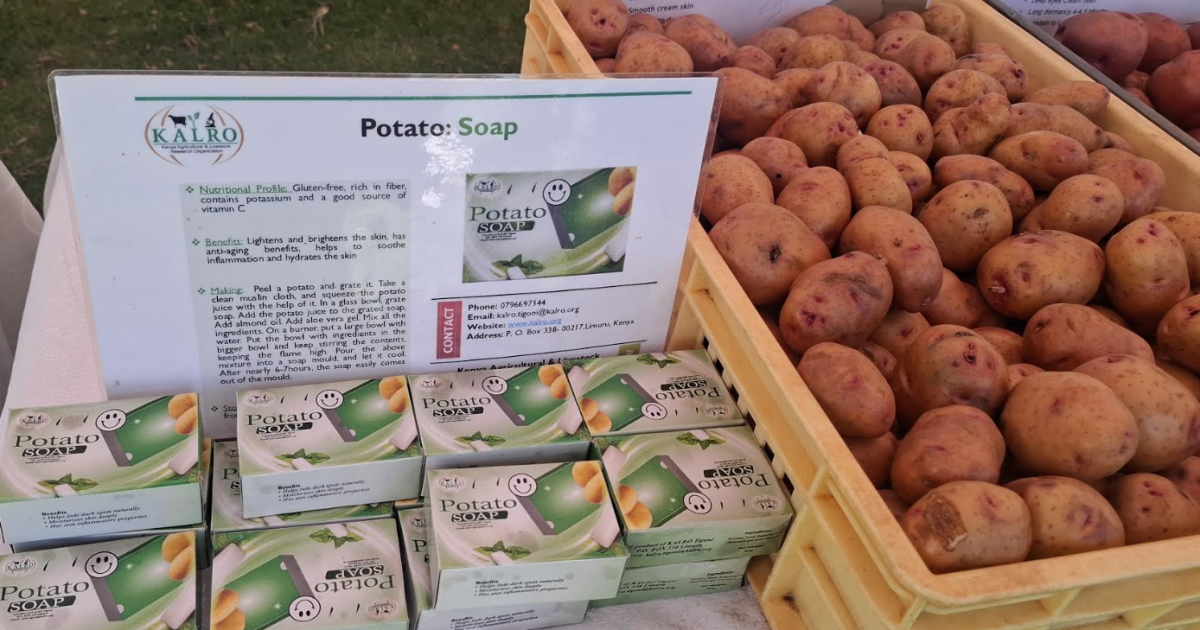
The push for diversification is also extending beyond conventional food products, with farmers being encouraged to explore innovative uses of potatoes, including potato-based soap.
Such innovations could open new markets for the crop, create employment and strengthen Kenya’s potato value chain by transforming potatoes from a largely raw agricultural commodity into a source of higher-value products.
The Kenya Agricultural and Livestock Research Organisation (KALRO) is encouraging potato farmers and young people to venture into value addition by turning surplus and damaged potatoes into soap to reduce post-harvest losses and create income opportunities.
KALRO researcher Faida John says that the potato soap technology provides an opportunity for farmers to earn additional income from potatoes that would otherwise be left to rot, particularly when market prices are low.
Speaking to KNA on the sidelines of the commissioning of the Marindas Seed Potato Centre in Kuresoi, Nakuru County, to help bridge a 126,000-tonne supply gap in certified potato seeds in the country, Faida noted that cut or damaged potatoes from a harvest can indeed be processed to make homemade soap.
“When there is surplus production, most farmers would rather let their produce go to waste. We thought of coming up with a value-added product, potato soap, that helps farmers and even the youth make a living through soap production,” Faida said.
He noted that the technology is relatively simple and uses locally available materials, including a blender, paper towels, troughs and sodium hydroxide, commonly known as acidic soda.
According to Faida, the soap can be made using either peeled or unpeeled potatoes, with the aim of minimising waste along the potato value chain.
“Potatoes contain vitamin C and antioxidants, which are retained in the soap because the potatoes are blended rather than sieved before being incorporated into the soap-making process. The antioxidants are very important because they help in removing dark spots and have some anti-ageing effect,” he explained.
He said that the soap is currently retailing at about Sh200 per piece, presenting an opportunity for farmers, youth and other players in the potato value chain to generate income and added that interested farmers and entrepreneurs can visit KALRO centres for training on how to produce the soap.
The researcher, however, cautioned that Kenya should not interpret the availability of value-addition technologies as an indication that the country has produced enough potatoes to meet domestic demand.
“We haven’t really fed ourselves. We can’t say we have a surplus,” he said, noting that significant quantities of potatoes are lost after harvest due to poor prices and inadequate storage.
Faida said farmers sometimes hold onto their potatoes hoping for better market prices, but the crop is highly perishable and can deteriorate before prices improve.
He noted that mechanically harvested potatoes can also have cuts and damaged tubers, which farmers often feed to livestock or leave to rot.
“Instead of letting them rot or wasting them, you can actually come up with a product that brings value to you and brings you revenue. That is what we are trying to do: bring money into the pockets of the farmers that we meet,” he said.
Faida further explained that the soap can be produced from different potato varieties, meaning farmers do not need to grow a specific variety to benefit from the technology, adding that potato soap is only one of several value-added products that can be developed from the crop.
Other products include dehydrated potato cubes, potato starch and potato flour, which can be used in baking cakes and other food products.
“Most of us just know the table part of potato and the processing part in terms of chips and crisps. But there is another array to it, the value-addition part,” Faida said.
Expanding potato value addition, Faida said, could help reduce wastage while creating new income-generating opportunities for farmers and young people.
Globally and regionally, potatoes remain one of the most highly wasted staple foods, with countries like Kenya losing roughly 23 per cent of their total potato harvest before it reaches the consumer.
By Wangari Ndirangu