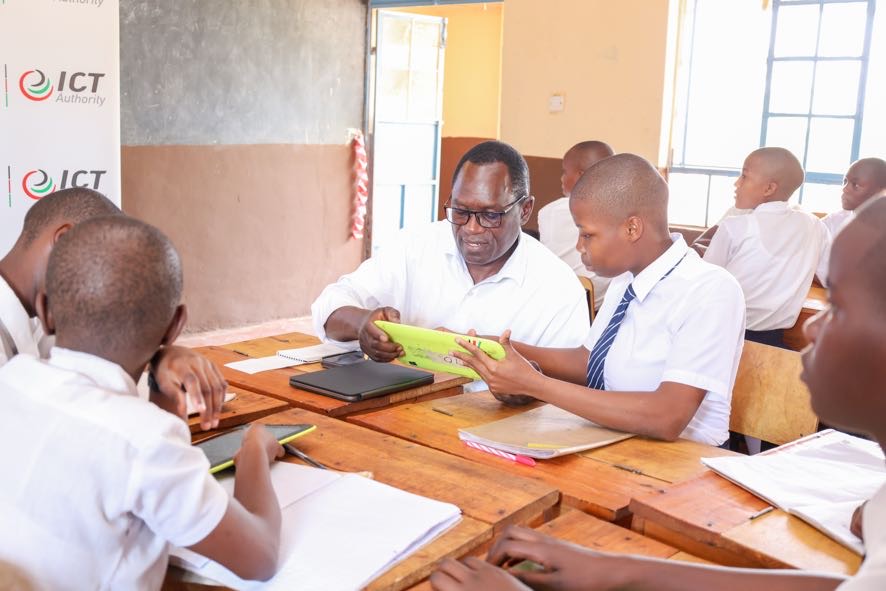
At least 332 public junior schools in Kisii County are set to benefit from interactive smart boards and laptops under the government’s National Classroom Experience of the Digital Literacy Programme Phase II.
The initiative is being implemented in partnership with the World Bank, the Kenya Digital Economy Acceleration Project (KDEAP) and the Ministries of Education and Information, Communications and the Digital Economy.
Speaking during the handover ceremony at Kisii Comprehensive School in Kisii town, Broadcasting and Telecommunications Principal Secretary Stephen Isaboke lauded the programme saying it was part of the government’s broader commitment to digitising education and ensuring learners acquire the digital competencies required to compete in the global economy.

Isaboke noted that introducing digital devices to learners at an early stage would ensure they develop computer skills, access educational resources and familiarise themselves with emerging technologies.
“Seeing these children using these devices today and answering computer questions at this level of their lives is amazing. It means Kenya can compete with countries such as India, China and those in Europe in terms of digital skills and competitiveness,” he said.
The PS pointed out that reliable internet connectivity was essential to ensuring that schools fully benefit from digital learning.
As a result, he said the government was implementing the Digital Superhighway programme, which targets the installation of 100,000 kilometres of fibre-optic cable and the establishment of 25,000 public Wi-Fi hotspots to expand internet access across the country.
Isaboke noted that nearly 50,000 kilometres of fibre-optic infrastructure had been installed through partnerships with private telecommunications operators and other government agencies to extend connectivity to schools and underserved areas.
“Kenya Power and Lighting Company, the ICT Authority and Communications Authority were collaborating to expand fibre-optic infrastructure, including by leveraging existing electricity infrastructure to connect more institutions,” he said.
Notably, a total of 250 kilometres of fibre had been installed, connecting 179 institutions and 32 public Wi-Fi hotspots in Kisii.
The County Director of Education Philip Chirchir decried the increase in cases of theft and vandalism of digital devices in schools, especially during the roll out of Phase I of the programme.
Chirchir urged the school heads to prioritise the security of the digital devices and work closely with the security agencies to ensure action is taken against anyone found stealing the school equipment.
He also encouraged the teachers and learners to embrace the programme, saying the devices will significantly improve teaching and learning.
Kisii Comprehensive School Principal James Mitunda said the digital learning devices will improve learners’ understanding and retention by enabling them to interact with educational content and apply concepts practically.
Mitunda said the school’s junior school section had 847 learners and urged the government to supply additional devices to the school to meet the needs of all learners.
The principal noted that expanding access to digital learning equipment would help teachers integrate technology across learning areas and make lessons more interactive.
He added the school already had electricity and internet connectivity but required a standby generator to ensure uninterrupted digital lessons during power outages.
At Kisii Comprehensive School, learners welcomed the live interactive digital class with schools in Nyamira, Siaya, Bungoma, Vihiga and Busia, saying the lessons were more engaging and improved their ability to research and understand different subjects.
Jacob Desmond, a learner at the school, said the technology had enabled them to conduct research more effectively and expressed his ambition to become a software engineer.
“I have had a pretty good experience learning about the hardware components and their uses. Learning has also been made easier through these tablets, and we were able to research well,” noted Desmond.
Whitney Florence, another learner, described the experience as enjoyable and called on the government to supply more devices to public schools to expand access to digital learning.
She said additional devices would enable more learners to benefit from interactive lessons and improve their classroom experience.
So far, the government has equipped 10,382 schools with the digital devices, accounting for nearly 50 per cent of all public junior schools, and trained more than 64,000 teachers.
The rollout forms part of the government’s wider efforts to integrate digital technology into education, expand internet connectivity and prepare learners for emerging opportunities in the digital economy.
By Alfred Misheba and Mercy Osongo