By M, KNA
The National Lands Commission (NLC) has sounded an alarm over increased uneconomical subdivision of land, particularly in areas that are potentially highly productive agriculturally.
Speaking during a two-days stakeholders’ forum to discuss findings on the effects of land fragmentation on food security, NLC Chairman Gershom Otachi said the results of the study showed shocking details in terms of how fast agricultural land is being subdivided.
Otachi cited the case of Nyamira County, where the average size of land shareholding at the end of the adjudication at the moment is between half an acre and one acre, as opposed to the 1970s where it was 20 acres.
“Therefore, we are moving in a direction where it is not sustainable to have expansive agricultural activities because of over subdivision of arable land,” the Chairman pointed out.
The NLC with support from the Food and Agriculture Organization (FAO) and European Union (EU) commissioned the research to assess the current situation of land fragmentation in 13 counties and come up with sustainable ways of addressing the issue.
The counties included Nyamira, Laikipia, Nandi, Trans Nzoia, Taita Taveta, Kiambu, Nakuru, Kajiado, Tana River, Makueni, Isiolo, Kisumu and Vihiga.
The study revealed that rapid population growth, inheritance of agricultural land, uncontrolled urbanization, absence or weak implementation of land protection policies, processes and procedures, land speculation, and development due to big public projects are the main drivers of land fragmentation.
As a result, Otachi added they were working closely with the counties which consider agriculture as a development function to bring the discussion to the ground and help the people to understand the effects of land subdivision.
Kisii Governor Simba Arati acknowledged that Kisii and Nyamira are among the counties facing land fragmentation due to the number of rural slums that are coming up.
Arati encouraged the residents to embrace the affordable housing project, saying that it would help to ease the land pressure.
Currently, the national government has allocated 1.8 billion in Kisii county for the construction of 927 affordable housing units in Nyanchwa, Ogembo and Nyaribari Masaba areas as part of providing decent, safe and affordable housing for citizens.
The County Boss also lauded the partners including the NLC, FAO and the EU for the efforts they have made in addressing land sub-division in relation to food security.
The report recommended the development of guidelines on viable minimum agricultural land sizes for all counties, enforcement of the existing processes and procedures in land transactions, extensive sensitization and awareness on the negative effects of land fragmentation and enhancing the capacity of the key institutions involved in the regulation of land use among others.
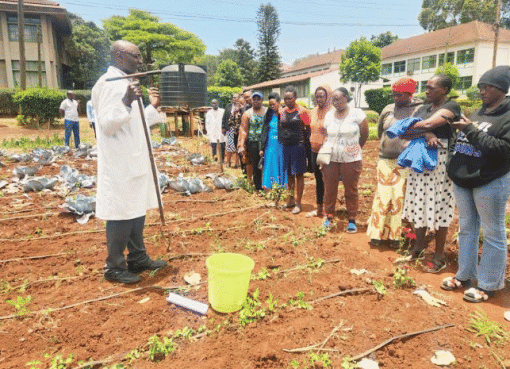
Speaking at the same forum, Kisii University Vice Chancellor Prof. Nathan Ogechi said the institution will continue to collaborate with the partners to enhance further research on land use through community engagements among farmers and the larger community.
According to FAO’s Deputy Country Representative Hamisi Williams, subdivision of land remains a great concern to every county because people are already bearing the burden brought by it.
Williams noted they are working closely with all partners to develop a demand-driven and unique policy that will benefit the affected community members.
The Kenya National Bureau of Statistics (2019) estimates show that Kenya has a population of about 48 million and the number is expected to surpass 100 million people by the end of 2058.
In this regard, the country is faced with the challenge on how to produce food that will meet the demand for the growing population against dwindling agricultural land sizes.
Therefore, there is a need to address the impact of land fragmentation on food security and land use.