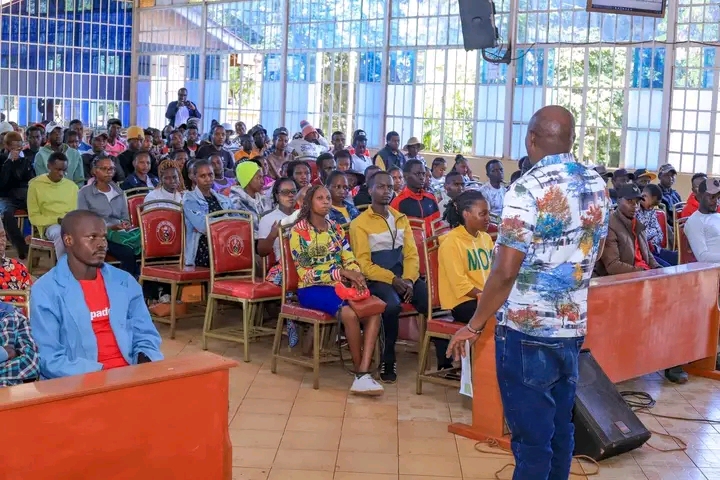
The National Youth Opportunity Towards Advancement project has been hailed by residents of Tinderet Sub County as a major empowerment initiative capable of transforming the lives of youths and women, with calls for county governments to uniformly waive license fees for beneficiaries and establish a foolproof monitoring mechanism to ensure the programme achieves its intended goals.
Residents, youth groups and small-scale traders said the success of the NYOTA project will largely depend on the support accorded to beneficiaries during the early stages of establishing their businesses.
They noted that many youths often struggle to sustain newly established enterprises because of high operational costs, including county business permit fees and market levies.
Youth leader Peter Kibet from Maraba market said county governments should grant NYOTA beneficiaries, who recently received the first instalment of Sh 22,000, a grace period of at least one year before requiring them to pay licence fees.
“Most of these young people start small enterprises such as welding workshops, kiosks, poultry farming and tailoring businesses. Subjecting them immediately to licence fees and levies weakens the businesses before they gain footing,” said Kibet.
He added that a uniform policy across counties would ensure fairness and equal opportunities for all beneficiaries of the grant regardless of their location.
At Songhor Trading Centre, businesswoman Esther Jepkemboi said the project has the potential to significantly reduce unemployment among youths and women if accompanied by proper follow-up mechanisms.
She noted that many empowerment initiatives fail because beneficiaries are abandoned after receiving startup support.
“The government should not only provide funds or equipment and walk away. There must be close monitoring and mentorship to ensure the businesses are progressing well and challenges are addressed in time,” she said.
Jepkemboi proposed the formation of local monitoring committees comprising county officials, national government representatives, administrators and community leaders to oversee implementation of the project.
She said the committees would help prevent misuse of funds and ensure accountability among beneficiaries.
Farmers in Kabiyet also welcomed the programme but emphasized the need for transparency in the selection of beneficiaries and management of resources.
Farmer Jackson Langat said previous empowerment initiatives had in some cases been compromised by favoritism and lack of accountability.
“The monitoring system must be watertight to ensure resources reach the intended beneficiaries. There should be regular inspections and audits to confirm that the supported projects are operational,” said Langat.
He further suggested the introduction of digital monitoring systems to track the progress of supported enterprises and evaluate their impact on local livelihoods.
Women groups in Ndalat called for continuous business training and mentorship for beneficiaries.
Women’s group chairperson Mary Chepkemoi said many young entrepreneurs lack adequate skills in financial management and business planning.
“Some beneficiaries may have good ideas but lack the knowledge to sustain business growth. Training on bookkeeping, savings and marketing should be part of the program,” she said.
Chepkemoi also urged county governments to collaborate with financial institutions and cooperatives to create affordable credit opportunities for beneficiaries seeking to expand their enterprises.
Boda boda operators in Tinderet Township said the project could help reduce rising unemployment among school leavers if properly implemented.
Motorcycle operator Brian Kirwa said easing license requirements for startups would motivate more youths to venture into self-employment.
“The economy is tough and many youths are unemployed. If county governments reduce the burden of licence fees, more beneficiaries will successfully establish businesses and become financially independent,” said Kirwa.
Education stakeholders in the region also supported stronger oversight of the programme.
Teacher Josephine Tuwei said some previous youth empowerment projects had failed because funds were diverted into non-productive activities.
She emphasized the need for regular evaluation and mentorship to ensure the intended objectives are achieved.
“The programme can succeed if beneficiaries are guided properly and closely monitored. Supervision and accountability are critical in ensuring the resources are used productively,” she said.
Residents also called for extensive public awareness campaigns to ensure people in rural areas understand the objectives and opportunities available under the NYOTA project.
They proposed the use of chiefs’ barazas, churches and local radio stations to disseminate information and encourage eligible youths and women to apply for support.
The residents expressed optimism that with coordinated support from both national and county governments, the NYOTA project could significantly improve household incomes, create employment opportunities and stimulate economic growth.
By Sammy Mwibanda