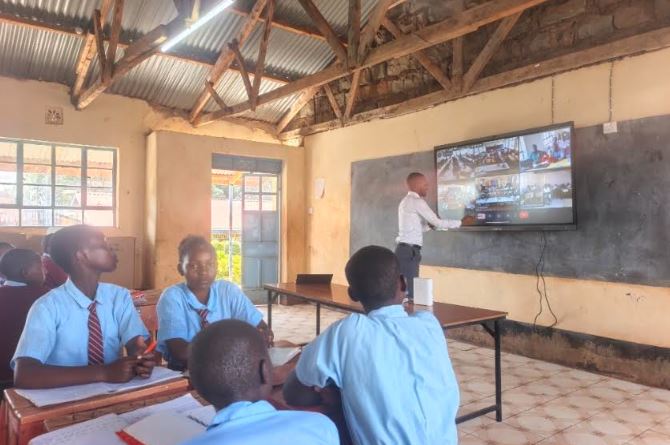
Public junior schools are beginning to embrace technology-driven learning as the government rolls out digital equipment to support the Competency-Based Education (CBE) curriculum.
Through the National Digital Class Experience programme, public junior schools are being equipped with interactive smart boards and teacher laptops to transform classroom instruction, improve access to learning resources and prepare learners for an increasingly digital world.
The initiative was launched at Sitotwet Junior School in Narok South, bringing digital learning closer to communities that have traditionally faced challenges accessing modern educational technology.
Information Communication and Technology Authority (ICTA) Chief Executive Officer, Mr Jessy Kiveu Maruti, said the programme was designed to give learners across the country more equitable access to technology and the educational opportunities it creates.
He said the first phase targeted 50 per cent of the 10,382 public junior schools earmarked for the rollout and that the initial phase had been completed. The authority expects to extend the programme to all targeted schools by April next year.
The project is being implemented by the national government through the Ministry of ICT and the Digital Economy, the Ministry of Education and the ICT Authority under the Kenya Digital Economy Acceleration Project (KDEAP), with support from the World Bank.
However, providing equipment is only one part of the transition to digital learning. Reliable internet connectivity will be essential for schools to access online educational resources and make full use of the technology.
Mr Kiveu said the authority was working towards ensuring that schools had dependable broadband connectivity, noting that the supporting infrastructure would determine how effectively the initiative could be used in classrooms.
ICTA board member Nayianoi Ntutu said the initiative would give children in rural areas opportunities to learn and develop digital skills comparable to those available to learners in major towns.
The programme is part of the government’s wider efforts to integrate information and communication technology into basic education as schools implement the CBE curriculum, which emphasises practical skills, creativity, critical thinking and the application of knowledge to real-life situations.
Under the initiative, each public junior school is expected to receive an interactive smart board and teacher laptops. The smart boards will enable teachers to deliver lessons using digital presentations, illustrations, videos and other interactive materials, making abstract concepts easier to understand and encouraging greater learner participation.
Teacher laptops will support lesson preparation, access to digital educational content and the presentation of materials through the smart boards. Used together, the devices are expected to help teachers move beyond conventional chalk-and-talk instruction towards more engaging, learner-centred lessons that complement the objectives of the CBE curriculum.
The rollout also underscores the need for continued teacher training, technical support and maintenance to ensure the equipment remains functional and becomes part of everyday teaching rather than remaining underused.
For schools in rural areas such as Narok South, the initiative offers an opportunity to expose learners to digital tools at an early stage while reducing disparities in access to educational resources. Its success, however, will depend on the government’s ability to sustain the rollout, strengthen connectivity and ensure teachers can effectively incorporate the technology into their lessons.
With full implementation targeted for April next year, the programme is expected to expand access to technology-enabled learning across public junior schools, supporting the country’s broader ambition of preparing learners with the knowledge and skills required in a digital economy.
By Emily Kadzo