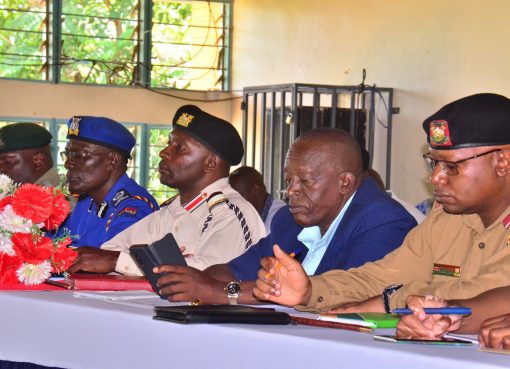
The Tana River County government is strengthening project monitoring and implementation to ensure accountability, transparency and maximum value for public funds.
The move seeks to strengthen public project oversight, improve accountability, and ensure efficient resource utilization.
The new initiative by the devolved government focuses on tracking progress, addressing bottlenecks in project execution, and aligning county priorities with national developmental goals.
The County Executive Committee Member (CECM) for Public Service Management and Administration, Abdullahi Hante, says a new chapter in accountable governance has begun in Tana River County following the launch of a comprehensive project stocktaking exercise.
Speaking to the press in his office, Hante contended that a well-structured monitoring and evaluation system is crucial for tracking public project progress, identifying challenges and making data-driven decisions that lead to successful project implementation.
He emphasized that effective monitoring and evaluation is vital for ensuring projects deliver intended outcomes and contribute to national development.
“It would also ensure that every shilling spent on public infrastructure projects, should translate into measurable improvements in governance and service delivery,” he said.
“The stocktaking exercise is a bold initiative set to redefine how development projects are planned, executed, tracked, and delivered for the benefit of the people,” he added.
Hante said the initiative brings together County leaders, technical officers and stakeholders across all departments.
“The launch signals a decisive shift from fragmented project implementation to a data-driven, transparent and results-oriented development approach,” he said.
The process is anchored under the Kenya Devolution Support Programme Phase II (KDSP II), which is a Four-year World Bank-funded program aimed at strengthening capacity and performance in all 47 counties.
Hante said beyond compliance with KDSP II requirements, the County government is positioning the stock-taking exercise as a catalyst for institutional reform that will reshape project management practices across all sectors.
The County Executive noted that gaps in project tracking, weak monitoring systems, and poor coordination across departments have often undermined the full impact of project investments.
“Projects have been initiated without complete records; some have stalled due to funding and procurement challenges, while others have lacked proper follow-up to ensure sustainability,” he stated.
He noted that recognizing these challenges, the County government has taken a bold step to transform how development is managed, moving beyond assumptions to evidence- and data-based decision-making.
“This exercise is not just about counting projects, but about understanding their impact, identifying gaps, and ensuring that every investment delivers value to the people,” said Hante, adding, “With this launch, Tana River has taken a significant step towards a future where every investment is tracked, every challenge is addressed, and every citizen benefits.”
The County Executive stated that once the KDSP II project is declared a success, the county is eyeing a Sh352 million Level Five Hospital project, jointly funded by the National government and the World Bank.
He said the County’s KDSP II focuses on strengthening devolution processes, with specific initiatives aimed at improving healthcare infrastructure, enhancing local institutional capacity, improving service delivery and strengthening accountability.
KDSP County Coordinator Omar Dhadho said the stock-taking exercise is being implemented through a rigorous and participatory methodology designed to ensure accuracy, credibility, and inclusivity.
Dhadho said technical teams will undertake a comprehensive desk review of project records, budgets, and departmental registers; field verification and GIS geo-tagging to confirm the physical existence and status of all public projects.
He said stakeholder consultations involving Project Management Committees (PMCs), contractors, Ward Administrators, and community beneficiaries of each project will be assessed based on its implementation status, alignment with development priorities and compliance with technical, environmental and social standards.
The Coordinator said at the heart of the KDSP, a performance-based grant initiative, is a commitment to address longstanding systemic challenges.
Dhadho said by embedding transparency, strengthening systems, and leveraging technology, the County is laying the groundwork for sustainable, inclusive, and impactful development.
“Previously the absence of a centralized project database meant that departments operated in silos, thus leading to duplication, inefficiencies and missed opportunities for learning and improvements,” he said.
Dhadho said through this exercise, the County aims to establish a GIS-enabled project management information system, enabling real-time tracking, improved coordination, and enhanced transparency.
“We are building a system where every project can be tracked, monitored and evaluated in real time. This is how we ensure accountability and better service delivery,” he noted.
He stated that the outcomes of the exercise are expected to be both immediate and transformative with a verified and comprehensive database of all county projects including clear identification of completed, ongoing, stalled and abandoned projects.
The coordinator said the success of the stock-taking exercise will depend on the active participation of all stakeholders including the county departments, the County Assembly, development partners, civil society organizations and local communities.
“This is a shared responsibility as accountability begins with us, but it must involve the people that we seek to serve,” he said.
By Hussein Abdullahi