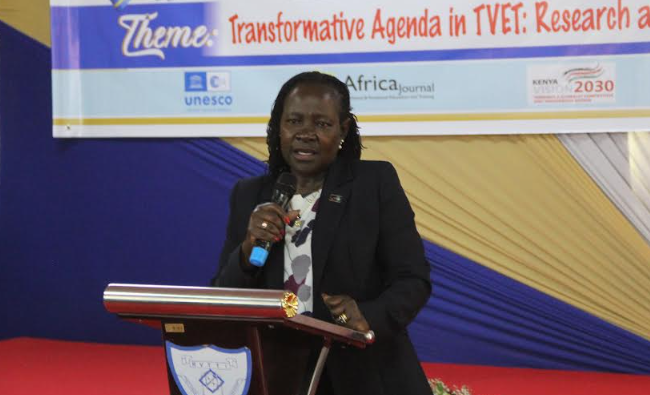
Technical and Vocational Education and Training (TVET) PS Dr. Esther Muoria has emphasized the importance of putting into practice research ideas, saying this is the ultimate catalyst for progress that transforms abstract thoughts into actionable solutions, drives innovation, empowers critical thinking, and directly improves the standard of living.
Speaking during the closing ceremony of the 14th TVET and Interdisciplinary International Conference, held at Rift Valley Technical Training Institute (RVTTI), Dr. Muoria explained that every conference gathers ideas. Some are presented with confidence; some are received with applause, and most are published, cited, and filed.
However, the real test of an idea is not whether it was presented well, but whether it was given life beyond the presentation.
According to the PS, without practical execution, even the most brilliant concepts remain confined to the mind, benefiting no one.
In her reflection on the fate of ideas, Dr. Muoria highlighted the example of two graves: the first one where the body is laid to rest and the second one, which she referred to as the most tragic, is the “graveyard of the mind”—the silent place where ideas are buried before they are tested, where research findings remain in conference files, where prototypes never leave exhibition tables, and where recommendations are printed but never implemented.
“As we close this 14th RVTTI TVET and Interdisciplinary International Conference, my challenge to all of us is simple: Let not the ideas generated here be buried in that second grave,” she noted.
The PS challenged stakeholders to take seriously the lessons learned from the conference, noting it has not merely gathered papers but has gathered possibilities and urgent national concerns touching trainees, trainers, industries, institutions, communities, and the wider economy in agriculture, artificial intelligence, entrepreneurship, renewable energy, industrial automation, and sustainable development.
Dr. Muoria noted that the true value of the conference will therefore not be measured only by the quality of presentations delivered but by what happens after people leave the hall, saying that a paper on artificial intelligence must help improve training, assessment, and institutional efficiency.
Similarly, work on agriculture must find its way into farms, laboratories, value chains, and communities. Research that does not move into practice becomes a well-written obituary of an idea that could have lived, she added.
Dr. Muoria said TVET is not designed to be a cemetery of theories but to be a workshop of solutions: Its strength lies in thinking deeply and building practically, in identifying problems and solving them, and in publishing knowledge and converting it into competence, productivity, enterprise, and national transformation.
“The tragedy of research is not always that it fails. Failure can teach. Testing can refine it. Piloting can reveal gaps. Industry can improve prototypes. Communities can validate solutions.
The greater tragedy is when research is never attempted beyond presentation, because an idea that is never implemented teaches nothing, changes nothing, and serves no one,” added Dr. Muoria.
She called on research experts not to let fear, bureaucracy, limited resources, institutional silos, or the search for perfect conditions become undertakers of innovation.
The PS decried that many promising ideas die because their owners wait for perfect funding, perfect laboratories, perfect partners, perfect policies, and perfect certainty.
She underscored that sustainable transformation rarely begins in perfect conditions. It begins when committed people take courageous first steps.
By Ekuwam Sylvester