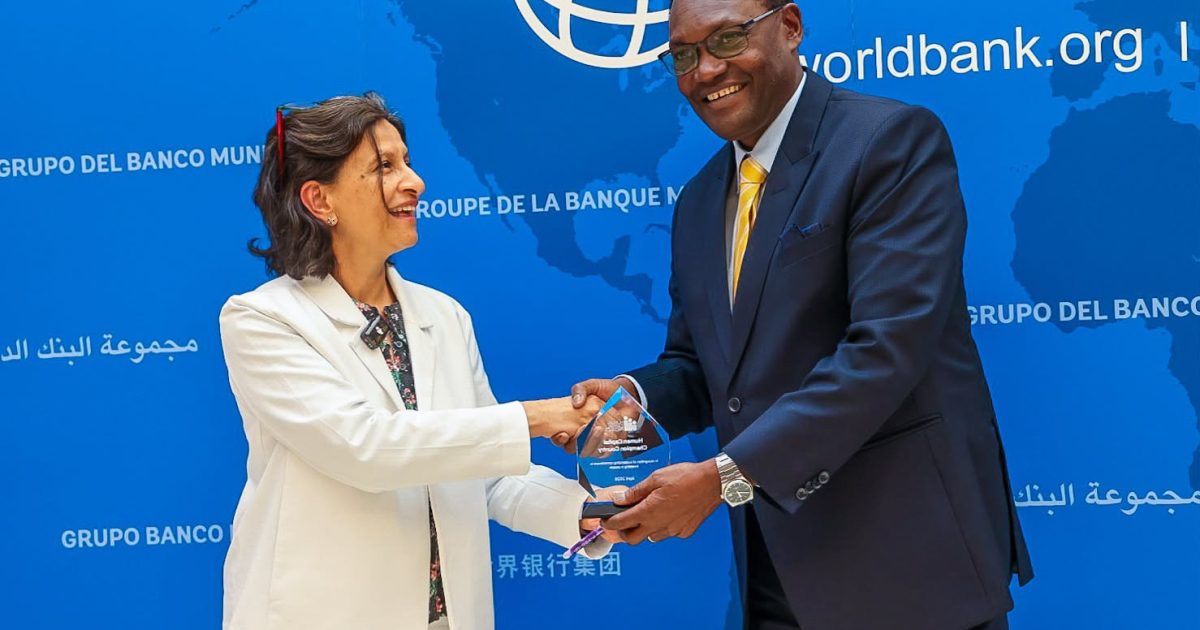
Kenya has been awarded the Human Capital Champion Award at a high-level country celebration hosted by the World Bank Group in Washington, D.C., in recognition of its sustained progress in building human capital.
The National Treasury Principal Secretary (PS) Dr. Chris Kiptoo received the award during the Human Capital Country Celebration held on the sidelines of the IMF/World Bank Spring Meetings.
The award places Kenya among the top-performing countries globally relative to its income level, reflecting consistent investments in education, health, and employment systems that underpin long-term productivity and inclusive growth.
Presenting the award, World Bank Group Vice President for People, Mamta Murthi, commended Kenya’s measurable progress under the expanded Human Capital Index Plus (HCI+), a framework that evaluates both the accumulation of human capital and how effectively it is utilised within the economy.
Kenya’s performance has been supported by tangible gains across key indicators, including a 16 per cent reduction in child stunting and significant expansion in access to tertiary education.
These improvements reflect sustained policy reforms and targeted government interventions aimed at strengthening human development outcomes.
The ceremony brought together ministers and senior officials from a range of countries, including Jamaica’s Fayval Williams, Ruslan Suinaliev, Murangwa Yusuf, and representatives from Vietnam, underscoring a shared global commitment to advancing human capital as a foundation for economic transformation.
The recognition further consolidates Kenya’s position as a leading reformer in human capital development and signals growing international confidence in its policy trajectory toward inclusive growth and long-term economic resilience.
Kenya’s HCI+ performance remains above the Sub-Saharan Africa average (126) and the average for lower middle-income countries (153), indicating its relative strength in converting investments in people into measurable development outcomes.
Human capital refers to the knowledge, skills, health, and capabilities that individuals accumulate over time, enabling them to contribute productively to economic and social development.
By Joseph Ng’ang’a