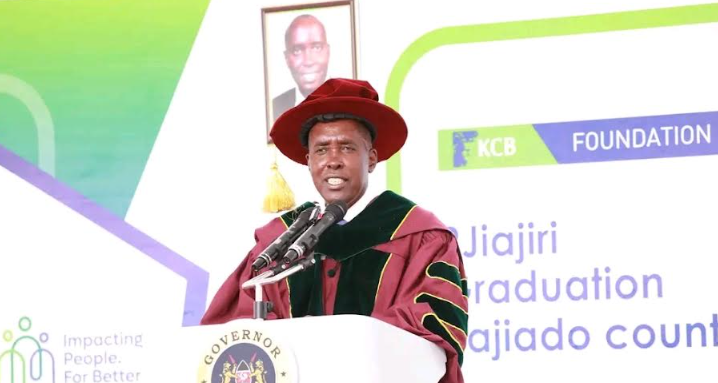
A total of 932 trainees from seven vocational training centres in Kajiado County have graduated under the KCB Foundation’s 2Jiajiri programme, in a move aimed at equipping young people with technical, vocational, and entrepreneurial skills.
The graduates were drawn from Isinya, Namelok, Meto, Ole Kasasi, Nkaiseri, Maa Institute, and Endasopia vocational training centers, with 87 trainees recognised for outstanding performance.
Speaking during the graduation ceremony, Kajiado Governor Joseph ole Lenku said the county government had prioritised education and vocational training as key drivers of youth empowerment and socio-economic development.

Lenku said the county had deliberately established vocational training institutions across the county, including in remote areas, to ensure young people had equitable access to technical education and skills development.
“We made sure these services are available in every part of the County, including remote areas. Today, we are seeing our graduates becoming self-employed, while others are securing jobs in leading organisations,” he said.
The Governor said investment in education was necessary to address historical gaps in access to formal education, particularly among older generations, which he noted had affected development in the county.
He commended the National Industrial Training Authority (NITA) for partnering with the County government to strengthen technical and vocational training.
Lenku said the programme, which started with about 200 trainees, had expanded significantly, with more than 1,400 young people now benefiting from the initiative.
“We started with about 200 trainees, and today, the number has risen to over 1,400. We expect even more young people to benefit next year,” he said.
Deputy Governor Martin Moshisho urged the graduates to apply the knowledge and skills acquired during their training to improve their livelihoods and contribute to the country’s industrialisation agenda.
Moshisho said countries seeking industrial growth must invest in skilled labour and quality workmanship, challenging the graduates to use their skills productively.
“You should go out and multiply what you have received through your education, because industrialisation depends on a skilled workforce,” he said.
KCB Foundation Manager, Bernard Barasa, said the Foundation remained committed to empowering young people through technical and vocational skills training in partnership with the Kajiado County Government.
He said the 2Jiajiri programme was designed to equip youth with employable and entrepreneurial skills, enabling them to create sustainable livelihoods through employment and enterprise development.
The County Executive Committee Member for Vocational Training, Youth, and Sports, Janet Sereu, challenged the graduates to focus on creating jobs rather than solely seeking employment.
“You should create opportunities for yourselves and others. I know you will change the face of Kajiado County. Go out and transform the future of this county,” she said.
NITA representative Musa Opuk assured the graduates that the certifications and awards issued under the programme, were recognised locally and internationally.
Opuk said the training had been conducted in accordance with established regulations and that the graduates had acquired the necessary competencies in their respective areas of specialization.
He cited the success of Ben Power Electricals, an electronic engineering graduate who established his own enterprise and has since created employment for more than 17 people, as an example of the opportunities available to skilled youth.
During the ceremony, 77 outstanding graduates received start-up toolkits to enable them to establish businesses in their respective trades.
One of the beneficiaries, Benson Lemayian, shared his success story and encouraged fellow graduates to remain committed to their professions, saying technical skills could provide a pathway to meaningful careers and successful enterprises.
The 2Jiajiri programme is implemented by KCB Foundation in partnership with the Kajiado County Government and focuses on two key pathways: skilling young people through training and certification and supporting them to establish and grow their own enterprises.
The programme aligns with the Fourth Pillar of the Kajiado County Development Agenda, which seeks to promote equitable access to quality education and position the county to take advantage of global opportunities and shared prosperity.
Since its inception in 2016, the 2Jiajiri programme has trained thousands of young people, disbursed more than Sh3 billion to support youth enterprises, and issued over 5,000 start-up toolkits.
The latest beneficiaries bring the number of graduates under the programme to more than 1,400.
By Sinkeet Kikon and Joyline Arodi