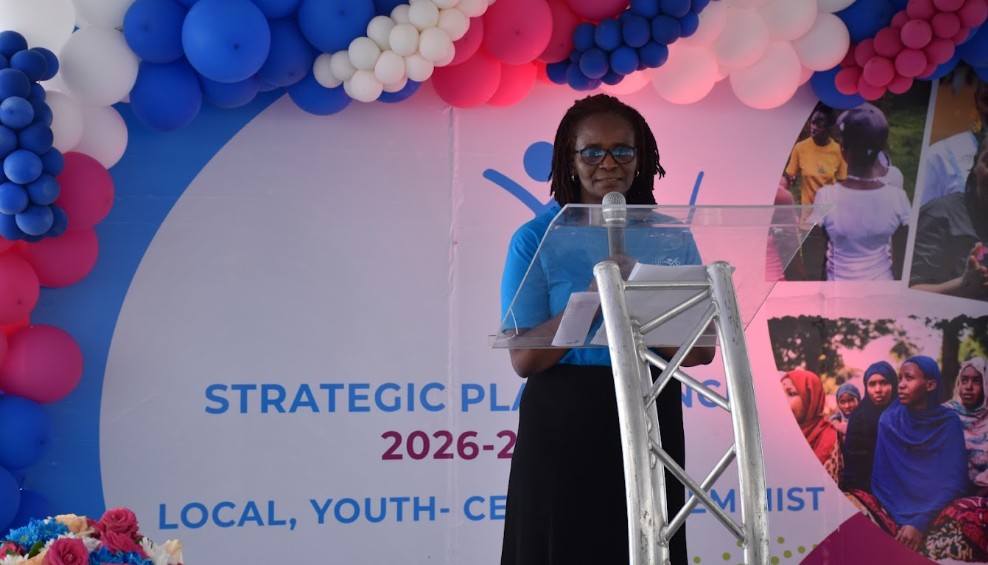
Youth for a Sustainable World (YSW) has unveiled an ambitious five-year Strategic Plan aimed at transforming the lives of young people in Kenya by expanding access to sexual and reproductive health services and promoting gender equality, youth leadership, and economic empowerment.
The 2026–2030 plan strategically positions young people at the centre as drivers of social change, sustainable development, and inclusive growth.
The locally led, youth-centred feminist organisation works with adolescents and young people aged between 10 and 24 years in at least 17 counties.
Speaking during the launch at the Tassia Catholic Primary School, Nairobi, Executive Director of YSW, Evelyn Samba underscored the organisation’s vision to empower young people particularly girls and young women, to understand their rights, seek opportunities, and build their futures.
“YSW is an organisation that works with young people aged 10 to 24 and currently we operate in at least 17 counties in Kenya,” said Samba.
“We prioritise to ensure young people have access to information on their sexual and reproductive health. We also prioritise gender equality and empowering young men and young women to understand their rights and to be able to say no to violence.”
The new strategy seeks to strengthen systems around Sexual and Reproductive Health and Rights (SRHR), economic justice, climate resilience, accountable governance, and youth participation in development policy by 2030.
Under the new plan, YSW will be advancing integrated youth-friendly Sexual and Reproductive Health and Rights (SRHR) information and services to improve health outcomes for adolescents and young people while addressing the poor SRHR outcomes, poverty, and inequality.
Samba said the organisation adopted peer-to-peer education to expand access to SRHR information among adolescents and young people.
“We work with young people as agents of change, where they are trained on peer education and using the peer-to-peer approach; they go out to talk to others about their sexual and reproductive health,” she said.
According to Samba, the approach helps break stigma and misinformation surrounding sexuality and reproductive health among adolescents.
“There is a lot of discomfort around sexuality for young people and therefore, if young people themselves are able to talk about this amongst themselves and pass on accurate and correct information, then we know that they are not going to rely on information they find online, which sometimes is erroneous,” she added.
Beyond peer learning, YSW is also partnering with county governments and healthcare providers to ensure the provision of youth-friendly services in public health facilities.
“Many young people shy away from seeking services because they feel it is not friendly. They approach a service provider who has bias or who is not well-equipped to meet the young person’s needs,” Samba explained.
She added, “We advocate for the government to ensure that there are sufficient, available, and appropriate resources for young people.”
Samba reiterated that advocacy will remain a central role for the organisation to push for increased public investment in accessible and youth-responsive health services.
At the community level, YSW is engaging parents, faith leaders, opinion shapers, and local institutions to address stigma and harmful attitudes surrounding adolescent sexual and reproductive health.
“A lot of the stigma that young people are having to deal with is actually emanating from us, the adults,” she said. “We are not yet at a point where we recognise and accept that young people have their own rights and these rights, up to and including sexual and reproductive health, must be respected and protected.”
She linked the continued silence around SRHR to increasing teenage pregnancies, HIV infections, and gender-based violence among young people.
“It is the reason that we continue to see increasing teen pregnancies. It is the reason we continue to see increased HIV infections among young people and increased gender-based violence amongst young people,” she stated.
The plan will also prioritize youth enterprise and market systems development, as it will strengthen vocational and entrepreneurship skills, therefore expanding access to finance and linking young people to jobs and markets by supporting youth-led enterprises.
She said the new plan will also promote gender equality and create a favourable environment where young people, especially girls and young women, can thrive with dignity and equality.
Responding to concerns over rising HIV infections among adolescents aged 15 to 19, Samba emphasised the need for honest conversations, sex education, and access to protection services rather than stigma and denial.
“We cannot deny the fact that these young people have relationships. But do they do that from a point of knowledge?” she posed, adding that youngsters should be guided to understand that what they feel during growth is normal, and they should also learn how to protect themselves.
According to her, the organisation, through the plan, envisions a future where all young people, especially those historically left behind, are placed at the centre of decision-making, enabling them to shape their futures, opportunities, and rights.
This includes enabling young people, especially girls and young women, to meaningfully engage in policy dialogue, planning, budgeting, oversight, and accountability mechanisms at all levels.
“Accountability begins with listening to young people and responding to their questions about programs and strategy implementation.”
She said YSW deliberately operates at the grassroots level to identify and learn challenges young people face.
“We are committed to working at the grassroots level with communities who experience these challenges daily and who understand better what needs to be done,” she said.
By Ian Chepkuto