

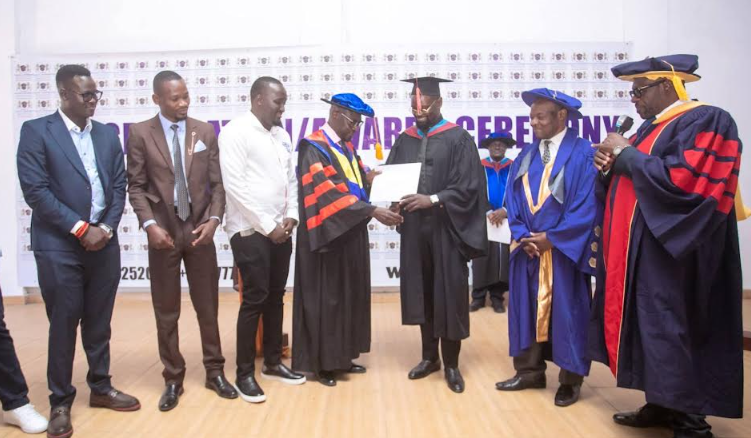
A 17-year-old learner who graduated with three degree qualifications emerged as one of the biggest highlights during the graduation ceremony of The African Talent University (TATU), which saw 89 learners awarded qualifications at its Kisumu campus.
Joel Kariuki, who earned degrees in data science, entrepreneurship, and music, crossed the stage three times to receive his qualifications, drawing prolonged applause from guests attending the ceremony.
Described by university officials as an exceptionally gifted multidisciplinary learner, Kariuki’s achievement came as the university, which received its Letter of Interim Authority on 20th April this year, celebrated graduates drawn from talent-based, experience-based, and conventional academic learning pathways.
The graduation also featured prominent creatives, including musician Prince Indah and award-winning filmmaker Daudi Anguka, whose professional achievements were assessed and recognized under the institution’s talent-based learning model.
Speaking during the ceremony, TATU Founder Prof. Humphrey Obora said the university was founded to identify, nurture, and certify talents that are often overlooked by conventional education systems.
Obora said the institution seeks to complement traditional academic learning by recognizing demonstrated abilities, innovation, entrepreneurship, and professional accomplishments.
“We assess who a learner is beyond examination grades. Many people possess exceptional talents and competencies that can create employment, solve societal challenges, and transform communities. Such abilities also deserve recognition and development,” he said.
Prof. Obora noted that the university uses a talent assessment framework which evaluates demonstrated competencies and achievements before assigning academic credits that can lead to various qualifications.
He cited Kariuki’s achievement as an example of what can be achieved when learners are allowed to pursue multiple strengths simultaneously.
Obora revealed that Kariuki’s family had initially disagreed with his assessment and enrolled him in Form One, only to later return after becoming frustrated with the conventional system.
“The father, when he first came, the family disagreed with me, and they took him to Form One. It is when they got frustrated that they brought him back, saying it is like what I told them was good,” said Obora.
He said the university later discovered that the teenager possessed exceptional energy and capacity to excel in multiple disciplines.
“The young man got straight A’s, but he has the energy and the tenacity to do more than one thing. For now, we were only able to do three; otherwise, he could have done four,” said Obora.
“This young man is not even 18. He is only 17 years old and has three degrees at once,” he added.
According to the university, eight graduates were recognized under its special talent category, while the rest completed programmes through other pathways offered by the institution.
Prince Indah termed the university a game changer for talented individuals who have traditionally found it difficult to gain formal academic recognition despite excelling in their respective fields.
He said the institution had created opportunities for musicians, performers, filmmakers, and other creatives to advance their education while continuing to build successful careers.
“For a long time, many talented people have been judged solely on academic papers despite making significant contributions to society through their skills and creativity. This university is creating a bridge between talent and education,” he said.
The musician added that the model would inspire young people pursuing careers in music, film, sports, and other creative sectors by demonstrating that talent and academic advancement can go hand in hand.
The graduation ceremony also featured exhibitions of innovations, business concepts, artistic productions, and community projects developed by learners as part of their training.
Prof. Obora said future graduations would place greater emphasis on innovation and enterprise development, with investors and venture capitalists expected to participate in identifying projects with potential for commercialization and growth.
The ceremony marked a significant milestone for the institution, coming barely two months after receiving regulatory approval to operate and reinforcing its ambition of becoming a center for talent development, innovation, and alternative pathways to higher education in Africa.
By Chris Mahandara

