Data from the Ministry of Agriculture, Livestock and Fisheries shows that the agricultural sector is the backbone of Kenya’s economy, contributing approximately 33 percent of her Gross Domestic Product (GDP) and another 27 percent of GDP indirectly through linkages with other sectors. It employs more than 40 percent of the total population and 70 percent of the rural population.
However, agricultural productivity has stagnated in recent years as smallholder farmers and agricultural enterprises continue to face challenges growing their businesses and improving the quality and quantity of agricultural goods due to climate change and high skyrocketing prices of farm inputs.
However, subdivision of land into smaller and smaller portions, especially for commercial development over time, has also led to scarcity of enough space to practice agriculture in the country hence, the need for more innovative ways to grow food and feed the population.
Consequently, farmers have been forced to come up with creative and innovative ways to maximize the potential of the available limited land space and those who have moved in this direction have successfully been able to make a fortune out of it.
One such farmer is Aggrey Abongo in the Manyatta area of Kisumu city. He has defied all the odds and successfully put up a thriving poultry farm in the backyard of his house.
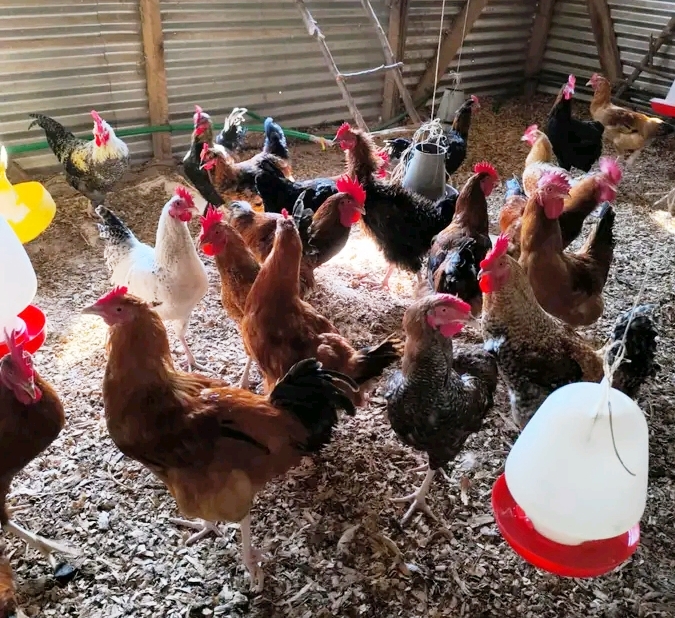
The soft clucking of chickens breaks the morning silence behind a row of rental houses in Manyatta, Kisumu. As the city slowly wakes up, Aggrey Abongo is already at work, moving between his poultry pens with a bucket of feed in hand. Around him, chickens scratch the ground while a few turkeys wander through the narrow space that serves as his farm.
At first glance, it is difficult to imagine that this small patch of land tucked between houses could support a thriving farming venture. But for Aggrey, what many people saw as an empty backyard became an opportunity.
More than a decade ago when he decided to venture into poultry farming, many of his neighbours doubted his decision. But Abongo is now smiling all the way to the bank!
“People thought I was wasting my time, they said farming is for the village. But I looked at that space and saw an opportunity,” he recalls with a smile.
That opportunity began in 2011 when Aggrey transformed a strip of unused land behind his rental house into a poultry farm. Starting with only a few birds, he gradually expanded his flock through patience and determination.
Today, the 48-year-old farmer keeps chickens and turkeys, selling eggs and meat to customers within the neighbourhood and beyond. What started as a simple experiment has become a source of income and food security for his family.
In a city where land is becoming increasingly scarce and food prices continue to rise, Aggrey’s story highlights the growing importance of urban farming.
Unlike crop farming, poultry requires relatively little space, making it suitable for densely populated estates such as Manyatta.
“Poultry gives you something almost every day,” he explains. “An egg is money. It is also food for the house.”
For Aggrey’s family, the farm has become more than just a business. The eggs and meat help reduce household expenses while providing a reliable source of nutrition. During difficult economic periods, the farm acts as a safety net.
The benefits extend beyond his household. By supplying poultry products locally, Aggrey contributes to food availability within the community and occasionally creates employment opportunities by hiring workers to assist with cleaning and feeding the birds.
On a good day, he can make up to Sh10,000 from the sale of meat and eggs, but laments that high cost of inputs such as feeds eats into his profits. At any one time, his backyard has in excess of 500 birds.
The rising cost of poultry feed remains his biggest challenge. Every increase in feed prices cuts into his profits, forcing him to carefully manage expenses.
“Feed is very expensive these days,” he says. “Sometimes you spend more than you expected, and it becomes difficult to make a good profit,”Disease outbreaks also pose a constant threat. A single i
llness can affect an entire flock if not detected and treated early. In addition, limited space makes expansion difficult.
The changing economic situation has further complicated matters.
“People still want chicken and eggs,” Aggrey says. “But many customers are struggling because of the high cost of living. They buy less and look for cheaper options.”
Despite these challenges, he remains optimistic.
As he walks us through his poultry pens, checking on the birds one by one, Aggrey speaks passionately about the potential of urban farming. He believes many city residents underestimate the value of small-scale agriculture.
“If many people in Kisumu farmed even a little, food would be cheaper,” he says. “We would not be waiting for everything to come from far away.”
His message is particularly directed at young people, many of whom view farming as a last resort rather than a business opportunity.
“Young people need to change how they think about farming,” he says. “It is not failure. It is strategy.”
He encourages them to start small and remain consistent, noting that even a modest flock of chickens can help cover school fees, pay rent and provide food for a family.
Standing beside the poultry pens he built over the years, Aggrey reflects on how far he has come.
“I started with very little,” he says. “What I have now is not much by other people’s standards. But it is mine, and it is growing.”
As Kisumu continues to expand and urban spaces become more crowded, Aggrey Abongo’s backyard farm serves as a reminder that opportunity can flourish in the most unexpected places. Between the houses of Manyatta, where many see limitations, one farmer has discovered possibility—proving that farming does not end where the tarmac begins.
By Mabel Keya – Shikuku and Dickens Joseph