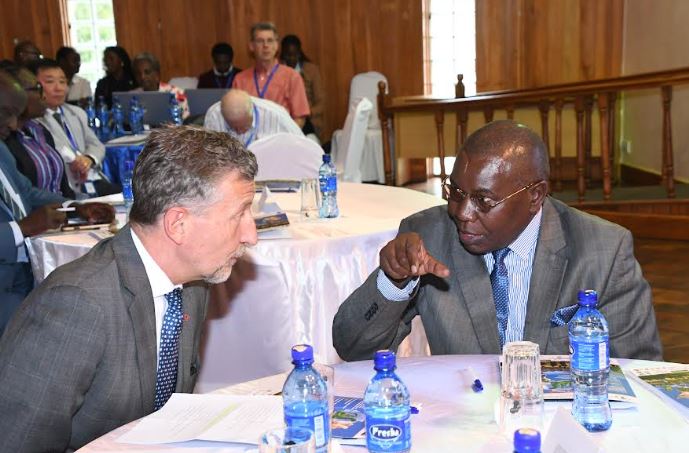
The government has reaffirmed its commitment to supporting science, technology, and innovation as key drivers of national development to address socio-economic challenges.
Speaking during the ongoing 9th African School of Fundamental Physics and Applications (ASP2026), Cabinet Secretary for Education Julius Migos Ogamba, through a speech delivered by Chairman, Board of Governors, Center for Mathematics, Science, and Technology Education for Africa (CEMASTEA) Dr. Pius Mutisya, said physics remains the foundation of modern development.
“Physics remains one of the most important foundations of modern development. It underpins advances in energy, healthcare, telecommunications, manufacturing, climate science, and digital technologies,” said CS.
He noted that as Kenya pursues its vision of becoming a knowledge-based economy, investing in science, technology, and innovation remains a national priority.
Ogamba said quality physics training is essential for developing the skilled workforce required to drive national development.
According to the Ogamba, Kenya’s education system must continue evolving by promoting experimentation, creativity, coding, robotics, innovation and problem-solving skills that enable learners to apply scientific knowledge to real-world challenges.
“Our education system must continue to evolve by emphasizing experimentation, creativity, coding, robotics, innovation, and problem-solving skills. Learners must be empowered not only to understand scientific concepts but also to apply them in solving real-world challenges,” he stressed.
Ogamba commended the University of Nairobi, the Centre for Mathematics, Science, and Technology Education in Africa (CEMASTEA) and local and international partners for organizing the programme, describing it as an important platform that brings together government, universities, researchers, industry, and development partners to advance science, innovation and education.
He observed that Africa’s challenges, including energy access, water security, agricultural productivity, healthcare delivery, and environmental sustainability, require evidence-based scientific solutions.
He therefore called for increased investment in both fundamental and applied physics research, alongside the expansion of modern laboratories, high-performance computing facilities, postgraduate scholarships, and support for early-career scientists.
“We must therefore strengthen investment in both fundamental and applied physics research and ensure that our universities and research institutions are equipped with modern laboratories, high-performance computing facilities, postgraduate scholarships, and adequate support for early-career scientists,” said CS.
The CS emphasized that collaboration among governments, universities, research institutions, and industry will be critical in accelerating scientific discovery and innovation.
He urged institutions to strengthen joint research programmes, researcher exchanges, shared laboratory facilities, postgraduate supervision, and equitable international partnerships that build local scientific capacity while contributing to global knowledge.
“We must promote joint research programmes, researcher exchanges, shared laboratory facilities, postgraduate supervision, and equitable international partnerships that build local capacity while contributing to global scientific advancement,” CS added.
Ogamba also underscored the need to make science education more inclusive by expanding opportunities for women, persons with disabilities, and learners from disadvantaged communities to participate and excel in physics education and research.
To strengthen the transition from education to employment, he encouraged universities and training institutions to integrate entrepreneurship, innovation, intellectual property management, and business development into their academic programmes.
“Universities and training institutions should integrate entrepreneurship, innovation, intellectual property management, and business development into their programmes,” he stressed.
He noted that internships, industrial attachments, mentorship programmes, incubation centers, and seed funding initiatives would help young people transform scientific ideas into viable enterprises, technologies, and employment opportunities.
“We can empower young people to transform scientific knowledge into enterprises, technologies, and jobs,” he said.
The CS stressed that the success of research should not be measured solely by academic publications but also by its contribution to society through patents, technologies, industries, and jobs, particularly in renewable energy, medical technologies, green manufacturing, and emerging digital industries.
“We must translate research into patents, technologies, industries, and employment opportunities, particularly in areas such as renewable energy, medical technologies, green manufacturing, and emerging digital industries.
He encouraged participants, including students, researchers, lecturers, and teachers from across the world, to take full advantage of ASP2026 as a platform for learning, collaboration, and networking.
“I encourage all participants to take full advantage of this opportunity to exchange ideas, build networks, and develop partnerships that will contribute to the advancement of science in Africa and beyond,” he said.
The CS reaffirmed the government’s commitment to supporting science, technology, and innovation and expressed confidence that the discussions and partnerships emerging from ASP2026 would contribute significantly to Kenya’s scientific and technological development.
By Ian Chepkuto and Malinda Boniface